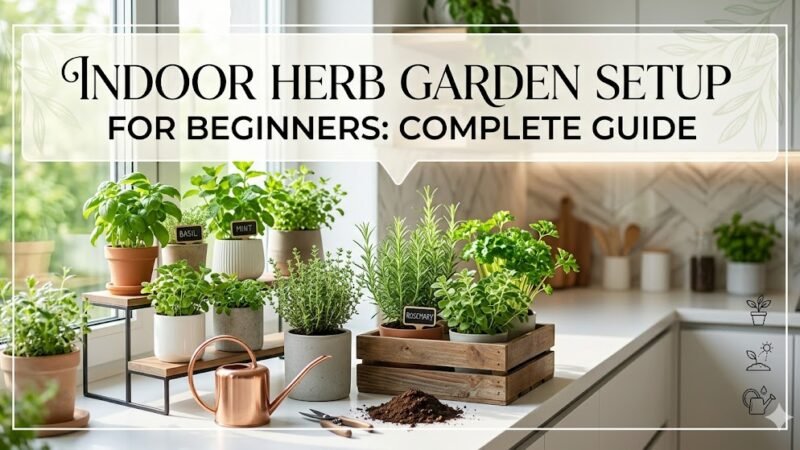
Indoor Herb Garden Setup for Beginners: Everything You Need to Know
Starting an indoor herb garden is one of the most rewarding and practical projects any beginner can take on. With just a windowsill, a few herb containers, and the right potting mix, you can grow fresh flavors year-round right inside your own home. Whether you’re interested in cultivating kitchen herbs like basil, mint, or parsley, or simply want to bring more greenery into your living space, setting up an indoor herb garden doesn’t require a green thumb or extensive gardening experience. Read our complete Indoor Gardening guide.
This beginner-friendly guide walks you through everything you need — from choosing the right grow lights to mastering proper watering techniques — so your herbs thrive from the very first day.
Why Growing Herbs Indoors Is Worth Every Bit of Effort
Before getting into the setup, it helps to understand what you are working toward. Fresh herbs have a way of completely changing how food tastes. A handful of fresh basil tossed into a pasta sauce is nothing like the dried version from a jar. A few sprigs of thyme added to roasted chicken right before serving, the kind you just snipped from a pot on your counter, adds a depth of flavor that store-bought herbs simply cannot replicate.
Beyond the culinary payoff, growing culinary herbs indoors saves a surprising amount of money. Grocery store herb packets cost anywhere from two to four dollars each, and half the bunch usually wilts in the refrigerator before you can use it. A single herb plant grown at home keeps producing for months with minimal investment. 💡 Curious how much you could actually save?
Use our free Garden Cost Estimator to compare your gardening spend against estimated grocery savings.
👉 Try the Garden Cost Estimator
There is also the matter of availability. An indoor herb garden grows year-round, which means fresh herbs in the middle of winter when outdoor gardens are long dormant. That alone makes the setup worthwhile.
The Best Herbs to Grow Indoors for Beginners
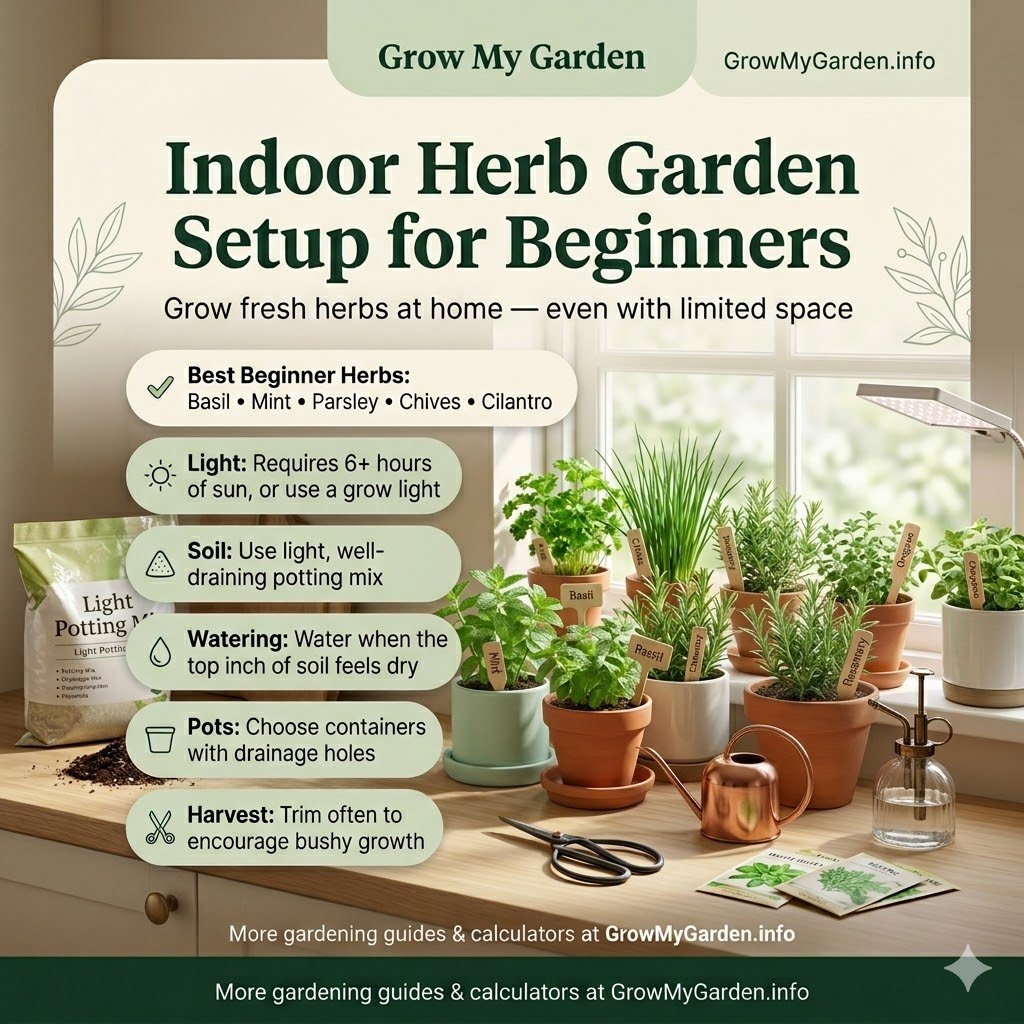
Not every herb is equally forgiving. Some require very specific conditions to thrive indoors while others are remarkably low-maintenance and adapt well to container life. If you are just getting started, picking the right plants from the beginning makes a significant difference.
Six Easy Herbs That Thrive in Pots
Basil is the most popular choice for a reason. It grows quickly, smells incredible, and goes into everything from salads to sauces. It does need warmth and plenty of light, which we will cover in the next section. See our complete guide on how to harvest basil without killing the plant for photos and step-by-step technique.
Mint is possibly the most forgiving herb you can grow indoors. It tolerates lower light conditions, bounces back from neglect, and spreads vigorously. The one thing to know is that mint prefers its own pot. Plant it alongside other herbs and it will crowd them out within a few weeks.
Chives are excellent for beginners because they ask for very little and give a lot. They grow in compact clumps, tolerate moderate light, and regrow quickly after each harvest. Snip them over eggs, soups, and baked potatoes.
Parsley is a bit slower to establish than the others, but once it does, it is incredibly productive. Flat-leaf parsley tends to have more flavor than the curly variety and holds up well as a potted plant. Once it establishes, learn how to harvest parsley so it keeps growing for months without needing to replant.
Thyme is a Mediterranean herb that naturally grows in rocky, dry conditions, which makes it extremely well suited to indoor container growing. It handles dry periods better than most herbs and does not demand constant feeding.
Oregano is another herb from warm, dry climates that adapts well to indoor life. It is compact, produces abundantly, and dries beautifully if you ever find yourself with more than you can use fresh.
Cilantro is worth mentioning separately. It grows fast, tastes wonderful, and is heavily used in cooking. However, it bolts quickly in warm indoor conditions, meaning it flowers and goes to seed before you can harvest much foliage. Succession planting, where you start a new pot every three weeks, is the most effective approach for keeping a continuous supply. For a deeper dive, we have a full step-by-step guide on how to stop cilantro from bolting indoors.
📅 Want to plan your cilantro succession schedule?
Use our Planting Date Calculator to map out sowing, transplanting, and harvest timing for your space.
👉 Try the Planting Date Calculator
What You Need Before You Plant Anything
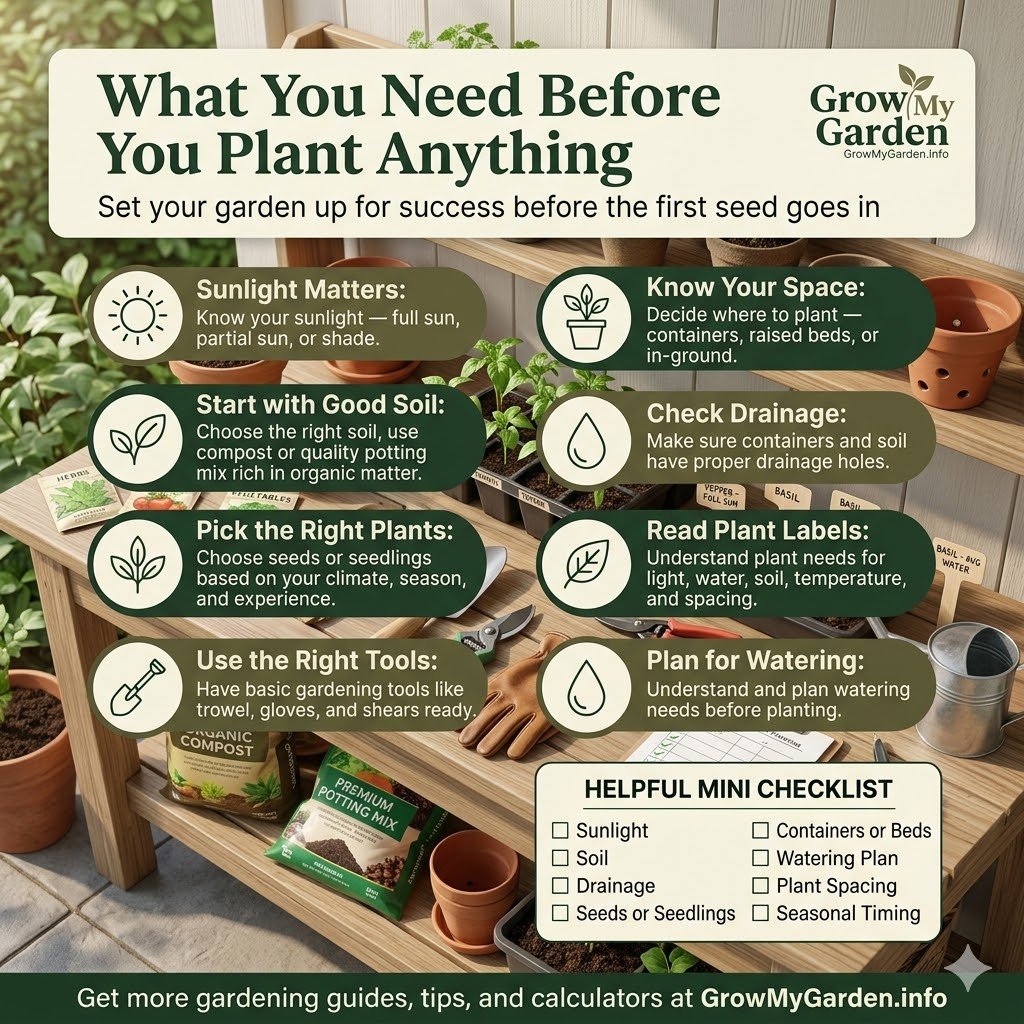
Getting the setup right before you plant saves you from troubleshooting later. There are three things that matter most: the containers you use, the potting mix you fill them with, and the location you place them.
Choosing the Right Containers for Your Herb Garden
The single most important feature in any pot for herbs is drainage holes at the bottom. Without drainage, excess water sits at the base of the pot, the roots stay saturated, and root rot develops quickly. This is the number one mistake beginners make, and it is entirely preventable.
Terracotta pots are the traditional choice and genuinely perform well for herbs. They are porous, which means the soil dries out more evenly and air reaches the roots more easily. The downside is that they dry out faster than plastic pots, so you will need to water a bit more frequently.
Pot size matters more than most beginners realize. A pot that is too large holds more moisture than a small plant can absorb, which creates the same waterlogging problem as a pot without drainage. For most culinary herbs, a pot that is around six inches wide and six inches deep is sufficient to start. Mint is the exception and does well in slightly larger containers given how vigorously it spreads.
A windowsill herb garden using individual small pots works well because it lets you customize the care for each herb. A window box planted with multiple herbs can also work, but only if the herbs have similar water and light requirements. Thyme and oregano make good companions. Basil and mint have different watering needs and are better kept separate.
Indoor herb garden kits are a convenient option for complete beginners because they bundle seeds, pots, soil, and often grow light recommendations into one package. They are a perfectly reasonable starting point, though you will likely outgrow them once you understand what each plant needs.
The Best Potting Mix for Indoor Herbs
Standard garden soil is not suitable for container herbs. It compacts in pots, drains poorly, and can introduce pests or diseases. What you need is a good quality potting mix formulated specifically for containers.
The ideal herb potting soil is light, loose, and well-draining. Many experienced gardeners recommend mixing a standard potting mix with about twenty percent perlite to improve drainage and aeration. Perlite is the small white granules you sometimes see in potting mixes, and it keeps the soil from becoming dense over time.
Vermiculite is another amendment worth knowing about. Unlike perlite, vermiculite retains some moisture while still maintaining good aeration, which makes it useful if your indoor environment tends to be dry and your pots dry out too quickly between waterings.
Soil pH is something most beginners overlook, but herbs generally prefer a slightly acidic to neutral pH, somewhere between 6.0 and 7.0. Most quality potting mixes fall within this range, so unless you are experiencing persistent growth problems, it is not something you need to test or adjust regularly.
How Much Light Do Indoor Herbs Really Need?
Light is the factor that most directly determines whether your herb garden thrives or struggles. Most culinary herbs evolved in full sun conditions outdoors, which means they need significantly more light than most common houseplants.
As a general rule of thumb, herbs need around six to eight hours of sunlight each day to grow vigorously. A south-facing window is the gold standard for indoor growing in the northern hemisphere because it receives the most direct sunlight throughout the day. East-facing windows work reasonably well for morning light. North-facing windows are not suitable for most herbs, which is exactly why my first attempt failed so badly.
Can Herbs Grow in Low Light Indoors?
Some herbs tolerate lower light conditions better than others. Mint and parsley can get by with around four hours of indirect light per day, though their growth will be slower than in a brighter spot. Chives are similarly tolerant of moderate light.
Basil, thyme, and oregano are not low-light herbs. If they do not get enough direct sun, they become weak, pale, and prone to problems. Do not place them in a dim corner and expect them to produce well.
Using LED Grow Lights for Your Herb Garden
If you do not have access to a bright window, or if you want to grow herbs in a space without natural light, a full-spectrum LED grow light is an excellent solution. Modern LED grow lights are energy-efficient, do not generate much heat, and provide the wavelengths plants use for photosynthesis.
Position your grow light six to twelve inches above the tops of your plants and aim for fourteen to sixteen hours of artificial light per day to compensate for the lower intensity compared to natural sunlight. A basic outlet timer takes all the guesswork out of managing the light schedule and is one of the most useful tools in an indoor herb setup.
Seeds or Seedlings: What Beginners Should Actually Start With
This is a question every beginner asks, and the honest answer is that seedlings are the better starting point for most people.
Starting herbs from seed indoors is absolutely possible and ultimately more economical. Basil, cilantro, and chives all germinate relatively quickly at room temperature. However, the germination period requires consistent warmth, moisture, and patience. It is a rewarding process, but it adds several weeks before you see harvestable growth.
Transplanting herb seedlings from a garden center into your own pots is faster, more reliable, and lets you get to harvesting within a matter of weeks. For beginners, this approach builds confidence because you start with an established root system rather than a tiny sprout.
If you want to try growing from seed, starting with cilantro or basil is a good entry point. Both germinate in about five to ten days under the right conditions and are forgiving enough that even an imperfect start usually produces viable plants. Plant seeds about a quarter inch deep in moist potting mix, cover the pot with a thin layer of plastic wrap to retain moisture, and place it somewhere warm until the seeds sprout.
📦 Not sure how many seeds or packets to buy?
Our Seed Quantity Calculator estimates exactly what you need based on your planting area — no guesswork.
👉 Try the Seed Quantity Calculator
Propagating herbs from stem cuttings is another method worth learning as you gain experience. Taking a four-inch cutting from an established mint or basil plant, removing the lower leaves, and placing the stem in a glass of water will produce roots within one to two weeks. Once the roots are about an inch long, pot the cutting in your prepared potting mix. This is a genuinely satisfying process and a free way to expand your herb garden.
Watering Indoor Herbs Without Overwatering Them
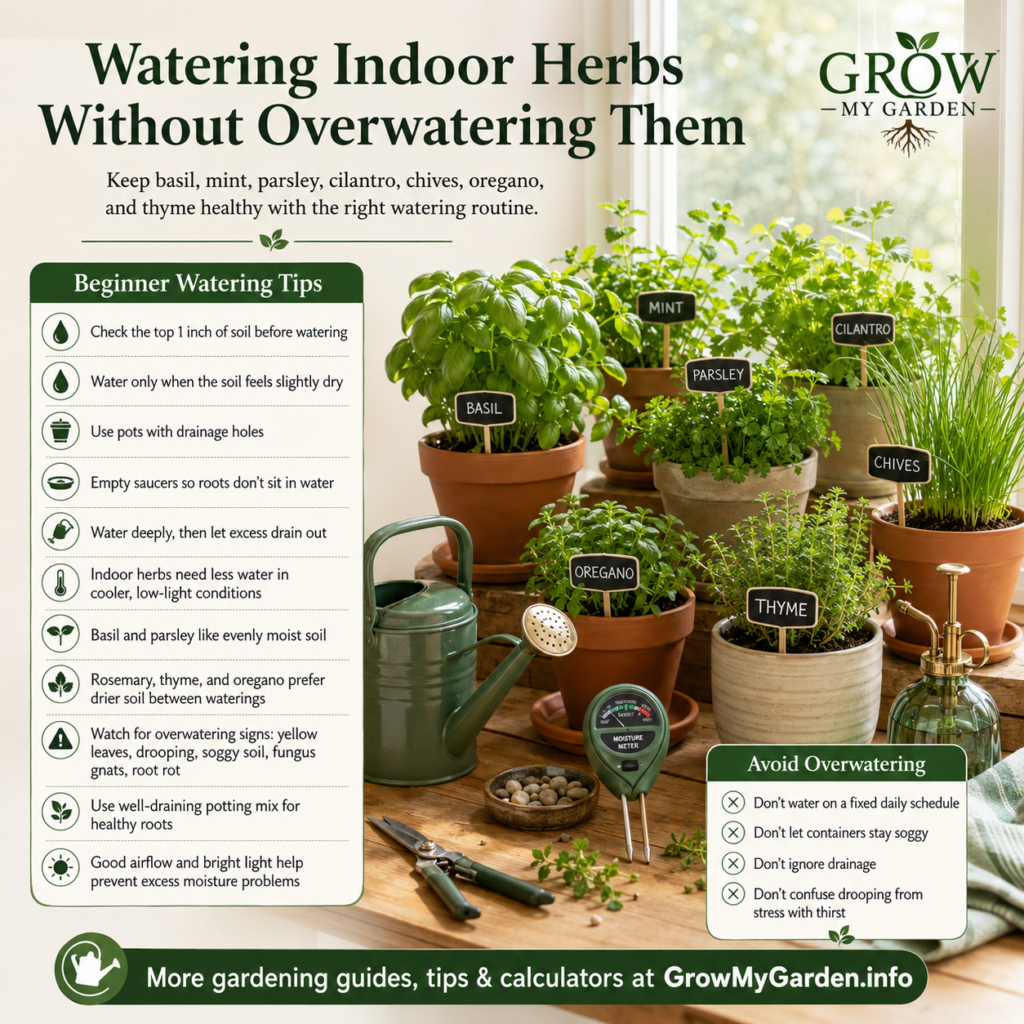
Overwatering is the most common reason herb plants die indoors. It is more damaging than underwatering because the effects happen underground where you cannot see them until it is too late.
How Often Should You Water Indoor Herbs?
There is no single correct answer to how often you should water indoor herbs because it depends on the pot material, the potting mix, the size of the plant, the ambient temperature, and the humidity of your space. What matters is the condition of the soil, not the calendar.
💧 Want a watering plan built for your specific setup?
Our Watering Schedule Tool calculates how much water your herbs need each week based on your conditions.
👉 Try the Watering Schedule Tool
The most reliable method is to push your finger about an inch into the potting mix. If the soil feels dry at that depth, water thoroughly. If it still feels moist, leave it for another day and check again. Herbs like thyme and oregano prefer to dry out more completely between waterings. Basil and parsley like more consistent soil moisture but still do not want to sit in saturated soil.
When you do water, water deeply enough that it drains out of the holes at the bottom of the pot. This encourages the roots to grow downward toward moisture rather than staying shallow at the surface. Empty the saucer beneath the pot after watering so the roots are not sitting in standing water.
Signs You Are Overwatering Your Herbs
Yellowing leaves are often the first visible sign of overwatering, particularly when they appear on lower, older leaves and the plant seems generally weak rather than just dry. Wilting herbs whose soil is still moist is another strong indicator that roots are struggling. If you notice a musty smell from the pot or see mold developing on the surface of the soil, those are clear signals that the growing medium is staying too wet.
Feeding Your Herbs: A Simple Fertilizer Routine
Herbs grown in containers rely entirely on you for their nutrients because the potting mix has a finite amount of available nutrition that depletes over time. Regular feeding keeps your plants producing healthy, flavorful foliage rather than slowing down into a slow decline.
A balanced liquid fertilizer applied at half the recommended strength every two to three weeks during the growing season is sufficient for most culinary herbs. Nitrogen is the most important nutrient for leafy herb growth because it supports the development of lush, productive foliage. An organic fertilizer formulated for edible plants is a good choice because it feeds gently and reduces the risk of nutrient burn.
🧪 Not sure how much fertilizer your herb pots need?
Our Fertilizer Calculator figures it out by bed or container size — so you never over or underfeed.
👉 Try the Fertilizer Calculator
Avoid overfeeding. More fertilizer does not mean more growth. Excess nutrients can cause soft, watery growth that is actually less flavorful than healthy growth under normal conditions. If your herbs are growing steadily and the foliage is a rich green, your feeding routine is working.
How to Harvest Fresh Herbs the Right Way
Harvesting is the most satisfying part of growing an indoor herb garden, and doing it correctly actually encourages the plant to produce more rather than slowing it down.
Pinching Back and Pruning Herbs for Continuous Growth
The fundamental rule of harvesting herbs is to trim above a leaf node, which is the point on the stem where a pair of leaves branches off. When you cut just above this point, the plant responds by branching out below the cut and producing two new stems where there was one. Over time, this creates a fuller, bushier plant that produces far more harvestable material than a plant that is never pruned.
For basil specifically, pinching back the growing tips as soon as you see a flower bud forming is critical. Basil that is allowed to flower will put all of its energy into seed production, the flavor of the remaining leaves will diminish noticeably, and the plant will decline much faster. Pinch those buds off the moment you see them and the plant will redirect its energy back into producing the flavorful leaves you are growing it for.
A general rule for harvesting is to never remove more than one third of the plant at a time. Taking too much at once stresses the plant and slows recovery. Harvest little and often rather than taking a large amount infrequently, and your herbs will reward you with continuous growth throughout the season.
If you find yourself with more fresh herbs than you can use immediately, you can dry them by tying small bundles loosely and hanging them upside down in a warm, dry space with good air circulation. Thyme and oregano dry particularly well and retain a strong flavor even after drying.
Common Problems Every Beginner Faces and How to Fix Them
Even with a solid setup, problems come up. Knowing how to identify and address them quickly is what separates a thriving indoor herb garden from one that slowly deteriorates.
Why Are My Herb Leaves Turning Yellow?
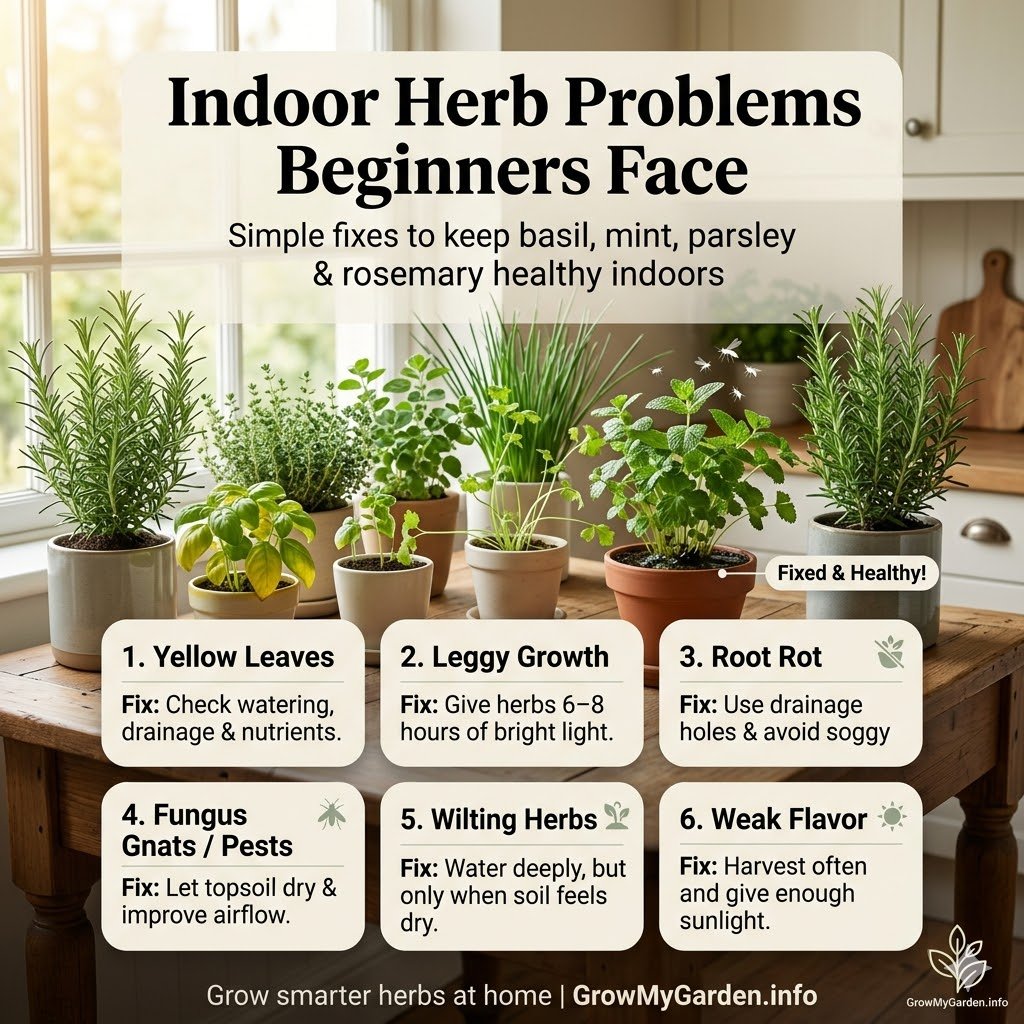
Yellow leaves on herb plants can point to several different issues. The most common causes are overwatering, insufficient light, or a nitrogen deficiency. Start by checking your watering habits and the amount of light the plant receives before assuming it is a nutrient problem. If the soil has been consistently moist and the location is dim, address those conditions first and watch whether new growth comes in healthier.
What to Do When Herbs Grow Leggy
Leggy herb plants, the ones that grow tall and spindly with large gaps between the leaves, are almost always suffering from insufficient light. The plant is stretching itself toward whatever light source is available, and the result is weak, elongated stems that cannot support themselves. Move the plant to a brighter window or add a grow light and you will see a noticeable difference within one to two weeks. Trim the leggy growth back to encourage fuller, more compact regrowth.
If basil is the herb giving you the most trouble, read our detailed guide on why your basil is dying and how to fix it.
Root Rot: How to Spot It and Stop It
Root rot develops when the roots sit in consistently wet soil for too long. The roots essentially suffocate and begin to decay. By the time you see the symptoms above the soil, including wilting, yellowing, and a general collapse of the plant despite moist soil, the damage below the surface is already significant.
If you suspect root rot, remove the plant from its pot and inspect the roots. Healthy roots are white or light tan and firm to the touch. Rotted roots are brown or black, soft, and may smell unpleasant. Trim away all the affected roots with clean scissors, treat the remaining roots with a diluted hydrogen peroxide solution, and repot the plant in fresh, well-draining potting mix in a clean pot. Recovery is possible if you catch it early enough, but prevention through proper watering is always the better approach.
Fungus gnats are another common issue in indoor herb gardens. These small insects lay their eggs in the moist top layer of potting mix, and the larvae feed on organic material near the roots. Allowing the top inch of soil to dry out completely between waterings disrupts the breeding cycle and reduces populations significantly. Sticky yellow traps placed near the pots are useful for monitoring and capturing adult gnats.
Frequently Asked Questions
1. What is the easiest herb plant to grow indoors?
Mint is one of the easiest herbs to grow indoors. Basil, parsley, and chives are also beginner-friendly.
2. What do I need to start an indoor herb garden?
You need small pots with drainage holes, quality potting mix, herb seeds or starter plants, sunlight, water, and a bright windowsill or grow light.
3. Which herbs should you start indoors?
Start with basil, mint, parsley, cilantro, chives, thyme, oregano, and rosemary and once it’s established, learn how to harvest rosemary without damaging the plant.
4. How do you start an herb garden for beginners?
Choose easy herbs, plant them in well-draining pots, place them near bright light, water when the top soil feels dry, and harvest regularly.
5. What herbs should never be planted together?
Avoid planting mint with other herbs because it spreads fast. Also avoid mixing herbs with different water needs, like basil and rosemary, in the same pot.
A Few Final Thoughts for Beginners
Starting an indoor herb garden does not require a large space, expensive equipment, or prior gardening experience. What it does require is a little attention to the basics: adequate light, the right potting mix, containers with proper drainage, and a watering approach based on what the soil actually needs rather than a rigid schedule.
The herbs you choose at the beginning matter. Starting with forgiving, low-maintenance herbs like mint, chives, and thyme builds the confidence and understanding that makes caring for more demanding plants like basil much easier later on.
The other thing worth knowing is that mistakes are part of the process. Losing a plant to overwatering or watching basil bolt because you forgot to pinch it back are not failures. They are the experiences that make you a better grower the next time around. Every experienced gardener started exactly where you are right now, with a pot, some soil, and a lot to learn.
Start simple, pay attention to your plants, and you will be harvesting fresh herbs from your own kitchen garden before you know it.

Leave a Comment