
Garden Cost Estimator
“Does growing your own actually save money?” deserves a real answer rather than a cheerful assumption. The honest version is: it depends on what you spend, what you grow, and how you count the first year, when beds, tools and soil are all new. A garden can pay for itself handsomely or quietly cost more than the supermarket — and the difference is mostly choices, not luck.
This estimator lays it out plainly. Enter your costs — seeds and plants, soil and compost, fertilizer, beds and tools, water and the rest — alongside your expected harvest and what that produce would cost at the shops. It returns your total outlay, the value of what you grow, your net saving, and the return on what you spent.
Garden Cost Estimator
Compare what your garden costs against the value of the harvest.
First-year costs are higher because beds, tools and soil are one-time buys that pay off across later seasons. Harvest value uses your local grocery price.
How the garden cost is calculated
The cost side is a straight sum of what you put in: one-time startup costs like raised beds and tools, plus the recurring costs of seeds, soil top-ups, fertilizer and water each season. The value side multiplies your expected harvest weight by the grocery price per pound of that produce — the figure that decides whether the effort beats simply buying it.
Subtract cost from value and you get the net saving. Express that against your spending and you get the return on investment as a percentage. The tool also shows a break-even harvest: the pounds of produce you’d need to grow just to cover your costs. Because so much first-year spending is one-time, the picture usually improves sharply in later seasons, when the beds are already built and only seeds, a little soil and feed recur.
Worked example: a typical first-year bed
Take the defaults: $25 on seeds and plants, $40 on soil and compost, $15 on fertilizer, $60 on beds and tools, and $20 on water and sundries — $160 in total. Against that, an 80-pound harvest valued at $3 a pound is worth $240. That leaves an $80 net saving and a 50 percent return on what you spent, with a break-even point around 53 pounds.
The interesting part is year two. The $60 for beds and tools and much of the soil cost don’t repeat, so the same harvest now sits against perhaps $50 of recurring costs — and the return roughly quadruples. Counting only the first year understates the case; counting the second shows where home growing really earns its keep.
Tips for making your garden pay
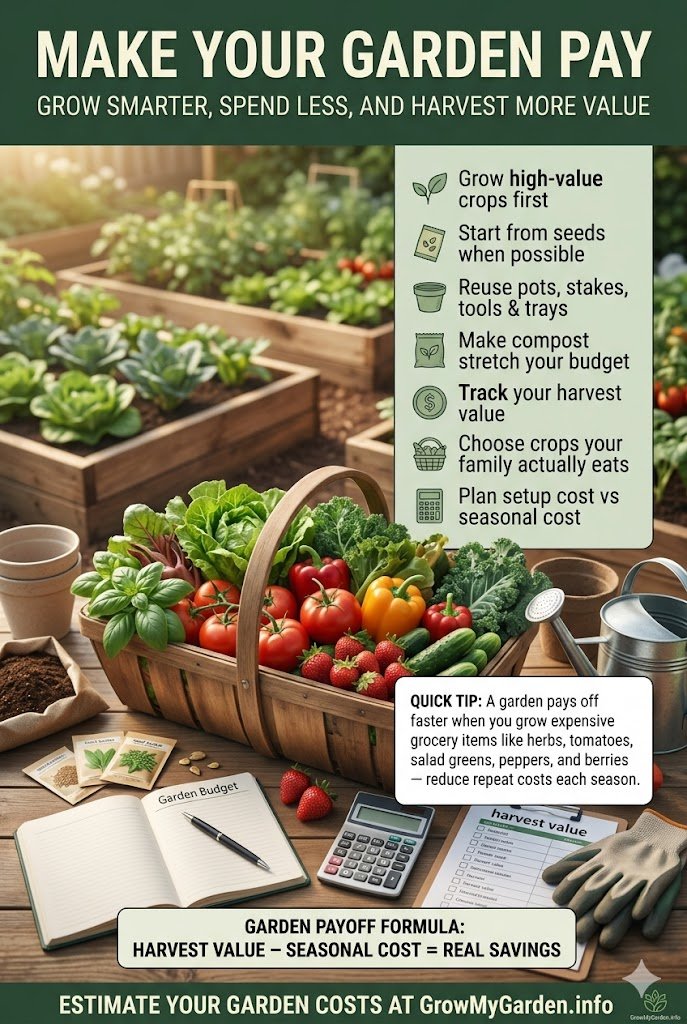
- Amortise the one-time costs. Beds, tools and the initial soil are bought once and used for years. Spread across several seasons, their per-year cost is a fraction of the first-year figure.
- Grow what’s expensive to buy. Herbs, salad leaves, cherry tomatoes and soft fruit cost a lot at the shop and crop generously at home, so they return far more per square foot than cheap staples like potatoes.
- Start from seed where it’s easy. Many crops are dramatically cheaper from a packet of seed than from bought transplants, and one packet plants a whole bed.
- Reuse and refresh, don’t replace. Topping up existing beds with compost each year costs a fraction of filling new ones, which is why recurring soil costs are so much lower than startup ones.
- Track a season honestly. Weigh your harvests once and you’ll know your real numbers — most gardeners are pleasantly surprised by the high-value crops and clear-eyed about the ones that aren’t worth the space.
Frequently asked questions
Is growing your own vegetables actually worth it? Financially, it usually is once the one-time costs of beds and tools are behind you and you focus on crops that are pricey to buy. The first year can be close to break-even because of startup spending; later years, when only seeds, compost and feed recur, typically show a clear saving — which the year-two comparison makes obvious.
How much does it cost to start a vegetable garden? A modest raised bed with soil, a few tools, seeds and feed often runs somewhere around the low hundreds, most of it one-time. Beds, tools and the initial soil are the big startup items; from then on you’re mainly buying seeds, occasional soil top-ups and fertilizer.
Does gardening really save money on groceries? It can, especially for high-value produce like herbs, salad greens and tomatoes that are costly per pound at the store. Saving the most comes down to growing what you’d otherwise buy a lot of, keeping recurring costs low, and getting good yields — the variables this calculator lets you test.
What should I grow to save the most money? Crops that are expensive to buy and productive to grow give the best return per square foot: fresh herbs, leafy salads, cherry and slicing tomatoes, and soft fruit top the list. Bulk staples that are cheap at the store, like main-crop potatoes or onions, save far less for the space they take.