
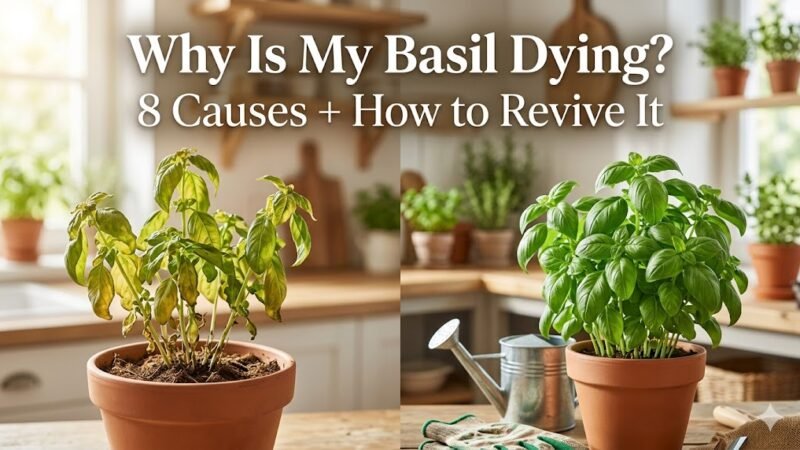
Why Is My Basil Dying? 8 Causes and How to Revive Your Plant
Basil has a reputation as one of the easiest herbs to grow. That reputation is mostly deserved — but it comes with a caveat. Basil is easy when its conditions are right, and surprisingly dramatic when they’re not. One wrong week of care and you’re looking at a wilting, yellowing, or blackened mess of what used to be a thriving plant.
If you’ve found yourself searching “why is my basil dying” at some point, you’re in very good company. The frustrating part is that basil plant problems often look similar on the surface. Drooping leaves and yellowing are symptoms shared by at least half a dozen different causes, which means you need to do a little detective work before you start trying to fix anything.
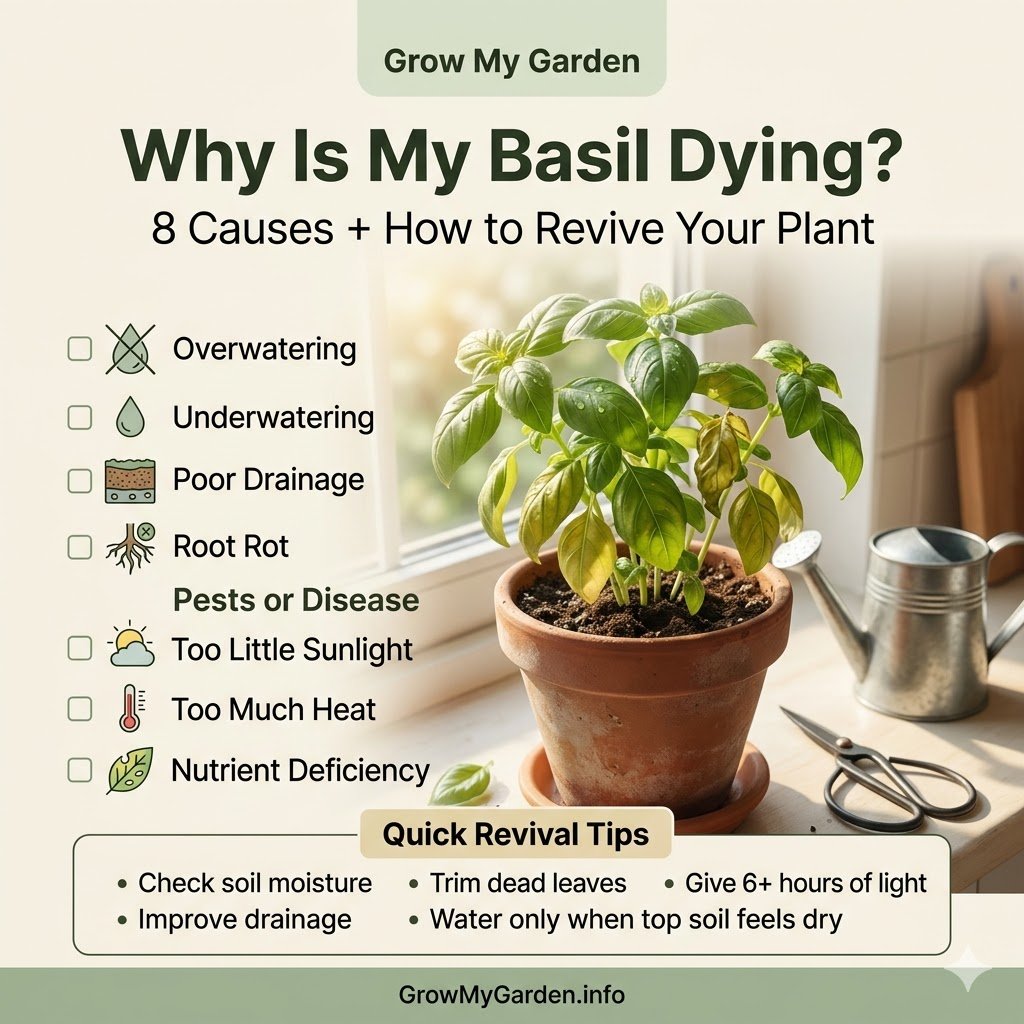
This guide walks through the eight most common reasons a basil plant dies or declines, what to look for with each one, and what to do to turn things around.
Why Basil Struggles More Than It Looks Like It Should
Basil (Ocimum basilicum) is a warm-season annual herb native to tropical regions of Asia and Africa. That origin story matters because it tells you everything about what basil actually wants: warmth, light, consistent moisture, and well-draining soil. In most temperate gardens and homes, it’s working against its natural preferences from the moment you bring it home.
Potted basil is especially vulnerable. A container limits how much root space the plant has, the soil dries out faster than it would in the ground, and any imbalance in watering or nutrients becomes visible much sooner. This is why so many common basil problems happen with container-grown plants — and why identifying the correct cause matters before you do anything else.
1. Overwatering and Root Rot
This is the most common reason basil plants die, and also the easiest to misdiagnose. When a plant wilts, the instinct is to water it more. But if the soil is already waterlogged, more water makes things significantly worse.
When roots sit in soggy soil, they’re deprived of oxygen. Oxygen-starved roots begin to rot, and rotting roots can’t deliver water or nutrients upward — so the plant wilts even though the soil is wet. Leaves typically turn yellow and drop off, and if you check the stem near the soil line, you may find it’s soft, mushy, or turning black. That’s basil root rot, and catching it early is the difference between saving the plant and starting over.
What to look for: Soil that’s stayed wet for several days, a sour or rotting smell from the pot, leaves yellowing from the bottom of the plant upward, and a stem base that feels soft rather than firm.
What to do: Stop watering immediately and let the soil dry out. If root rot has already developed, remove the plant from its container, trim away any brown or mushy roots with clean scissors or pruning shears, and repot into fresh, well-draining soil. Going forward, make sure your container has drainage holes — basil sitting in standing water will not survive long.
The most reliable watering method is the finger test. Push a finger about an inch (2.5 cm) into the soil — if it feels dry at that depth, water thoroughly until water runs out the drainage holes. If it still feels moist, wait another day. How often you’ll end up watering depends on your pot size, the ambient temperature, and whether the plant is indoors or outside, but overwatered basil is a far more common problem than underwatered basil.
2. Underwatering and Dehydration
On the opposite end of the spectrum, a basil plant that isn’t getting enough water will wilt just as dramatically — but the signs look different. Drought-stressed basil tends to collapse quickly and completely, with leaves that feel dry or papery and may curl at the edges. The soil will be pulling away from the sides of the pot, and the pot itself will feel noticeably lighter than usual.
The good news is that underwatered basil is usually easier to rescue than overwatered basil, as long as the plant hasn’t been left dry for too long.
What to do: Water deeply and immediately, allow the excess to drain fully, and move the plant somewhere slightly cooler and out of intense direct sun for a few hours. A wilting basil plant that’s simply thirsty should perk back up within an hour or two of a good drink. If it doesn’t recover within 24 hours, there may be a secondary issue at play.
To avoid underwatering during hot weather, consider moving outdoor container basil to a spot that gets some afternoon shade, which slows evaporation from both the soil and the leaves.
3. Not Enough Sunlight
Basil is a full-sun herb, and it means it. It needs six to eight hours of direct sunlight each day to grow well — not bright indirect light, not a shaded patio, actual sun. When it isn’t getting enough, the plant starts stretching toward the nearest light source. Stems become thin and leggy with large gaps between the leaf sets. Leaves grow smaller and paler than usual. Growth stalls or slows to nearly nothing.
Low-light basil also tastes noticeably different. The aromatic essential oils that give basil its intense flavor develop in response to sunlight, so a plant grown in dim conditions is both weaker and less flavorful than one grown in full sun.
What to do: Move an indoor basil plant to a south-facing window that receives direct sun for most of the day. If you’re growing basil indoors in a low-light home or apartment, a grow light placed about six to eight inches above the plant, running for twelve to fourteen hours per day, will compensate well. For outdoor plants, if the planting spot is shaded by trees, a fence, or nearby structures, relocation is usually the simplest solution.
4. Cold or Heat Stress
Few common herbs are as cold-sensitive as basil. Temperature stress — whether from cold or excessive heat — is one of the leading reasons healthy-looking plants suddenly start to decline.
Basil begins to suffer noticeably once temperatures drop below 50°F (10°C). Below that threshold, cold damage shows up as sudden blackening or darkening of the leaves, often appearing overnight. At or near freezing, the whole plant collapses within hours. Even exposure to a cold draft from an open window or an air conditioning vent can be enough to cause chill damage in an indoor plant.
The ideal growing temperature for Ocimum basilicum sits between 65°F and 85°F (18–29°C). Below that range, growth stalls and the plant becomes stressed. Above it, heat stress starts showing up as rapid wilting even when the soil is moist, along with premature flowering — the plant racing to set seed before conditions deteriorate further.
What to do: If you’re growing basil outdoors, bring containers inside whenever overnight temperatures are forecast to drop toward 50°F. For in-ground basil in early autumn, a row cover or frost cloth can extend the season by a few weeks. In summer heat, mulching around the base of outdoor plants helps regulate soil temperature, and moving containers off concrete or paved surfaces (which can radiate intense heat from below) can reduce stress significantly.
5. Pest Infestation
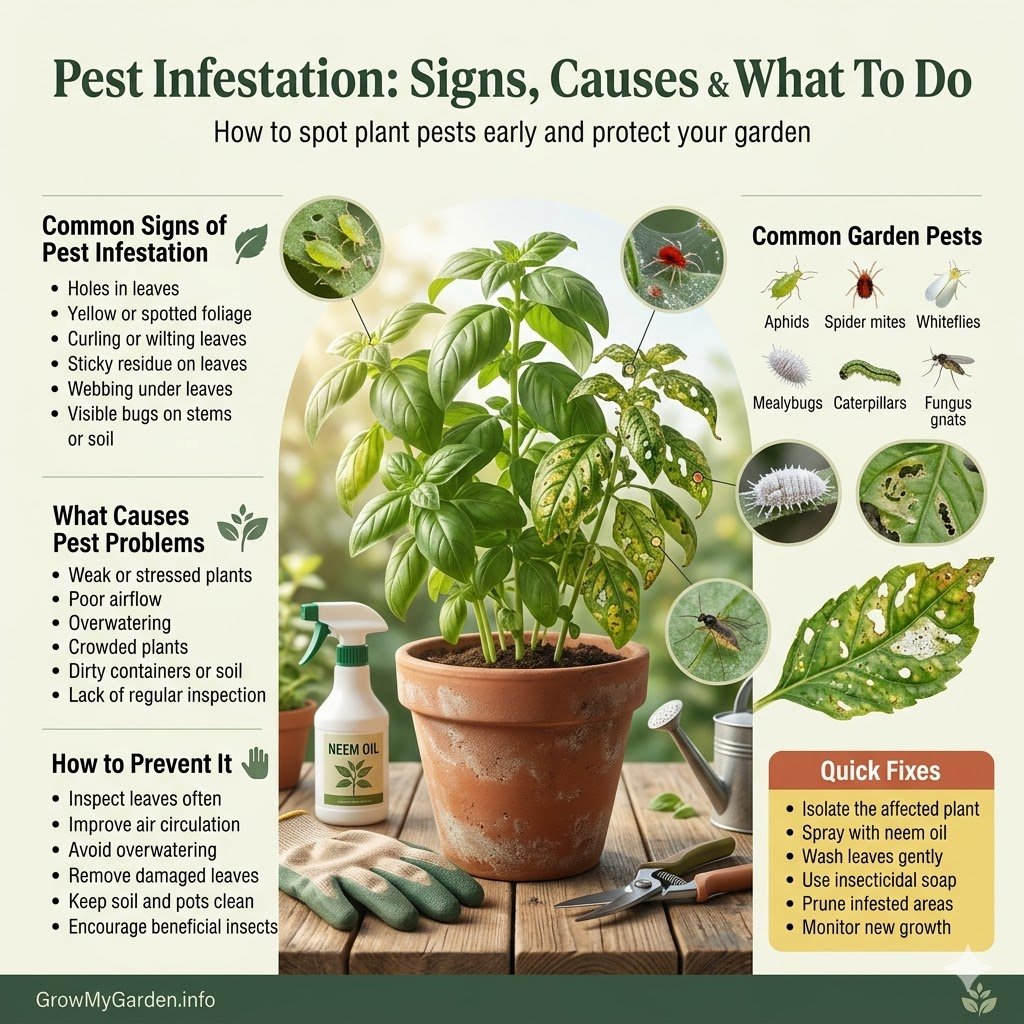
Basil has more than its share of insect admirers. A pest infestation can go from barely visible to severe relatively quickly, especially on plants that are already somewhat stressed by heat or inconsistent watering.
Aphids on basil are among the most common culprits. They cluster on the undersides of leaves and around new growth, feeding on plant sap and leaving behind a sticky residue called honeydew. Heavy infestations cause leaves to curl, yellow, and distort, and the honeydew can encourage sooty mold to develop on the leaf surface. Aphids respond to the same treatments regardless of which plant they’ve targeted — the neem oil and soap approach that works for getting rid of aphids on roses is equally reliable on basil.
Spider mites are harder to spot but equally damaging. They thrive in hot, dry conditions and typically colonize the undersides of leaves. The first signs are usually a stippled or finely bronzed appearance on the upper leaf surface, along with fine webbing if the infestation has been building for a while.
Fungus gnats don’t damage the leaves themselves — their larvae feed on roots in the soil. The result is a plant that wilts and declines in a way that closely resembles overwatering, which makes the actual cause easy to miss. If you see small flies hovering around the soil surface whenever you move or water the plant, fungus gnats are likely involved.
Whiteflies and thrips are less common outdoors but can be significant problems for basil grown in greenhouses or on indoor windowsills.
What to do: For aphids and spider mites, neem oil is a highly effective organic treatment. Dilute it according to the product label and apply it to both sides of the leaves in the early morning or evening to avoid leaf scorch. Insecticidal soap is another reliable option that’s safe to use on edible herbs.
For fungus gnats, the most effective fix is straightforward: let the top inch of soil dry out between waterings, since the larvae can’t survive without consistently moist soil. Yellow sticky traps placed near the pot help monitor and reduce the adult population. Read our complete Pest Control And Plant Health guide.
6. Fungal and Bacterial Disease
Basil is susceptible to a handful of specific diseases that can cause rapid decline if they’re not identified early.
Basil downy mildew, caused by the pathogen Peronospora belbahrii, is the most widespread disease affecting basil worldwide. It first appears as yellowing between the leaf veins, followed by a characteristic grayish-purple fuzzy growth on the undersides of the leaves. It spreads quickly in warm, humid conditions and can devastate a planting within days. Once sweet basil has a heavy downy mildew infection, recovery is very difficult — removing infected plants and improving airflow around the remaining ones is usually the most practical response.
Fusarium wilt, caused by the soil-borne fungus Fusarium oxysporum, produces sudden wilting, yellowing leaves, and dark brown streaking visible inside the stems when you cut them open. It has no cure once established, and infected plants should be removed and disposed of rather than composted to prevent the fungus from spreading.
Bacterial leaf spot shows up as dark, water-soaked spots on the leaves that spread and turn brown or black over time. It’s spread primarily by water splashing from soil onto leaves, which is why watering at the base of the plant rather than overhead is always better practice for basil.
Gray mold (Botrytis cinerea) typically develops in cool, damp conditions — often at the end of the growing season or in poorly ventilated indoor settings. It appears as a fuzzy gray coating on affected tissue, usually starting at damaged, dead, or dying leaves.
Good preventive practices go a long way with all of these diseases: space plants generously to allow air to circulate freely between them, remove yellowing or dead leaves as soon as they appear, and water at the base of the plant. If you’ve had persistent disease problems across multiple growing seasons, choosing a downy-mildew-resistant basil variety for your next planting is worth considering.
7. Nutrient Deficiency
Basil doesn’t have enormous nutritional demands compared to heavy-feeding vegetables, but it still needs a reasonably healthy soil to perform well. In containers especially, nutrients in the potting mix become depleted over a single growing season.
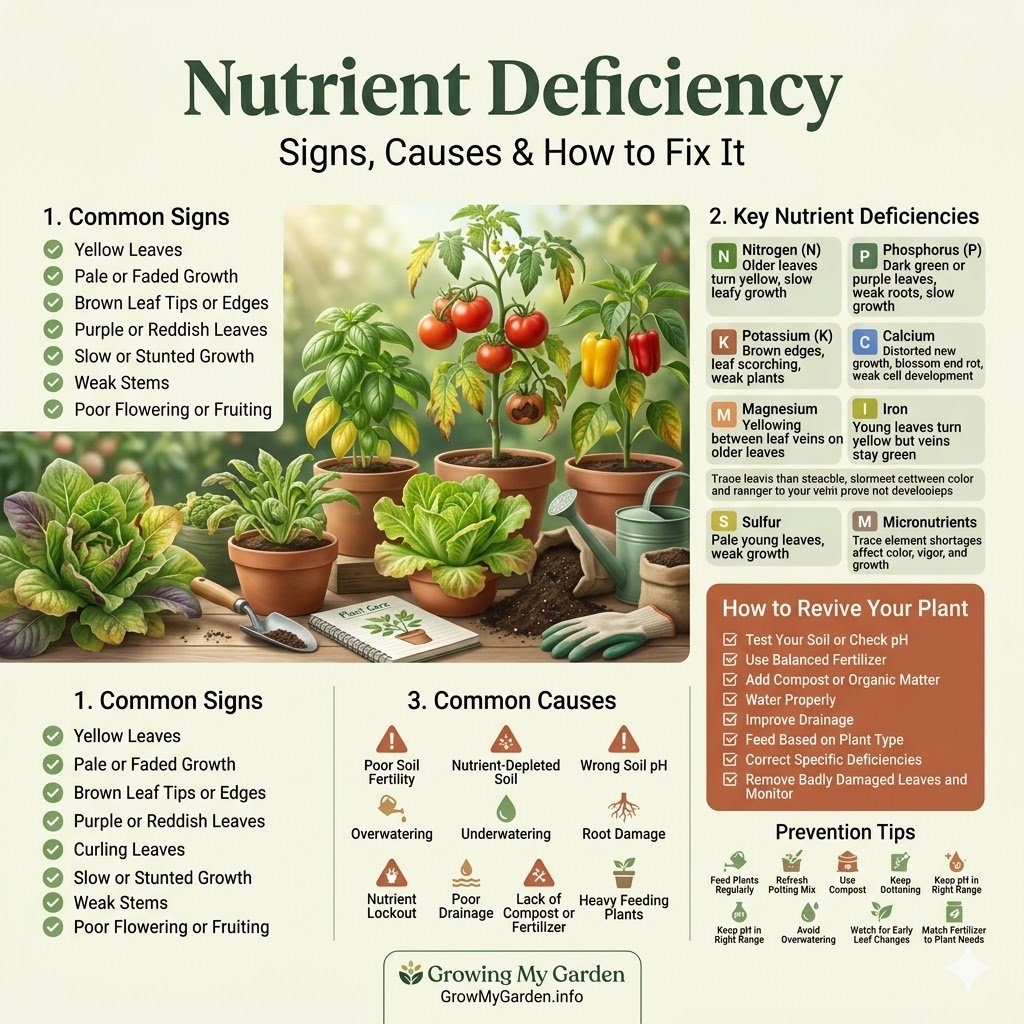
Nitrogen deficiency is the most common nutritional problem. It shows up as yellowing that begins on the older, lower leaves and slowly works its way up the plant. Since nitrogen drives leafy growth, a shortage affects basil more visibly than herbs grown primarily for flowers or seeds.
Magnesium deficiency produces a more specific pattern — the veins of the leaf stay green while the tissue between them turns yellow, a symptom called interveinal chlorosis. It’s less common than nitrogen deficiency but does occur in containers where the potting mix has been exhausted.
What to do: For most container-grown basil, a balanced liquid fertilizer diluted to half the recommended strength, applied every two to four weeks through the growing season, is sufficient. A standard 10-10-10 NPK formula works well. Avoid the temptation to overfeed — too much nitrogen produces fast, lush growth that is both more attractive to pests and less flavorful at harvest.
Basil grows best in slightly acidic to neutral soil, ideally at a pH between 6.0 and 7.0. If your plants consistently look unhealthy despite correct watering and adequate light, a simple soil pH test can quickly tell you whether the soil chemistry is working against you. Irregular watering can block nutrient uptake even when nutrients are technically present in the soil — the same mechanism behind blossom end rot in tomatoes, where calcium doesn’t reach the fruit because of moisture fluctuations rather than a true calcium shortage.
8. Transplant Shock and the Grocery Store Basil Problem
There’s one particular type of declining basil that deserves special attention — the grocery store basil problem. You bring home a beautiful, fragrant pot from the supermarket, set it on the kitchen counter, and within a week it’s a collapsed, yellowing wreck. This is so common it might as well be a gardening rite of passage.
Here’s what’s actually happening. Supermarket basil pots typically contain a dozen or more seedlings packed tightly together in a small container, grown very quickly under intense commercial greenhouse conditions to look their best at the point of sale. They’re not set up for long-term survival. The roots are massively overcrowded, the growing medium is often a peat-heavy mix that swings between waterlogging and drying out, and the plants have usually been through cold or heat stress in transit from the greenhouse to the shelf to your home.
What to do: When you bring home a supermarket basil plant, think of it as raw material rather than a finished product. Separate the clump of seedlings into groups of three or four, pot them into proper containers with fresh, well-draining potting compost, and give them a week to settle in a bright spot before harvesting from them heavily. Most of them will recover well once they have room to establish.
The same principle applies to any basil that’s been recently repotted or transplanted from a nursery tray to the garden. Some wilting in the first day or two after repotting is entirely normal — this is transplant shock, and it’s the plant adjusting to its new environment. Keep the soil consistently moist but not wet, provide a little shade for the first few days, and in most cases the plant will settle and start growing again within a week.
If that’s your setup, it’s worth keeping an eye on the tomatoes too — tomato hornworms are one of the most destructive pests you’ll encounter in that pairing, and they can strip a plant surprisingly fast if they’re not caught early.
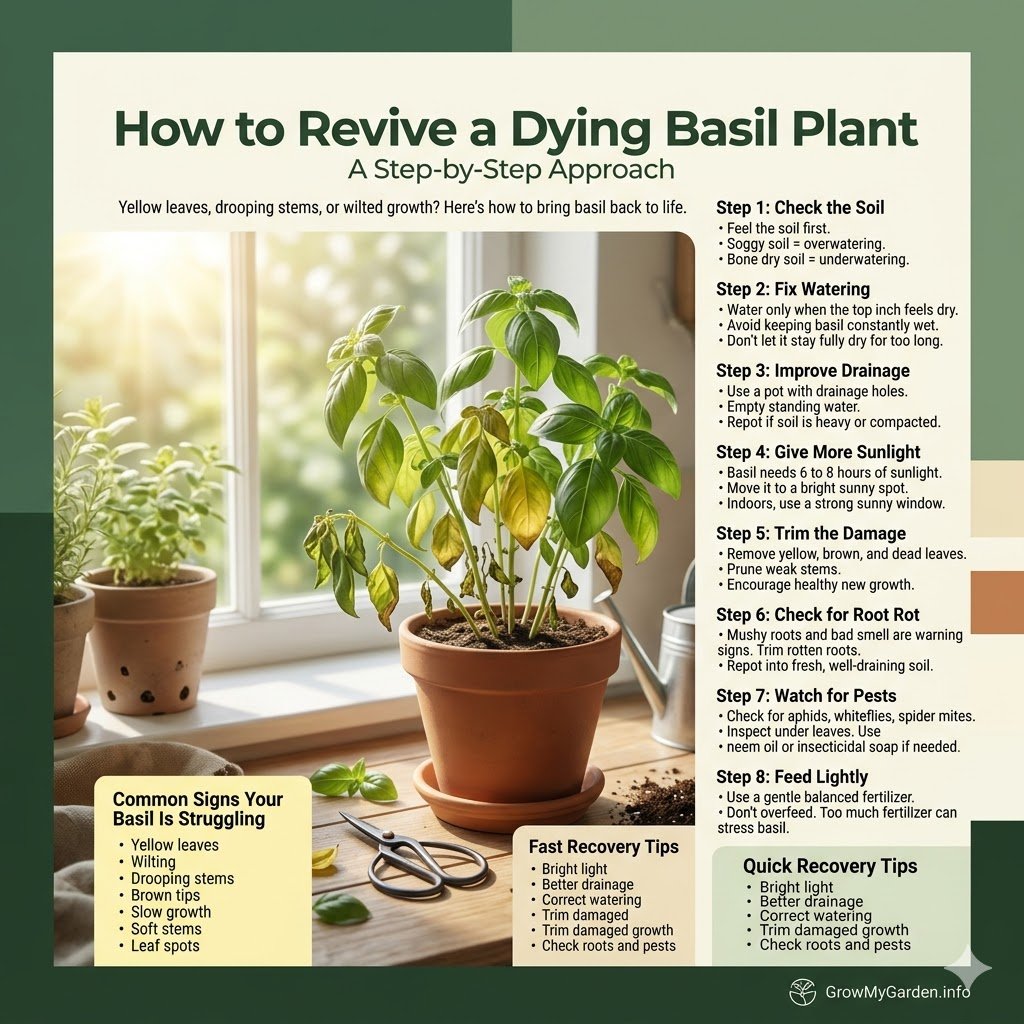
How to Revive a Dying Basil Plant: A Step-by-Step Approach
If your basil is clearly struggling but you’re not entirely sure of the cause, working through the following steps in order is the most efficient way to find and fix the problem.
Step 1 — Assess the soil. Check soil moisture before doing anything else. Push a finger an inch into the soil. Is it soaking wet or bone dry? Correct the watering issue first, because most other interventions won’t work if the roots are either suffocating or dehydrating.
Step 2 — Evaluate the light. Is the plant receiving at least six hours of direct sunlight per day? If it’s near a window that doesn’t face south, or if it’s sitting on a kitchen counter away from windows entirely, light may be the core issue.
Step 3 — Consider the temperature. Has the plant been near a cold draft, an air conditioning vent, or outdoors during a cool night? Move it to a warmer, stable environment.
Step 4 — Inspect the leaves and stems carefully. Turn the leaves over and look at both surfaces. Are there insects, webbing, or spots? Is there fuzzy growth on the undersides? Is the stem near the soil line soft or discolored? Each of these points toward a specific cause.
Step 5 — Check the roots. Gently remove the plant from its pot. Healthy roots are white or light tan and firm to the touch. Brown, soft, or mushy roots indicate root rot.
Step 6 — Feed if the basics are in order. If watering, light, and temperature are all sorted but the plant still looks pale and is growing very slowly, a half-strength liquid fertilizer can help restore momentum. Don’t fertilize before addressing those fundamentals — a plant with root rot or severe drought stress can’t absorb nutrients anyway.
Most dying basil plants can be brought back if you catch the problem in time and act on the right cause. The ones that can’t be saved — severe fusarium wilt, fully rotted root systems — are the exception rather than the rule. And even if the main plant is beyond recovery, healthy stem cuttings can be rooted in water and potted up to start a new generation within a couple of weeks.
Frequently Asked Questions
Why is my basil wilting after watering?
Wilting after watering almost always points to root rot rather than dehydration. When roots have been damaged by consistently waterlogged soil, they lose the ability to transport moisture upward — so the plant wilts even though the soil is wet. Check the stem at the soil line for softness or discoloration, and inspect the roots for any brown, mushy sections.
Why are my basil leaves turning yellow?
Yellowing basil leaves most commonly result from overwatering, nitrogen deficiency, or the early stages of downy mildew. The pattern of yellowing can help narrow it down. Yellowing that starts on the lowest leaves and progresses upward suggests a nutrient issue. Yellowing between the leaf veins while the veins themselves stay green points to magnesium deficiency or downy mildew.
Why does my grocery store basil keep dying?
Supermarket basil is grown very quickly in overcrowded conditions and is sold at peak appearance with no long-term viability in mind. Separating the seedlings, repotting them into fresh compost, and allowing a week for recovery before harvesting gives them a fighting chance at a longer life.
How do I know if my basil has root rot?
The main indicators are wilting despite moist soil, a soft or blackened stem at the base of the plant, a sour smell from the potting mix, and roots that are brown and soft rather than white and firm when you remove the plant from its pot.
Can basil recover from overwatering?
Yes, often — particularly if the problem is caught before root rot has become extensive. Stop watering, ensure the pot drains freely, and let the soil dry out fully before the next watering. If root rot is present, repot into fresh compost after trimming away the damaged roots.
How often should I water basil?
There’s no universal answer since it depends on your climate, pot size, and whether the plant is indoors or outside. The reliable approach is to check the soil before each watering session: if the top inch feels dry, water thoroughly until it drains from the bottom; if it still feels moist, wait another day and check again.
Can basil survive in low light?
Basil can stay alive in lower light conditions for a while, but it won’t thrive — growth will be weak and leggy, the plant will become more susceptible to disease, and the flavor of the leaves will be noticeably less intense. Six to eight hours of direct sunlight is what basil genuinely needs to perform well.
Why does my basil have black spots on the leaves?
Black spots on basil leaves are most often caused by bacterial leaf spot, cold damage, or advanced downy mildew. If the spots appeared after a cold night or a spell of cold drafts, temperature damage is the likely cause. If they developed alongside a grayish growth on the leaf undersides, downy mildew is the more probable culprit.
The Bottom Line
Most basil problems trace back to a relatively short list of causes: too much or too little water, not enough sunlight, temperature stress, a pest infestation, or soil and disease issues. The plant tells you quickly when something is wrong — that responsiveness works in your favor as long as you know what the symptoms mean.
The most important habit to develop is resisting the urge to water reflexively whenever a plant looks unhappy. Checking the soil first, assessing the light, and working through the likely causes in order will solve most basil plant problems faster and more reliably than any single intervention.
With the right conditions and a little attentive care, Ocimum basilicum is a genuinely rewarding herb to grow — vigorous, aromatic, and generous with its harvest. Getting past these early stumbling blocks is usually all it takes to grow basil that actually thrives.
Need help planning your herb setup? Use the free tools at GrowMyGarden.info: the Watering Schedule Calculator for a personalized irrigation plan, the Fertilizer Calculator to work out the right feeding routine for your basil, and the Plant Spacing Calculator if you’re growing multiple basil plants in a raised bed or container.

Leave a Comment