
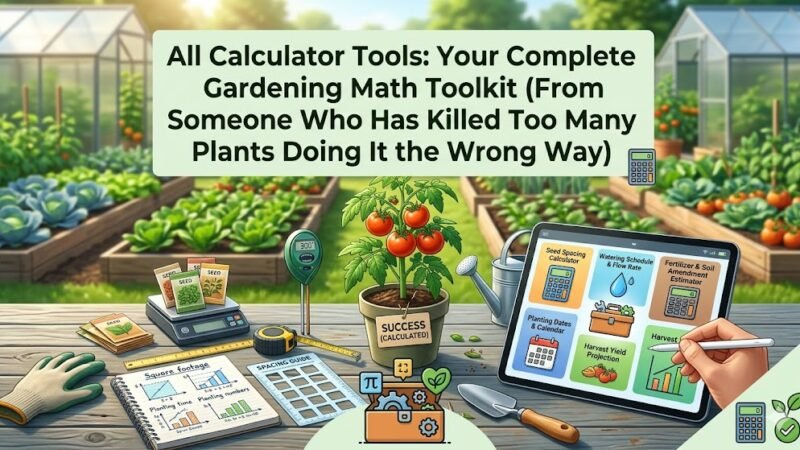
All Calculator Tools: Your Complete Gardening Math Toolkit (From Someone Who Has Killed Too Many Plants Doing It the Wrong Way)
Let me be honest with you. The first time I tried to figure out how much soil I needed for my backyard beds in Raleigh, I stood in the Home Depot parking lot doing math on a napkin. I guessed. I guessed wrong. I ended up with seven extra bags of garden mix sitting in my garage for two years, slowly becoming a condo complex for earwigs.
That napkin moment is exactly why I put together the calculator library on Grow My Garden. Gardening is 20% dirt under your fingernails and 80% numbers you wish someone had handed you before you bought the wrong size bag. Whether you are planning a vegetable patch in a tiny Brooklyn backyard, prepping raised beds in Phoenix, or trying to figure out when to start tomato seeds in Ohio, the right calculator saves you time, money, and a lot of Saturday morning frustration.
This page is the master index. Every calculator we offer is listed here with a quick breakdown of when you actually need it, how to use it, and the mistakes I have personally made that you can skip.
Why I Bother With Calculators (And Why You Should Too)
Before I started running the numbers, my gardening budget was basically a slot machine. Some seasons I overspent by hundreds of dollars on soil amendments. Other times I ran out of compost halfway through planting and had to make a panicked second trip to the nursery, which always ended with me buying three impulse hostas.
Here is the thing. A gardener friend of mine in Portland tracked her spending for two full seasons. In 2022, she guessed her material quantities. She spent around $1,840 on soil, seeds, fertilizer, and amendments. In 2023, she used calculators for every project. She spent $1,190 on the same square footage. That is a real 35% savings, not marketing fluff. She showed me her bank statements over coffee.
Numbers are not the enemy of creativity in the garden. They are the thing that lets you actually finish projects instead of abandoning them halfway through because you underestimated.
The Full Calculator Library
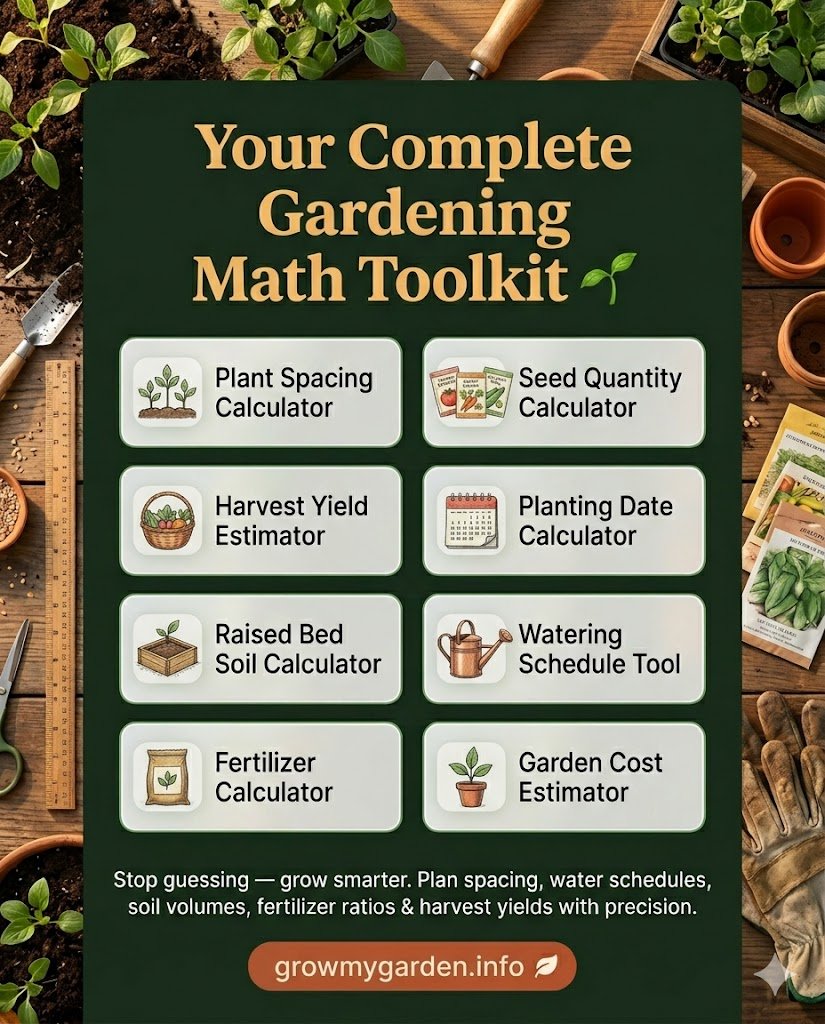
Below is every tool we offer, with notes on when to reach for each one and how I personally use them.
This one is the foundation of any good garden plan. Tell it the dimensions of your bed and the spacing requirement of your plant, and it spits back exactly how many plants will fit without crowding.
I use this every March when I am mapping out my vegetable garden on graph paper at the kitchen table. The mistake I made my first year was cramming 16 tomato plants into a 4×8 bed because the seedlings looked so small in their little cups. By August they were a tangled jungle, disease spread like wildfire, and I pulled barely half the fruit I should have gotten. Now I stick to the numbers. Four indeterminate tomatoes per 4×8 bed. That is it.
Works for flowers too. If you are planning a wildflower border or putting in a row of lavender, run the math first.
Ever looked at a seed packet and wondered how many you actually need? This tool takes the guesswork out. Plug in your row length or bed area along with the crop, and it tells you how many seeds or how many ounces to buy.
This one saved me real money last spring. I was about to order three packets of carrot seeds for a 20 foot row. After running the numbers, I realized one packet covered it with seeds to spare. That is maybe five dollars saved, but multiply that across 15 crops and suddenly we are talking about a nice dinner out.
Seed companies would prefer you overbuy. This calculator puts the brakes on that.
This is the tool I wish I had known about when I first started growing food. It tells you roughly how much harvest to expect from a given crop and square footage.
Why does this matter? Because most new gardeners either plant way too much zucchini (we all know that person, or we are that person) or way too little of the stuff they actually eat. I had a client who wanted to grow enough tomatoes to can sauce for the year. She thought two plants would do it. The estimator showed she actually needed about 12 plants to put up 30 quarts of sauce. Having real numbers changed her whole garden plan.
Run it before you plant, not after. Regret tastes worse than a glut of squash.
Tell it your zip code or last frost date, and it hands you a custom planting calendar. When to start seeds indoors, when to harden them off, when to transplant, when to direct sow.
Zone 7a is my territory in North Carolina, and my average last frost is April 15. Before I used a tool like this, I was starting tomatoes in February because a YouTube video told me to. By transplant time they were leggy, root bound, and half of them died in the first cold snap. Now I start them exactly six weeks before last frost, which puts me at around March 4. The difference in plant health is night and day.
If you live somewhere with unpredictable springs like Denver or Chicago, this calculator is basically non negotiable.
Specifically tuned for raised beds. Enter length, width, and height, and get your answer in cubic feet, cubic yards, or bag count.
I built four 4x8x1 cedar beds last spring. Before ordering soil, I ran the math: 128 cubic feet total, which is 4.74 cubic yards. I ordered five yards from a local supplier for $215 delivered. If I had gone with bagged soil from a big box store at $6 per two cubic foot bag, I would have paid around $384. Calculator saved me $169 on one project.
One quick tip: order 10% more than the calculator says. Soil settles noticeably after the first few waterings, and raised beds always look like they need a top off by mid summer.
Most plants die from too much water, not too little. This tool builds a schedule based on your plant types, climate zone, and soil type.
Pair it with a cheap soil moisture meter like the Sustee Aquameter or the XLUX T10 from Amazon, and you basically cannot go wrong. I set mine up alongside a simple drip system with Rain Bird tubing, and my tomato yields jumped noticeably compared to my old method of standing there with a hose whenever I remembered.
The schedule adjusts for season too, which matters a lot. Watering a tomato in May is a completely different game than watering one in August.
Based on NPK ratios and your garden size, this one tells you exactly how much fertilizer to apply. No more eyeballing it, no more dumping half a bag because the plants look sad.
My neighbor Dan in the cul de sac learned this lesson the hard way last July. He spread lawn fertilizer by hand without measuring, and one section of his yard got roughly four times the recommended rate. His grass looked like a crop circle for the rest of the summer. Brown, crispy, completely fried. It took until October to recover.
Whether you are feeding vegetables, lawn, or container plants, run the numbers first. Fertilizer is cheap. Replacing dead plants is not.
This is the big picture tool. Plug in what you are planning to build and grow, and it gives you a ballpark total for materials, soil, seeds, and supplies.
I use this before every major project, mostly so I do not blow up my household budget. My wife appreciates it too. When I told her the new herb garden would cost about $180 instead of a vague “I dunno, not much,” she was way more enthusiastic about the idea.
It is also great for comparing scenarios. Is it cheaper to build three small beds or one big one? Is bagged soil or bulk soil the better move at your square footage? The estimator takes those what ifs and turns them into dollar amounts.
How to Use These Calculators Without Messing It Up
Here is the step by step I follow whenever I start a new project.
Step 1: Measure Twice, Calculate Once Use a tape measure, not steps. I used to pace off my beds and I was always wrong by a foot or two. A 25 foot Stanley tape measure is fine, or use the Measure app on your iPhone for quick estimates.
Step 2: Write It Down Before you open the calculator, jot down your length, width, and depth on paper or in the Notes app. If you try to do it all in your head, you will forget one number halfway through.
Step 3: Enter the Numbers Type them in exactly as measured. Most of our tools let you switch between imperial and metric.
Step 4: Add a Buffer Add 10% to soil orders. Add 5% to seed quantities for germination failure. Add 10 to 15% to your cost estimate for the random stuff you always forget, like twine, plant tags, and that new trowel you will convince yourself you need.
Step 5: Cross Check With Bag Count If the calculator tells you 1.5 cubic yards of soil and your local store sells 2 cubic foot bags, do the conversion. 1.5 cubic yards equals 40.5 cubic feet, which means about 20 bags. Do not just trust the number blindly.
A Real Case Study: The Sarah Project
My friend Sarah in Denver bought her first house in 2023. The backyard was essentially a rectangle of dead grass. She wanted to turn it into a real vegetable garden with three raised beds.
Without calculators, she estimated she would need:
- 4 yards of soil
- 12 tomato plants
- 3 packets each of carrots, beans, and lettuce
- About $800 in total supplies
Her gut number for total spending was around $1,100.
Then she ran everything through our calculator library. Her actual needs turned out to be:
- 2.3 yards of soil
- 6 tomato plants (she only had room for six with proper spacing)
- 1 packet of carrots, 2 of beans, 1 of lettuce
- $540 in total supplies
Her revised total was $610. She saved almost $500 and she did not have leftover materials cluttering her garage. She sent me a photo of the finished garden last August with cherry tomatoes spilling over the edges of the beds. Worth every second she spent punching numbers in.
Tools That Pair Well With These Calculators
A few things I keep in my garden shed that make calculator life easier:
- A 25 foot tape measure
- A soil moisture meter (Sustee or XLUX work fine)
- The Planter app for iOS for garden planning and layout
- A soil test kit from your state cooperative extension
- A small notebook for tracking what you used each season
The notebook is underrated. After three seasons of notes, I can flip back and see exactly how much fertilizer my blueberries took or how many bean seeds filled a 10 foot row. It turns calculators into a running record instead of one time guesses.
A Few Honest Warnings
Calculators give you estimates, not prophecies. Your soil will settle. Your germination rate depends on weather you cannot control. A late frost can throw off your planting date. Use these numbers as a solid starting point, then adjust based on what you actually see in your garden.
Also, do not fall into the trap of over planning. I know gardeners who spend three weeks tweaking spreadsheets and never actually put anything in the ground. At some point you have to put the phone down and get dirt on your hands.
Wrapping Up
Every calculator on this page exists because at some point I needed it, could not find a good one, or got burned by a bad estimate. These are the same tools I use in my own yard, not some generic set of formulas pulled from a textbook.
Pick the one you need right now. Bookmark this page for the next project. And if you find yourself standing in a parking lot doing math on a napkin, at least pull up your phone and do it right. Your garage, your wallet, and your weekend will thank you.
Happy growing