

How to Harvest Rosemary Without Killing the Plant (What I’ve Learned After Years of Snipping)
The first rosemary plant I ever owned died a slow, sad death on my back porch one summer. I treated it like parsley, grabbed handfuls every time I cooked, and by fall it looked like a tiny gray skeleton. That mistake taught me something important. Harvesting rosemary the right way is less about how much you take and more about where and when you cut.
This Mediterranean herb is generous when you respect its rhythm and stubborn when you don’t. If you want fresh sprigs for years without losing the plant, a few simple pruning habits make all the difference. Here’s what actually works.
If you’ve stumbled here because your rosemary is starting to look a little rough, or you just want to do right by the one you brought home from the garden center last weekend, you’re in the right place. Rosemary is forgiving, but it has rules. Break them and the plant sulks. Follow them and you’ll have more rosemary than you know what to do with. Read complete Herb Gardening guide.
Let me walk you through what actually works.
Why Rosemary Is Different From Other Herbs
Most folks treat rosemary like basil or cilantro, and that’s where the trouble starts. Basil wants to be cut often. Cilantro is happy to be yanked. Rosemary, on the other hand, is technically Salvia rosmarinus (you may still see it labeled Rosmarinus officinalis on older plant tags). It’s an evergreen Mediterranean shrub from the mint family, and it grows woody stems that don’t bounce back the way soft herbs do.
Here’s the part most blog posts skip: once a rosemary stem turns brown and woody, it usually won’t push out new leaves from that section. So if you cut too far down into the old wood, you’re basically signing a death warrant for that branch. The green tips are where life happens. The brown base is structure.
Treat it like a small shrub, not a salad green, and everything changes.
The Best Time to Reach for the Pruners
Spring through early fall is prime harvesting season here in the States, especially once you see that fresh green growth flushing out at the tips. That young, soft growth is the sweet spot. It snips clean, regrows quickly, and tastes brighter than the older stuff.
A few timing rules I stick to:
Morning is best. I usually head out around 9 or 10 a.m., once the dew has burned off but before the sun gets brutal. The essential oils in the leaves are at their peak then, which is why your kitchen smells like a Tuscan trattoria the second you walk back inside.
Skip harvesting right before a hard freeze. If you’re up in zone 6 or colder and winter is closing in, give the plant a few weeks to settle before frost hits. Cutting stresses the plant, and stressed rosemary plus a cold snap is a bad combination.
If you’re up in zone 6 or colder and winter is closing in, give the plant a few weeks to settle before frost hits. Not sure of your exact planting and harvest windows? Use this Planting Date Calculator to plan by your climate zone.
Avoid harvesting when it’s flowering heavily. Those pale blue blooms are gorgeous and the bees love them, so I let the plant put on its show. You can still snip a sprig or two, but I hold off on bigger harvests until flowering slows down.
Indoor plants on a sunny kitchen windowsill can be harvested gently year-round, but they grow slower in winter, so I take less.
The One Third Rule (Please Don’t Skip This)
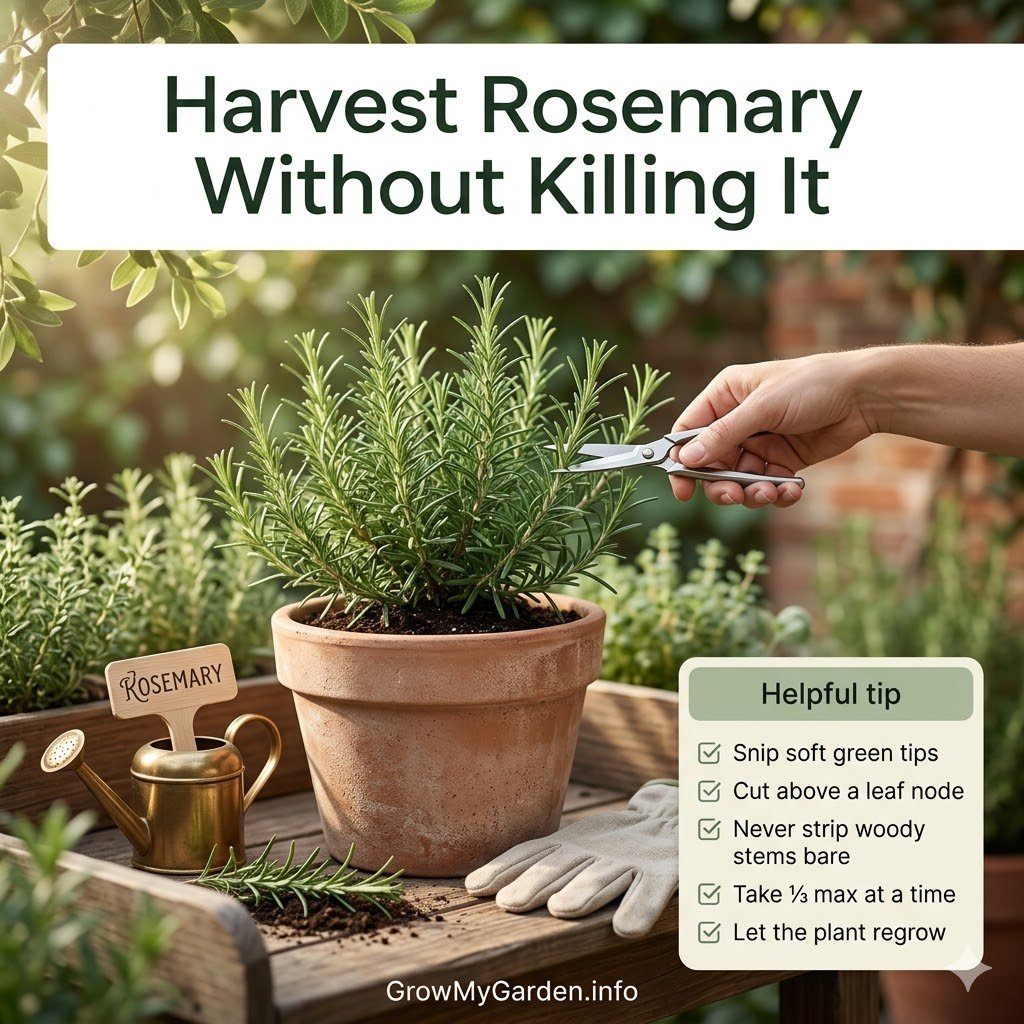
If you remember nothing else from this article, remember this: never take more than a third of the plant at one time.
For a young plant in its first year, take even less — a few sprigs at a time. Want to estimate what your rosemary (or other herbs) will actually produce over a season? Try the Harvest Yield Estimator to set realistic expectations.
I know that feels stingy when you’ve got a giant bush staring at you. But rosemary uses its leaves to photosynthesize, and those leaves are also its food factory. Strip too many and the plant can’t power its own recovery. I learned this the hard way with that porch plant in Sacramento.
For a young plant in its first year, I take even less. Maybe a few sprigs here and there, just enough to season a dish. Let it build up a strong root system before you start treating it like a grocery store.
The Right Way to Make the Cut
Grab a pair of sharp bypass pruners or, honestly, a good pair of kitchen scissors will do for small sprigs. Whatever you use, make sure the blades are clean. I wipe mine down with rubbing alcohol before I start, especially if I’ve been pruning anything else in the yard. Spreading fungal issues between plants is a rookie mistake I’ve made more than once.
Here’s the step by step I follow:
Step 1: Look at the stem and find a spot where you can see green growth. You want to cut on the soft, flexible part, not down into the gnarled woody base.
Step 2: Locate a leaf node, which is just the spot where leaves are coming out of the stem. You’re going to cut about a quarter inch above one of these nodes.
Step 3: Hold the stem gently with one hand and snip at roughly a 45 degree angle. The angle helps water run off the cut instead of pooling on it.
Step 4: Move around the plant. Don’t keep hacking at the same side. I walk around mine and take a little from here, a little from there, almost like I’m giving it a haircut rather than a buzz cut. This is what some folks call rotational harvesting, and it keeps the plant balanced and bushy.
Step 5: Step back every few cuts and look at the overall shape. Rosemary that gets harvested unevenly turns into a lopsided mess.
Cutting just above a node tells the plant to send out two new shoots from that spot, which means more rosemary down the road. It’s the same principle behind pinching back basil, just slower.

Don’t Cut Into the Brown
I’ll say it again because this trips up so many people. Avoid cutting deep into the old woody base. Those bare brown stems aren’t going to leaf back out for you. Stay in the green zone.
If your plant has gotten leggy and woody at the bottom with all the green pushed to the top, you’ll need a different strategy. Light, regular trims encourage branching lower down over time. Some gardeners do a slightly harder prune in early spring to reshape, but I keep it conservative. I’d rather have a slightly awkward looking rosemary than a dead one.
What to Do With What You Cut
Fresh sprigs keep beautifully wrapped in a slightly damp paper towel inside a glass container in the fridge for about two weeks. I keep a little jar on the top shelf and just pull from it as I cook.
For longer storage, you have a few options:
Air drying is the old school way and works great because rosemary has low moisture content already. Bundle five or six stems with kitchen twine, hang them upside down in a dry, well ventilated spot away from direct sunlight, and wait about two weeks. Once the leaves crumble between your fingers, strip them off the stems and store them in a small mason jar.
A dehydrator speeds things up. I use mine on the herb setting for about three hours. It’s overkill for a few sprigs but worth it when I’ve done a big harvest.
Freezing is my favorite for cooking. Strip the leaves, chop them up, drop them in an ice cube tray, cover with olive oil, and freeze. Those little flavor bombs go straight into the pan when I’m searing lamb or roasting potatoes.
Infused oils are simple and make the kitchen smell incredible. Just be careful with food safety, since homemade herb infused oils can carry botulism risk if not refrigerated and used within a week.
If you’ve got way more than you can use, the cuttings also propagate well. Strip the bottom leaves off a four inch piece, dip it in rooting hormone, stick it in a small pot of well draining soil, and keep it lightly moist. You’ll often see new growth within a month. I’ve gifted a dozen baby rosemary plants this way over the years.
Common Mistakes That Quietly Kill Rosemary
A few things I see all the time that nobody warns new gardeners about:
Overwatering after harvesting. People think a freshly trimmed plant needs babying with extra water. It doesn’t. Rosemary hates wet feet and root rot is one of the top killers of this plant. Stick to its normal watering schedule.
Overwatering after harvesting is one of the top killers. Rosemary hates wet feet, so stick to its normal watering routine — don’t add extra water just because you’ve trimmed it. Use this Watering Schedule Tool to figure out exactly how much your garden needs each week.
Harvesting from a plant that’s already stressed. If your rosemary is yellowing, wilting, or showing white powdery mildew on the leaves, don’t harvest. Fix the underlying problem first. A stressed plant has nothing to spare.
Using dull or dirty scissors. A clean cut heals fast. A crushed, torn stem is an open invitation to disease.
Forgetting to feed container-grown rosemary. In-ground plants generally take care of themselves, but rosemary in a pot eventually runs out of nutrients. A light feeding of a balanced organic fertilizer in spring goes a long way.
A light feeding of balanced organic fertilizer in spring goes a long way for potted rosemary. Not sure how much to use for your bed or container size? This Fertilizer Calculator figures it out for you.

Frequently Asked Questions
Can rosemary help with nerve pain? Some early research suggests rosemary’s anti-inflammatory compounds, like carnosic acid and rosmarinic acid, may ease mild nerve pain when used as a topical oil or tea. Evidence is limited, so talk to your doctor before relying on it.
How to cut rosemary so it keeps growing? Snip about a quarter inch above a leaf node on the soft green part of the stem, never down into the woody base. Take no more than one third of the plant at a time, and rotate where you cut to keep growth balanced.
Is it better to freeze or dry rosemary? Freezing keeps the flavor closer to fresh and works great for cooking. Drying lasts longer on the shelf and is easier for everyday seasoning. For best taste in roasts and stews, freeze it. For pantry storage, dry it.
Does rosemary break down acetylcholine? No, rosemary does the opposite. Its compounds, especially 1,8-cineole, inhibit the enzyme that breaks down acetylcholine. That’s why it’s linked to memory and focus benefits in several studies.
What are the negative effects of rosemary? In food amounts, rosemary is safe for most people. Large doses of the essential oil or concentrated extracts may cause stomach upset, vomiting, or seizures. Pregnant women should avoid medicinal amounts, and it can interact with blood thinners and blood pressure medications.
Will It Really Grow Back?
Yes, as long as you’ve followed the rules above. Healthy rosemary that’s been harvested properly will push new growth within a week or two during the active growing season. The cut points will branch into two new stems, the plant fills out, and by the next round of harvesting you’ll have even more to work with.
It’s one of the most generous plants in the garden once you understand what it wants. Mine on the patio in my current home has been going strong for six years now. It survived a move, a brutal Texas summer, and one accidental encounter with my neighbor’s golden retriever. Treat it gently and it’ll outlive your interest in cooking.
Now go give yours a careful, thoughtful trim. Your roast chicken will thank you.




Leave a Comment