
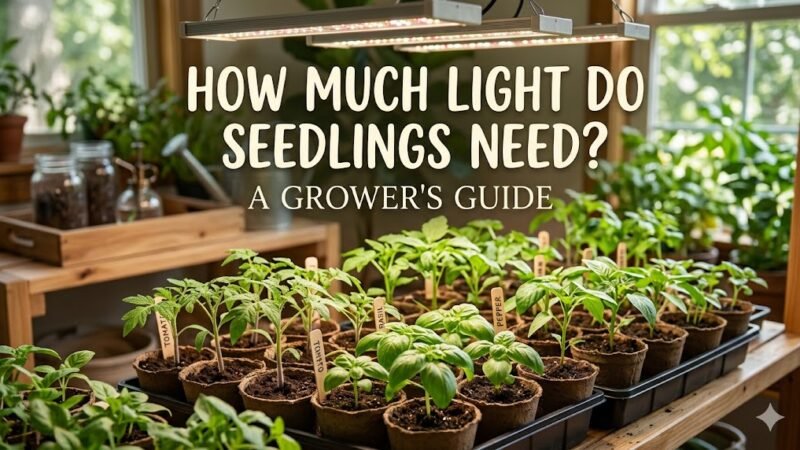
How Much Light Do Seedlings Need? A Real Grower’s Guide to Getting It Right
The first time I started seeds indoors, I was convinced I had everything under control. Seed trays lined up like soldiers on my kitchen windowsill, a fresh bag of seed starting mix, and the kind of beginner confidence that only comes before a humbling failure. Two weeks later, my tomato seedlings were four inches tall and flopping over like overcooked spaghetti. Pale, stretched, structurally useless.
That embarrassing tray of seedlings taught me the most important lesson in seed starting: light is not just one of several factors. It is the whole game.
If your seedlings look like they are auditioning for a horror movie, the odds are good that light is the culprit. And if you are starting seeds for the first time and want to avoid the mistakes I made, this guide is written for exactly you. Read our complete Indoor Gardening guide.
Why Seedlings Are Light-Hungry From Day One
Here is something most beginner guides skip over: a germinating seed does not actually need light right away. It runs on the stored energy packed inside the seed itself. But the moment those first tiny structures, called cotyledons, push out into the open air, the whole equation changes. That seedling immediately starts depending on photosynthesis to feed itself.
Photosynthesis is a seedling’s only way to make food, and it needs sufficient light intensity to work properly. Without enough of it, the plant does something clever but ultimately self-destructive: it stretches upward, thinning its stem and burning through its reserves in a desperate attempt to reach the light source. Horticulturalists call this process etiolation. Gardeners call it “leggy seedlings.” Either way, once a seedling gets leggy, it rarely catches up.
What surprises most people is just how much more light a seedling needs compared to a mature houseplant. Your pothos can survive quite happily in a dim corner. Put a pepper seedling in that same corner and within two weeks you will be looking at a pale, floppy mess.
The Actual Numbers: Hours Per Day and What They Mean
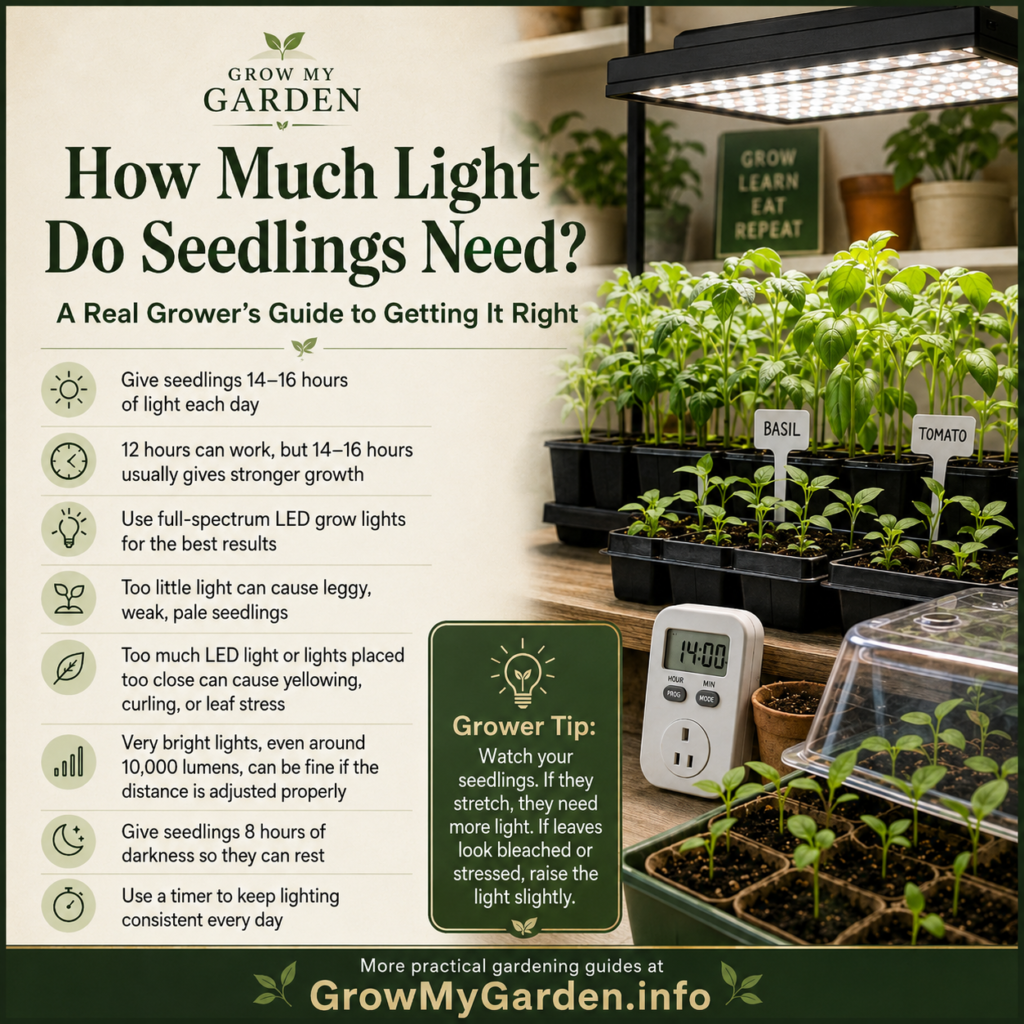
For the majority of vegetable and flower seedlings, the productive daily light exposure falls somewhere between 14 and 16 hours. That number shocks a lot of people, especially those hoping their windowsill will do the heavy lifting.
Here is the uncomfortable truth for anyone growing seeds indoors from January through April in most of the United States: a south-facing window typically delivers somewhere between 4 and 6 hours of usable sunlight on a clear winter day. Factor in overcast skies, and that number drops further. The gap between what seedlings need and what a window actually provides is exactly why supplemental grow lights are not a luxury item. They are a necessity for most American gardeners north of roughly the 35th parallel.
But here is the flip side that often gets overlooked: seedlings need a dark period too. Running grow lights around the clock sounds generous but it actually works against the plant. During darkness, seedlings process the energy gathered during the day, regulate their growth hormones, and build root mass. Deprive them of that nightly rest and you will see signs of stress, including slightly curled leaves and unusually slow root development. A good rule of thumb is 16 hours of light followed by 8 hours of complete darkness.
A basic digital outlet timer takes care of this automatically. The BN-LINK Digital Programmable Timer has been sitting in my seed starting room for three growing seasons and I have touched it exactly once, the day I set it up. It costs around twelve dollars and it is genuinely one of the smartest purchases I have made as a gardener.
Natural Light vs Grow Lights: An Honest Comparison
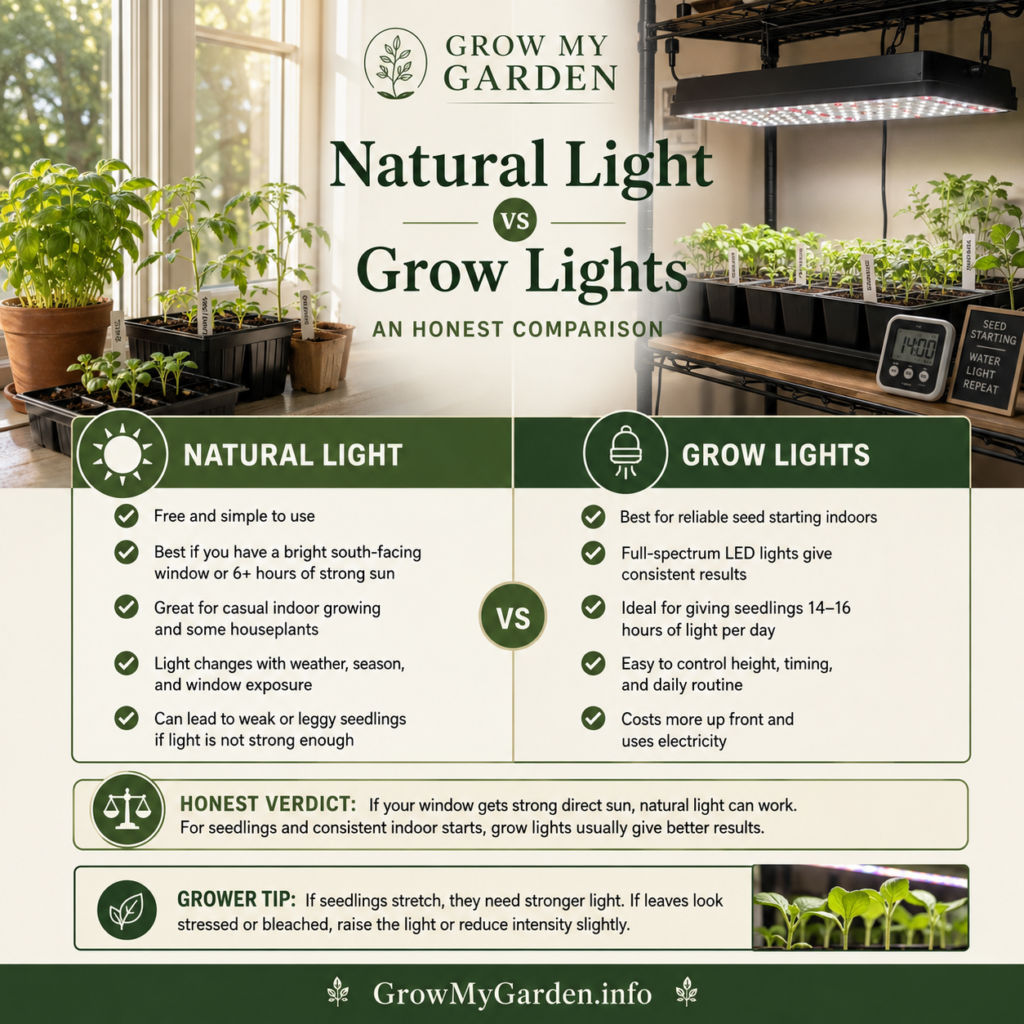
If you live in the southern United States, say Texas, Southern California, or Arizona, a south-facing window can be a legitimate seed starting setup from late winter onward. The sun stays stronger, the days are longer, and the light angle is more favorable. Pair it with a piece of white foam board behind your trays to bounce extra light back onto the plants and you have a respectable low-cost system.
For growers in Minnesota, Michigan, Wisconsin, the Pacific Northwest, or anywhere that sees serious cloud cover from October through April, that same windowsill setup is fighting against nature. The light not only lacks hours, it also lacks intensity. When sunlight passes through a cold glass pane on a February afternoon, a significant portion of the photosynthetically active radiation, which is the specific bandwidth plants actually use to drive photosynthesis, gets filtered or scattered. Your seedlings end up with the gardening equivalent of a weak handshake.
This is not a knock on windowsill growing. If you’re planning to grow those herbs long-term on the same windowsill beyond the seedling stage, our indoor herb garden setup guide for beginners covers containers, potting mix, watering, and everything else the light equation doesn’t include. But for tomatoes, peppers, and other vegetables that need a substantial head start indoors, artificial light is the dependable, consistent solution that removes the guesswork entirely.
Choosing a Grow Light That Actually Does the Job
The grow light market has exploded in the last decade, and walking into it without a little background knowledge is like shopping for a mattress without knowing what firmness you prefer. Overwhelming.
The single most useful specification to understand is color temperature, measured in Kelvin. For seedlings, you want lights in the 5000 to 6500 Kelvin range. These emit a cool, blue-white light that promotes compact, sturdy growth, which is exactly the opposite of the leggy stretching that happens without enough light. Warm-toned bulbs in the 2700 to 3000 Kelvin range are better suited for flowering plants and fruiting stages. File those away for later and focus on the cool daylight spectrum for seed starting.
T5 Fluorescent Shop Lights are the traditional choice and they remain genuinely solid for beginners. They are inexpensive, produce great light quality for seedlings, and are widely available at hardware stores across the US. The main quirk is that they need to hang close, usually within 2 to 4 inches of the seedling tops, to deliver adequate light intensity. You will adjust the height frequently as plants grow.
Full-Spectrum LED Grow Lights have become legitimately excellent options over the last few years, and the prices have dropped to a point where they make sense for most home growers. The Spider Farmer SF-300 and the Barrina T5 LED Shop Light are two options that consistently get strong reviews from seed starting communities on platforms like Reddit’s r/vegetablegardening and the Old Farmer’s Almanac community forums. LEDs run cooler and use less electricity, which matters when you are running lights 14 hours a day for 8 to 10 weeks straight.
For anyone who wants to get into the weeds on light measurement: look for PPFD ratings on LED fixtures. PPFD, or photosynthetic photon flux density, tells you how many light-carrying photons are actually hitting a square meter of your growing surface each second. For seedlings, a PPFD of around 200 to 400 micromoles per square meter per second is a healthy range. Anything significantly above that can cause light burn on tender young foliage, which is a whole other headache.
Step-by-Step: Building a Simple Indoor Seed Starting Light Setup
Before you set up your space, it helps to know how many trays you’ll actually be running. Use the Seed Quantity Calculator to figure out exactly how many seeds and packets you’ll need based on your planting area — then size your light setup accordingly
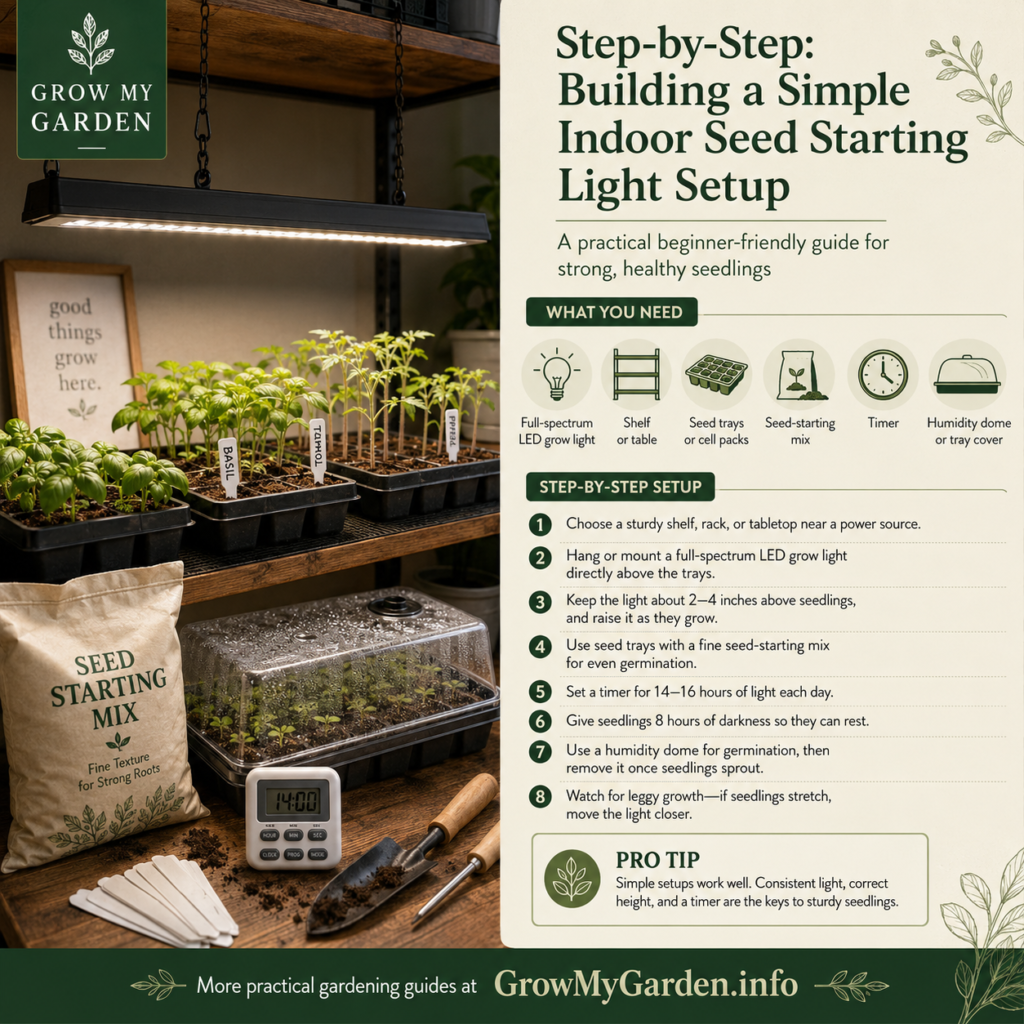
Step 1. Pick your grow space. A basement corner, utility room, or spare bathroom shelf works well. You want a stable, easy-to-clean surface where temperatures stay above 60 degrees Fahrenheit consistently.
Step 2. Install your light fixture. For T5 or shop lights, hang them on an adjustable chain or use a height-adjustable stand so you can raise the fixture as your seedlings grow. For LED panels, follow the manufacturer’s recommended hanging height, which is typically listed right on the product page.
Step 3. Set your trays directly beneath the light. Start with the fixture 2 to 3 inches above seedling tops for fluorescent lights and 12 to 18 inches above for most LED panels.
Step 4. Plug the light into your digital timer and program it for 16 hours on and 8 hours off. I run mine from 6 AM to 10 PM, which aligns with my schedule and lets me actually observe my plants during lit hours.
Step 5. Check your seedlings every couple of days and adjust light height as needed. Upward stretching toward the light means lower it. Bleached or curling leaf tips mean raise it.
Step 6. Begin hardening off about 7 to 10 days before your outdoor transplant date. Move seedlings outside to a protected spot for a few hours each day, gradually increasing their exposure to real sun and wind. This transition is genuinely important. A seedling that has spent its whole life under a controlled indoor light setup will be shocked by the raw intensity of full outdoor sun on its first day outside.
A Case Study Worth Paying Attention To
In a trial conducted by educators through the University of Vermont Extension program, tomato seedlings were grown under three different daily light schedules: 12 hours, 16 hours, and continuous 24-hour light exposure. By the sixth week, the 16-hour group had produced the sturdiest stems, the deepest green foliage, and the most well-developed root systems of the three groups.
The 12-hour seedlings were noticeably leggier and slower to develop true leaves past the cotyledon stage. The continuous light group, perhaps counterintuitively, showed signs of physiological stress including slight leaf curling and marginal tip burn, even though they had received the most total light input. The dark period, it turns out, is not just a break from light. It is a biologically active recovery period that plants have evolved to need. This finding lines up with what experienced seed starters observe in practice season after season.
Reading Your Seedlings: Signs That Something Is Off
Seedlings are actually pretty communicative once you learn to read the signals.
Too little light produces a clear pattern. Stems stretch tall and thin, leaning dramatically toward the nearest light source. Leaf color is pale and washed out, closer to yellow-green than a rich deep green. The stems cannot support the plant’s weight. If your seedlings look like they are trying to escape the tray and reach the window, they want more light.
Too much light is less common indoors but it does happen, particularly with high-powered LED lights set too close to the canopy. Leaves look bleached or faded at the edges and tips. In more serious cases the foliage starts curling downward and the soil surface dries out faster than usual because of the heat radiating from the fixture.
A Few Plant-Specific Notes
Tomato seedlings and pepper seedlings sit at the demanding end of the spectrum. Both need the full 14 to 16 hours per day and will make their unhappiness known quickly in low-light conditions. Lettuce seedlings and herb seedlings like basil and cilantro are considerably more forgiving and can manage well on 12 to 14 hours with decent intensity. Most annual flower seedlings perform well on a 14-hour schedule as a general starting point.
Frequently Asked Questions
1. How much grow light should seedlings get?
Most seedlings need 14–16 hours of light per day.
2. Is 12 hours of light enough for seedlings?
Yes, 12 hours can work, but 14–16 hours is better for strong, healthy growth.
3. Is 10,000 lumens too bright for seedlings?
Not always. It depends on distance. Keep strong lights 12–24 inches above seedlings and watch for leaf burn.
4. What type of light do seedlings need?
Seedlings need full-spectrum LED grow lights with cool white/blue light for leafy growth.
5. Can seedlings get too much LED light?
Yes. Too much light or lights too close can cause yellow leaves, crispy edges, curling, or stunted growth.
What Gets You There Faster Than Anything Else
You can spend a lot of money on premium seed mixes, heat mats, and specialty fertilizers. And some of those things are genuinely useful. But nothing moves the needle on seedling quality more decisively than getting the light right. Strong, consistent, properly timed light produces the kind of compact, dark green, structurally sound seedlings that actually thrive when they hit the garden.
Get the light right and most other variables become secondary. Mess up the light and no amount of careful watering or ideal temperature will save you from a tray full of disappointment. It is really that fundamental. Start with 16 hours on and 8 off, a decent full-spectrum fixture at the right height, and a timer that does the thinking for you. The rest of the details you can dial in as you go.
Your seedlings will tell you when they are happy. And honestly, a tray of fat, stocky, deep green seedlings sitting under a grow light on a cold February morning is one of the most quietly satisfying things in gardening.


Leave a Comment