
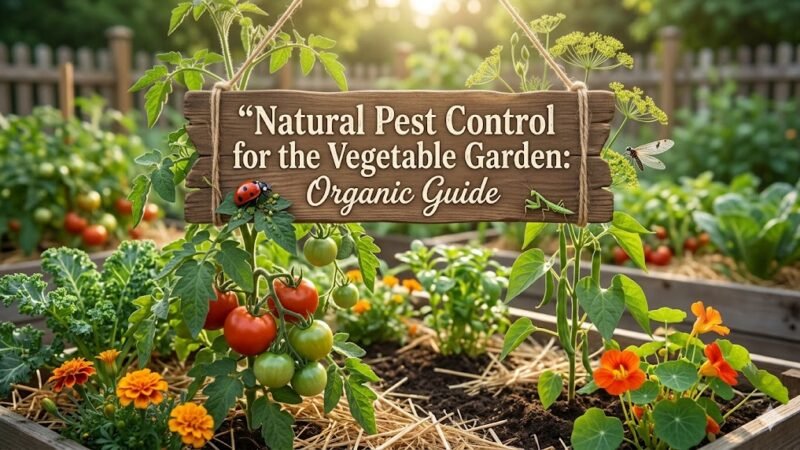
Natural Pest Control for the Vegetable Garden: A Real Gardener’s Playbook
The moment you spot the first aphid cluster curling under your pepper leaves, the temptation to reach for a chemical spray is very real. But here’s what years of tending a backyard vegetable garden actually taught me — you don’t need to poison your plot to protect it. Natural pest control isn’t just a trend; it’s a smarter, longer-lasting approach to keeping your harvest intact. Wondering what a healthy, pest-free garden could actually yield? Check the Harvest Yield Estimator.
From companion planting that confuses insects before they settle, to beneficial insects that hunt pests around the clock, the strategies behind organic pest management work with your garden’s own biology. And they’re completely safe for your kids, your pets, and the soil that feeds your family.
Since then, I’ve spent years learning how to run a productive vegetable garden that manages pests without reaching for a bottle of synthetic chemicals. What I’ve landed on is a combination of old wisdom, ecological thinking, and a few genuinely clever tricks — and none of it requires a chemistry degree or a costly subscription service. What you’ll find here isn’t textbook theory. It’s organic pest management in practice, built through a lot of seasons, a lot of mistakes, and more mornings crouching under squash leaves than I care to admit. Read our complete Pest Control & Plant Health guide.
Start Underneath: Soil Health Is the Real Foundation
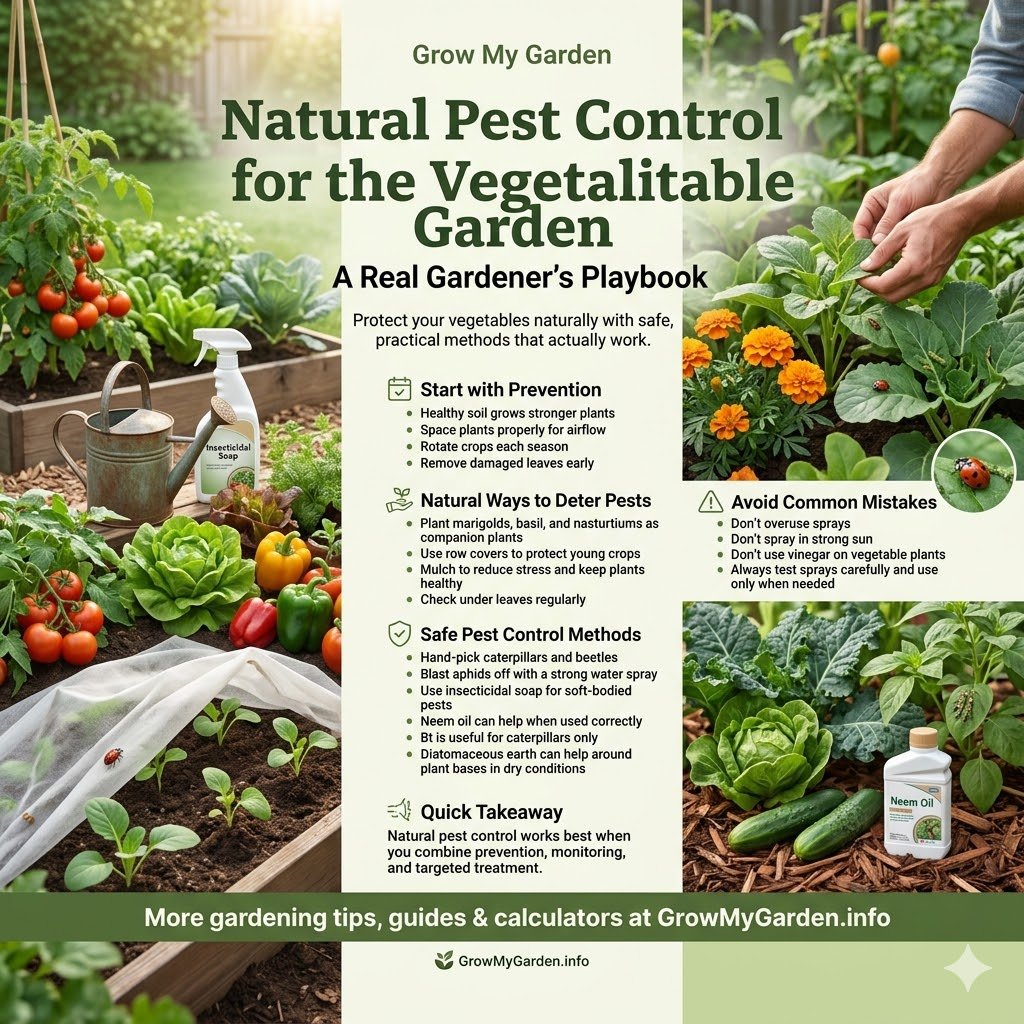
Most gardeners treat vegetable garden pest control as something you do after you see a problem. I’ve learned it starts months earlier, in the dirt.
Healthy garden soil is teeming with microbial life that directly supports plant immunity. When your vegetables are growing in well-amended ground — rich in compost, with good drainage and proper structure — they’re genuinely more resilient to insect pressure. Think of it as the difference between a well-rested person and a sleep-deprived one walking into flu season. Stressed plants are pest magnets; thriving ones are not.
Here’s what I do at the start of every season:
1. Top-dress with compost. A 2–3 inch layer of finished compost improves soil biology and feeds plants steadily through the season. I use my own hot compost pile, but bagged options from brands like Espoma or Coast of Maine work well. Good compost improves both soil health and garden biodiversity at the microbial level — things you can’t always see but absolutely benefit from. If you’re filling or amending a raised bed, the Raised Bed Soil Calculator tells you exactly how much soil and compost to buy.
2. Mulch generously. I spread straw or shredded leaf mulch around my tomatoes, peppers, and cucumbers. Mulching for pest control is underrated: it suppresses weeds that can harbor insects, retains moisture to reduce plant stress, and creates hiding habitat for ground beetles that eat cutworm eggs at night.
3. Respect proper plant spacing. Crowded plants are stressed plants, and stressed plants attract trouble like a flashing neon sign. Airflow matters too — tight spacing encourages the fungal diseases that weaken plants and make them more vulnerable to insect attack. Use the Plant Spacing Calculator to find exact spacing for every vegetable in your garden.
4. Switch to drip irrigation. Overhead watering keeps foliage wet, which many pests adore. A drip system from Rain Bird or DripWorks keeps moisture at root level, reducing the humidity at leaf level where thrips and spider mites love to set up shop. Consistent moisture also protects tomatoes from stress-related problems that have nothing to do with insects — like blossom end rot, which hits hardest when watering is uneven.
Not sure how much water your garden actually needs? The Watering Schedule Tool calculates it by crop and bed size.
Know Your Enemy: Early Pest Detection Changes Everything
Half of sustainable pest control is just showing up and paying attention. I walk my garden every morning with coffee — a ritual that sounds idyllic, but it’s honestly just effective. Early pest detection keeps small problems from becoming catastrophic ones.
Here’s what I encounter most in a typical American vegetable garden, and the telltale signs each pest leaves behind:
- Aphids cluster on new growth and leaf undersides, leaving a sticky residue. You’ll often spot ants moving around them — ants actually “farm” aphids for that honeydew. If aphids have found your roses specifically, this guide covers how to get rid of aphids on roses using the same natural methods.
- Cabbage worms and cabbage loopers chew ragged holes through brassicas like kale, broccoli, and cabbage. White butterflies hovering over your brassica bed are the adults laying eggs.
- Tomato hornworms are extraordinary camouflage artists that can strip a plant in two days. Frass (droppings) on the soil beneath the plant gives them away before you ever spot the caterpillar itself. Hornworms move fast once they’re established — here’s a full breakdown of how to get rid of tomato hornworms before they do real damage.
- Squash bugs and squash vine borers are the unofficial mascots of summer heartbreak for American gardeners. Bronze egg clusters on leaf undersides signal squash bugs; sudden vine wilting is almost always the borer.
- Spider mites appear during hot, dry spells. Fine webbing and a dusty-gray look on leaves are the giveaway.
- Flea beetles punch tiny shot-holes through young eggplant, peppers, and arugula seedlings — sometimes faster than the plants can recover.
- Leaf miners leave pale serpentine trails mapped across leaf surfaces like abstract art.
- Slugs and snails work under cover of darkness, leaving their silver signature trail on foliage and soil.
- Wireworms (the larval form of click beetles) tunnel through root vegetables and carrots underground, where damage isn’t visible until harvest.
I use the free app iNaturalist for anything I can’t immediately identify. It’s surprisingly accurate for insect ID and has saved me from treating the wrong pest more than once.
Your First Line of Defense: Companion Planting and Physical Barriers
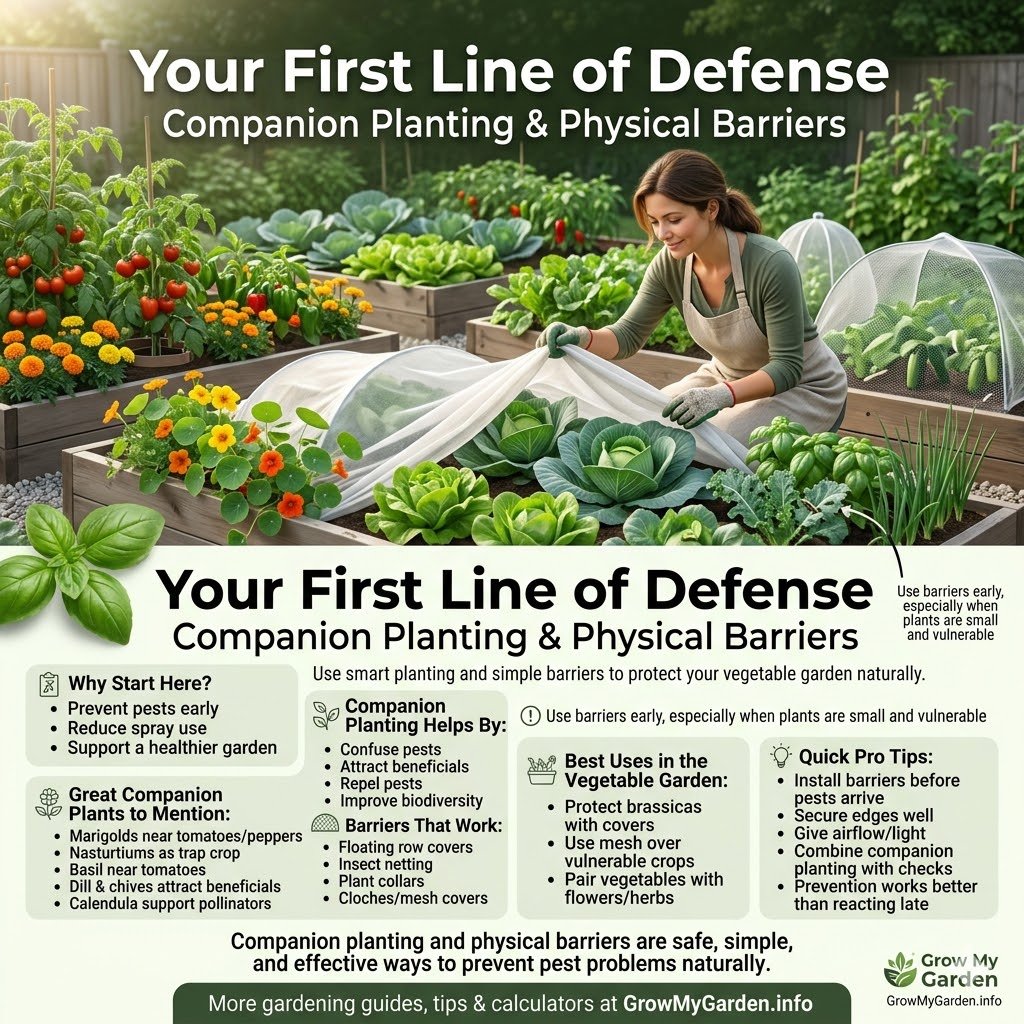
Companion planting is one of those ideas that sounds almost too old-fashioned to work — and yet it keeps proving itself. The logic is sound: when you grow a diversity of plants together (polyculture rather than monoculture), you disrupt pest lifecycles and create a garden ecosystem where no single insect can run the table.
Companion plants I actually use:
- French marigolds form a border around my tomatoes and peppers every year. They’re not magic, but over a full season they measurably reduce aphid and whitefly pressure.
- Basil interplanted with tomatoes reportedly deters thrips and aphids. It also makes for better pasta, which is its own argument.
- Nasturtiums work as a trap crop — aphids prefer them and often colonize nasturtiums instead of your vegetables. Plant them as a sacrificial outer ring.
- Lavender and rosemary planted along bed borders repel whiteflies and aphids with their volatile oils. They also look great and smell better than anything else in the garden.
- Mint (kept in a container to prevent it from taking over the world) deters aphids and flea beetles near brassicas and leafy greens.
- Dill, fennel, and borage I let flower intentionally — they’re magnets for hoverflies and parasitic wasps that then patrol my whole garden for prey.
- Garlic and chives near carrots and roses discourage Japanese beetles and aphids from settling in.
Physical barriers that actually earn their keep:
- Floating row covers (I prefer Agribon-15 fabric) are one of the most effective tools in pesticide-free gardening. Draped over brassicas early in the season and sealed at the edges, they shut out cabbage moths, flea beetles, and carrot flies before a single egg is laid.
- Exclusion netting with a fine mesh is worth the investment if flea beetles routinely destroy your young eggplant each spring.
- Copper tape around raised bed frames gives slugs and snails a mild electrical shock — natural, immediate, and strangely satisfying.
- Plant collars made from cardboard or cut plastic cups set around transplant stems block cutworms from feeding at the base of young seedlings overnight.
- Yellow sticky traps hung near the soil level catch fungus gnats; position them higher and they trap whiteflies and winged aphids.
- Beer traps — shallow containers sunk into the soil and filled with cheap beer — lure slugs in and don’t let them back out. Slugs, it turns out, love lager.
- Diatomaceous earth dusted around the base of plants creates a barrier that damages the exoskeletons of crawling insects like earwigs, slugs, and sowbugs. Use food-grade DE and reapply after rain.
Calling in Reinforcements: Biological Pest Control
This is where eco-friendly pest control gets genuinely exciting — when you stop thinking about your garden as a battlefield and start managing it as an ecosystem with a natural predator food web in place.
Beneficial insects do enormous pest control work at zero cost, if you create the habitat they need. Here’s the crew you want patrolling your beds:
- Ladybugs are the poster child of beneficial insects for good reason — both adults and larvae eat aphids relentlessly.
- Lacewings are even more voracious. Their larvae — sometimes called “aphid lions” — will consume aphids, thrips, spider mites, and small caterpillars.
- Parasitic wasps, including braconid wasps, are tiny and completely harmless to humans. They parasitize caterpillars and aphids. If you’ve ever seen white rice-grain-shaped objects attached to a tomato hornworm, those are braconid cocoons — the wasps are consuming the hornworm from the inside out. Nature is ruthless and wonderful.
- Hoverflies look like small bees and have larvae that clean up aphid colonies efficiently. Their adults pollinate while their young patrol.
- Praying mantis are ambush generalists — they’ll eat almost anything that moves, including pests and, occasionally, beneficial insects. Introduce them selectively.
- Ground beetles are underappreciated nighttime hunters. They eat cutworms, slug eggs, and wireworms. A permanent mulch layer gives them daytime cover.
To attract beneficial insects, I’ve installed a couple of insect hotels built from bamboo tubes, pine cones, and drilled timber. I also maintain a native flower section with echinacea, anise hyssop, and goldenrod as a dedicated wildlife habitat garden — giving beneficial insects a reason to live near my vegetables rather than just visit.
Beyond insects: toads and frogs eat slugs, earwigs, and caterpillars by the dozens. I keep a shallow dish of water near my garden beds to encourage them. Bats handle an impressive volume of moth control — and moths are the adults that lay the eggs that become the caterpillars eating your brassicas. A bat house on a fence post near the garden is one of the highest-ROI investments in biological pest control I know.
For soil pests — grubs, root maggots, and fungus gnat larvae — beneficial nematodes like Steinernema feltiae are genuinely effective. Apply them to pre-moistened soil at dusk (they’re UV-sensitive), and they’ll work through the root zone parasitizing larvae. Brands like ARBICO Organics and NaturesGoodGuys ship them fresh and alive.
When Prevention Isn’t Enough: Organic Sprays and Treatments That Work
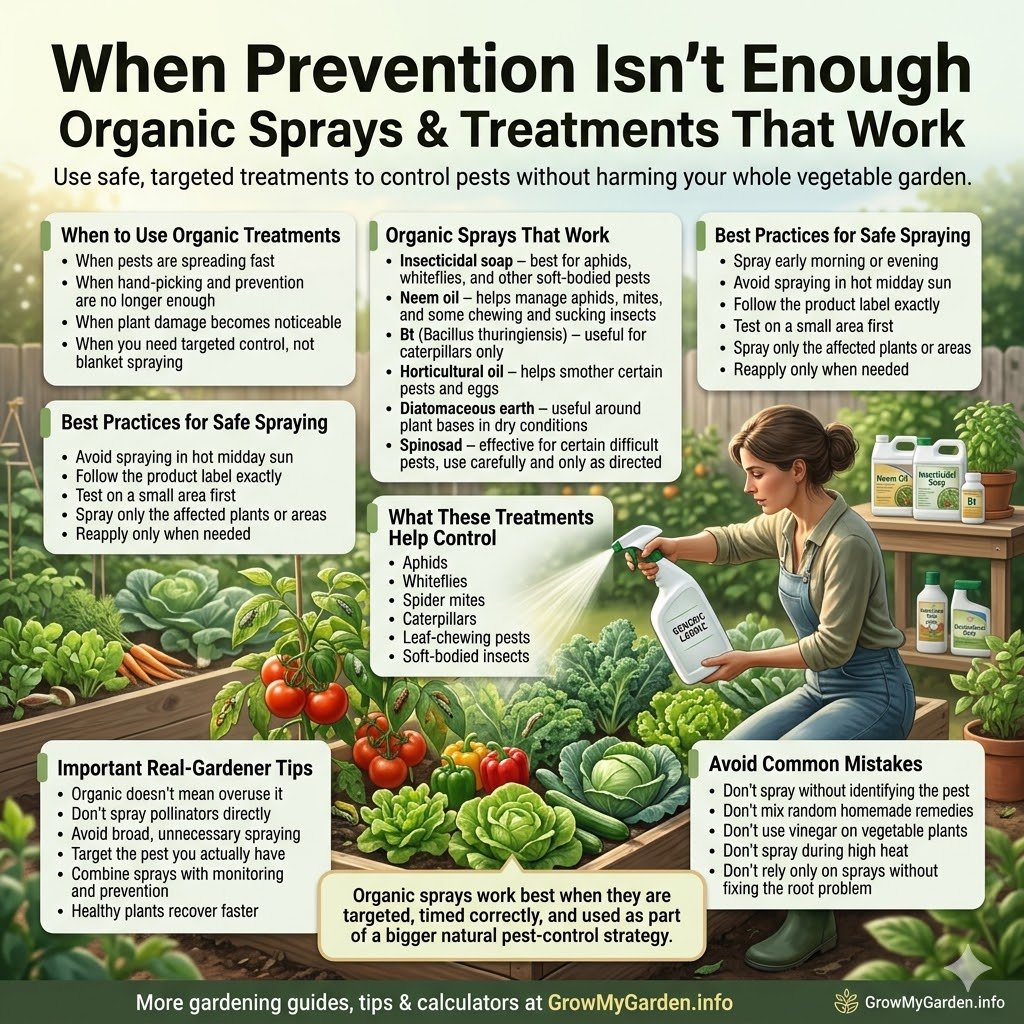
Sometimes you walk out and find a full-scale situation — aphids blanketing your beans, spider mites coating your cucumbers in fine webbing during a heat wave. At that point, observation isn’t enough. Here are the treatments I keep on hand, in order of how often I reach for them:
Neem oil spray is my go-to workhorse. It disrupts the hormonal system of soft-bodied insects and deters egg-laying without harming most beneficial species. My recipe: 1–2 tablespoons of cold-pressed neem oil, 1 teaspoon of castile soap, 1 quart of warm water. Mix well, apply at dusk, and hit the undersides of leaves where pests actually live. Don’t spray in direct sun — the oil can scorch foliage.
Insecticidal soap spray is faster-acting and contact-based. It works by disrupting insect cell membranes on impact. Mix 2 tablespoons of pure, unscented castile soap (Dr. Bronner’s is my standard) per quart of water. Effective on aphids, spider mites, whiteflies, and mealybugs. No residual protection, but immediate results.
Garlic spray is cheap, homemade, and genuinely works as a deterrent. Blend a full bulb of garlic with 2 cups of water, strain thoroughly, then dilute before spraying. The sulfur compounds are the active ingredient, and the smell is — let’s just say “assertive.”
Hot pepper spray deters soft-bodied pests and also discourages mammals like rabbits and squirrels from snacking on your plants. Blend 2–3 fresh hot peppers, strain, dilute, add a drop of dish soap.
Bacillus thuringiensis (Bt) is a naturally occurring soil bacterium that produces proteins specifically toxic to caterpillar larvae but harmless to everything else — including children, pets, birds, and beneficial insects. It’s my primary defense against cabbage worms and cabbage loopers on brassicas. Monterey Bt and Bonide Thuricide are both widely available at garden centers.
Spinosad — also from Monterey Garden — is derived from a soil organism and is particularly effective against thrips, flea beetles, leaf miners, and squash vine borers. It breaks down quickly and has minimal impact on most beneficial insects if applied in the evening.
Pyrethrin (derived from chrysanthemums) is a broader-spectrum natural insecticide I use only as a last resort, since it’s less selective and can affect beneficial insects. It breaks down rapidly in sunlight, which limits residual impact.
Kaolin clay mixed with water creates a white mineral coating on plant surfaces that physically confuses and deters chewing insects like Japanese beetles and squash bugs. It requires reapplication after rain and is fussier to use than sprays, but it’s remarkably effective for some growers.
The Integrated Approach: How It All Fits Together
What makes chemical-free pest control actually work long-term is thinking in systems rather than individual fixes. Integrated pest management (IPM) — a framework developed in agricultural science that translates directly to home gardens — is essentially the principle of using the least disruptive method first and escalating only when necessary.
In my garden, the decision hierarchy looks like this:
- Prevention first — healthy soil, crop rotation (I never plant brassicas or nightshades in the same bed two years running), proper plant spacing, good garden hygiene (removing plant debris and diseased foliage at season end), and consistent weed control.
- Habitat and biodiversity second — companion planting, native flowering plants, insect hotels, water sources for amphibians.
- Physical intervention third — row covers, copper tape, plant collars, hand-picking pests (tedious, but effective), beer traps.
- Targeted organic treatments last — and only the most specific option available for the pest I’ve actually identified.
This hierarchy keeps the garden ecosystem in balance. It’s not a zero-pest garden — and that was never the goal. The goal is a garden where pest populations stay manageable because everything that eats them has a home and a reason to stay.
Frequently Asked Questions
1. What is the best homemade insecticide for vegetable gardens?
Use a strong water spray first. For soft pests like aphids, use commercial insecticidal soap or neem oil if needed. Avoid harsh homemade mixes because they can burn leaves.
2. How to naturally deter pests from vegetable garden?
Use row covers, hand-picking, water spray, companion planting, healthy soil, mulch, and regular leaf checks, especially under leaves.
3. What are the 5 methods of pest control?
Cultural, mechanical/physical, biological, chemical, and preventive/monitoring control. IPM combines methods to reduce pest damage safely.
4. What is safe to spray on my vegetable garden?
Safest options: water spray, insecticidal soap, neem oil, horticultural oil, or Bt for caterpillars. Always spray in the evening and follow the product label.
5. Can I spray vinegar on plants to keep bugs away?
No, avoid vinegar on vegetable plants. Vinegar can burn plant leaves and damage desirable plants; it works more like a contact herbicide than a safe bug spray.
After a few seasons of thinking this way, something actually shifts. Your garden starts running a little more on its own. Not effortlessly, not perfectly — but with a resilience that no amount of chemical spraying ever gave me. And you get to drink your morning coffee surrounded by ladybugs and hoverflies and the occasional toad, which is, I’ll tell you, a considerably better way to start a Tuesday.
Got a specific pest problem I didn’t cover? Drop it in the comments — I read every one.


Leave a Comment