
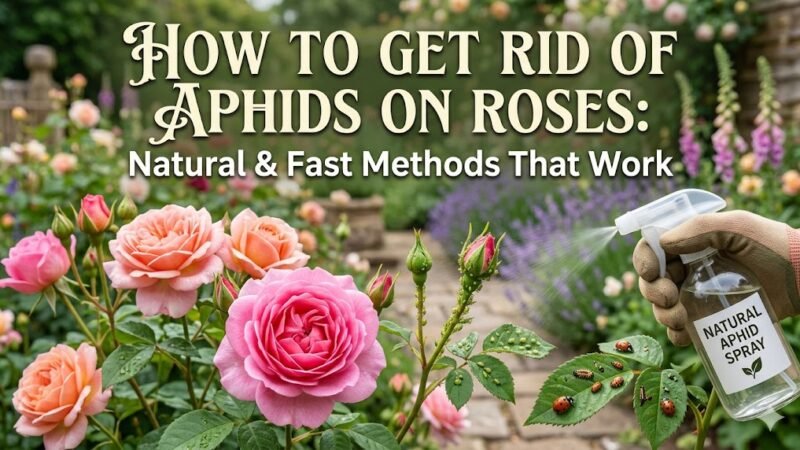
How to Get Rid of Aphids on Roses (What Actually Works, From Someone Who’s Been There)
I remember the morning I walked out to my backyard rose garden, coffee in hand, feeling genuinely proud of how things were coming along. The buds were forming, the canes were pushing out fresh growth, and everything looked like it was headed in the right direction. Then I leaned in closer and spotted them — tiny, clustered, and absolutely everywhere.
Rose aphids had moved in overnight and made themselves completely at home on my most prized rose bushes. If you have ever had that same gut-punch moment, you are not alone. Learning how to get rid of aphids on roses is something every American gardener eventually faces, and the good news is that it is very manageable once you know what actually works.
That was my introduction to rose aphids. And if you are reading this right now, you are probably having the same moment I did. The good news? This is a very fixable problem. The better news? You do not need to nuke your garden with harsh chemicals to solve it. Read our Pest Control And Plant Health guide.
Let me walk you through everything I have learned, the hard way and the right way.
What Exactly Are You Dealing With?
Before you reach for anything, it helps to know your enemy. The culprits on rose bushes are almost always one of two species: Macrosiphum rosae, the classic rose aphid, or Macrosiphum euphorbiae, the potato aphid that moonlights on all kinds of flowering plants. Both are soft-bodied insects with piercing-sucking mouthparts that work like tiny syringes, tapping straight into your rose stems and flower buds to drink the plant sap inside.
Rose aphids typically appear green or pink, sometimes almost translucent. They are tiny, only about 1/16 to 1/4 inch long, with oval pear-shaped bodies. You will almost always find them in clusters on the undersides of leaves, around new growth, and packed onto flower buds. They love the most tender, sugar-rich parts of the plant, which is exactly why your most beautiful new growth always takes the first hit.
Here is the part that makes aphid infestations go from annoying to alarming so fast: female aphids can reproduce without mating. Every female is essentially born pregnant. Within a week to ten days, a newborn female becomes a mother herself, pumping out more live aphid nymphs. No eggs, no waiting, just an exponential surge of insects that can overwhelm a rose bush shockingly quickly.
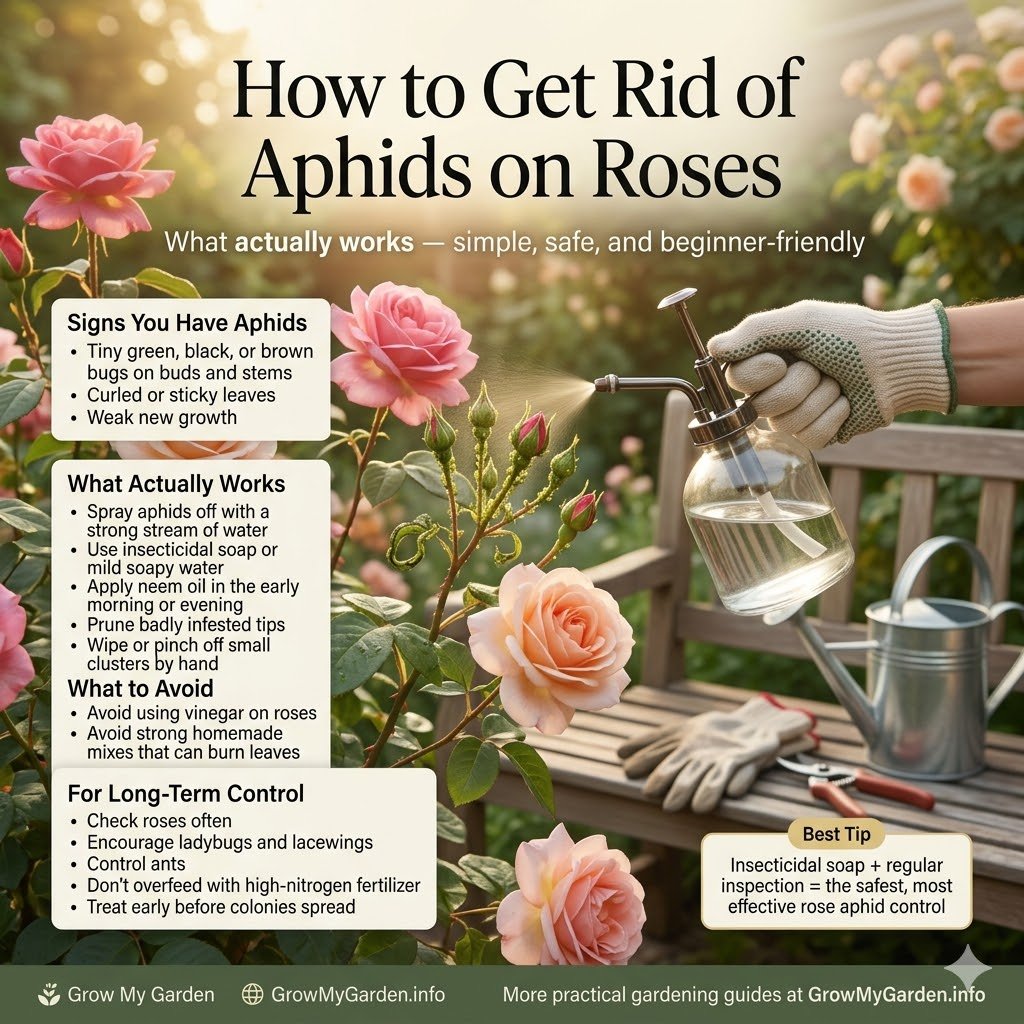
How to Know If Aphids Are the Problem (Not Something Else)
A lot of people confuse aphid damage with other issues. Here is what to look for specifically:
Sticky, shiny residue on leaves and stems. This is honeydew, the sugary waste aphids excrete as they feed. If your rose bush feels tacky when you touch it, aphids are almost certainly the cause.
Sooty mold. That dark, dusty black coating on leaves that looks like someone sprinkled soot over your plant? It grows on top of honeydew deposits. It is not a disease itself, but it blocks sunlight and signals a serious aphid population underneath.
Curling, puckered, or wilting leaves. When aphids feed heavily on new growth, the plant tissue becomes distorted. Leaves curl inward or pucker at the edges. Flower buds may never open properly.
An ant parade on your rose canes. This is the most underrated sign of an aphid infestation. Ants do not eat aphids — they actually farm them, protecting aphids from natural predators in exchange for access to the honeydew. If you see ants marching up and down your rose bush like they own the place, look closer. There is almost always an aphid colony nearby.
Stunted plant growth and fewer blooms. A rose bush dealing with a large aphid colony puts its energy toward survival rather than flowering. You will notice fewer buds and overall sluggish growth during what should be the most active part of the growing season.
When Aphids Show Up (Timing Matters More Than You Think)
Here is something I did not understand until I started paying more attention: nature actually gives aphids a head start every spring. When temperatures consistently hit around 50 degrees Fahrenheit, aphid nymphs start hatching from overwintered eggs that have been quietly sitting on plant debris and mulch all winter. The warm spring weather arrives, rose bushes push out new growth, and the aphids get right to work.
The problem is that beneficial insects like ladybugs and green lacewings do not become active until temperatures average closer to 60 degrees. That 10-degree window is basically a free pass for aphid colonies to establish themselves before their natural predators even clock in for the season. By early summer, populations can hit their peak if nothing has been done to manage them.
This is why early spring monitoring is so important. Walk your rose garden once a week starting in early April. Flip leaves over, check around buds, run your fingers along new canes. Catching a small colony of a dozen aphids is nothing. Catching ten thousand is a whole different afternoon.
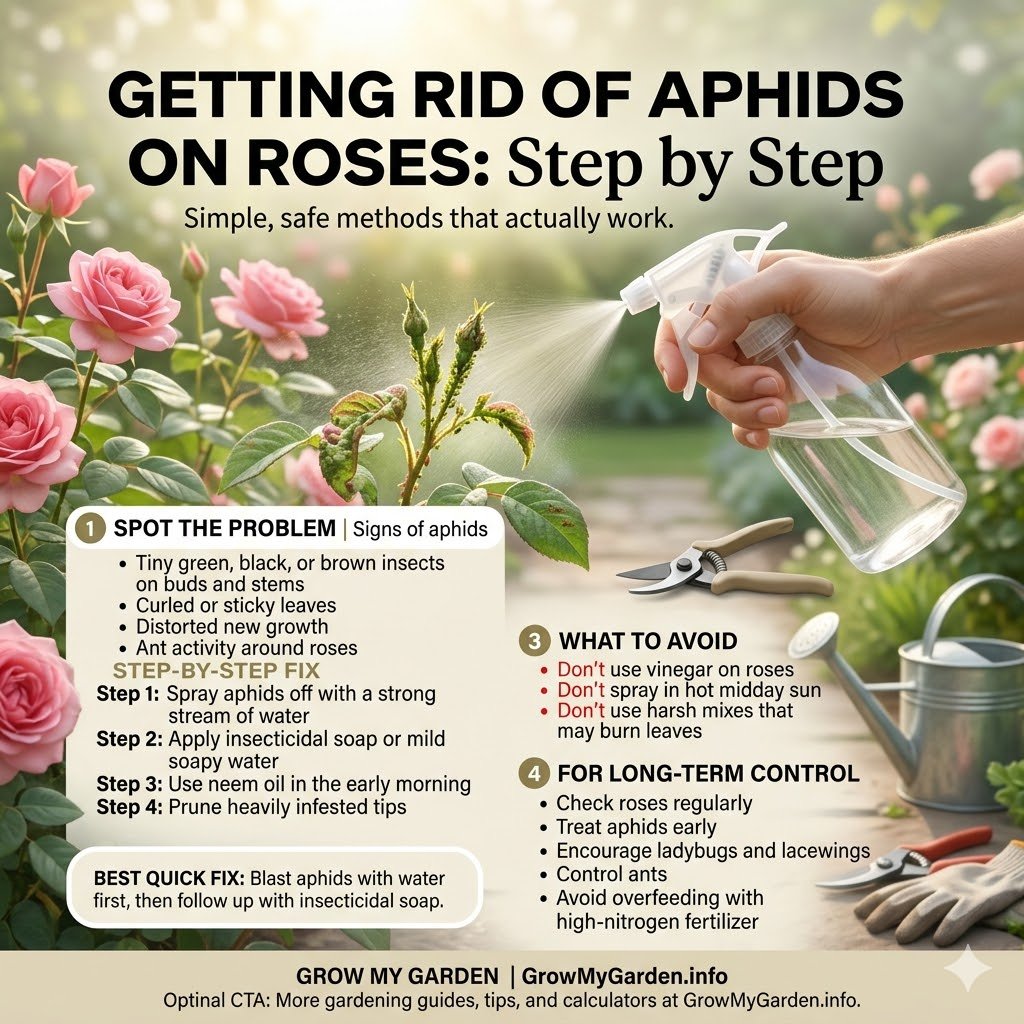
Getting Rid of Aphids on Roses: Step by Step
Step 1: Start With the Simplest Method — Water
Before you buy or mix anything, try a strong stream of water from your garden hose. This works remarkably well for mild to moderate infestations on rose bushes that are well established. Use a hose-end sprayer attachment and direct a firm but not violent stream at the undersides of leaves, around the flower buds, and along the stems.
The key is to knock the aphids off without shredding your petals or stripping off new growth. A moderately strong stream does the job. Spray in the morning so the foliage can dry out before evening — wet leaves overnight encourages fungal disease, and the last thing you need is to solve an aphid problem while starting a black spot problem.
You will likely need to repeat this for several days in a row. Aphids that fall to the ground become much easier prey for ground-level predators, so this approach works on two levels at once.
💧 Consistent watering also plays a role in keeping roses pest-resilient. Plants under water stress are softer targets for aphid colonies. Our free Watering Schedule Tool calculates exactly how much water your garden needs each week based on your setup. 👉 Try the Watering Schedule Tool free
Step 2: Hand Removal for Small Infestations
Pull on a pair of garden gloves and simply wipe or squish aphid clusters by hand. I know that sounds deeply unglamorous, but it is genuinely effective when you catch an infestation early. A damp paper towel or a soft cloth works even better — you can wipe entire clusters off stems in one swipe.
Check the undersides of leaves carefully. Aphids love to hide there where they are out of sight and partially sheltered from rain.
Step 3: Mix Up a Soapy Water Spray
This is the workhorse home remedy that actually holds up under real garden conditions. Mix one tablespoon of mild liquid soap — something like Ivory dish soap, not a heavy grease-cutting detergent — into one quart of water. Pour it into a spray bottle and apply it directly to the aphid colonies.
The soap works by breaking down the waxy coating on the aphids’ soft bodies, causing them to dry out and die on contact. The important thing is that the spray actually touches the insects — it does not work as a barrier or a deterrent, only as a direct hit.
Repeat every five to seven days for two to three applications. One round rarely clears a well-established colony.
Step 4: Bring In Neem Oil
Neem oil is probably the most versatile organic pest control option available to American home gardeners right now, and it has genuinely earned its reputation. It is pressed from the seeds of the neem tree, and it works on aphids by disrupting their feeding behavior and interfering with reproduction.
Mix neem oil according to the product label — most concentrates call for about two tablespoons per gallon of water with a few drops of liquid soap added as an emulsifier. Shake well and apply with a sprayer, making sure to coat the undersides of leaves where aphid colonies tend to concentrate.
Apply in the early morning or evening rather than during peak sun hours. Neem oil applied in bright midday sun can cause leaf burn, especially on rose foliage. It is also worth noting that neem oil is broadly safe for pollinators when applied at the right time — bees are not active in the very early morning or after dusk.
Beyond aphids, neem oil also helps keep spider mites, mealybugs, and scale insects in check, so you are essentially doing preventive work on multiple fronts with one product.
Step 5: Address the Ant Problem
If ants are present — and they usually are when aphid populations get large — they need to be handled separately. Ants actively guard aphid colonies from predators like ladybugs, and no amount of spraying will hold aphid populations down long-term if ants keep running interference.
Place ant bait stations at the base of affected rose bushes. You can also wrap the lower canes with sticky tape barriers designed to prevent ants from climbing. Products like Tanglefoot work well for this. Once the ants lose access to the honeydew supply, they move on, and beneficial insects can do their job unobstructed.
Recruiting the Good Guys: Natural Predators
One of the most satisfying long-term strategies is building a garden ecosystem that keeps aphid populations naturally in check. Ladybugs — technically ladybird beetles from the family Coccinellidae — are the rock stars of aphid control. A single adult ladybug can consume up to 50 aphids a day. Their larvae are even more voracious, eating up to 250 aphids a day despite being a fraction of the size.
Green lacewings are equally impressive. Their larvae are nicknamed “aphid lions” for a reason. Parasitic wasps are another important player — they lay their eggs inside aphid bodies, and the hatching larvae take care of the rest.
To attract these beneficial insects, plant nectar-rich flowers near your rose garden. Dill, fennel, sweet alyssum, and yarrow are particularly good at drawing in lacewings and parasitic wasps. Avoid spraying broad-spectrum chemical pesticides anywhere in the vicinity — they wipe out natural predators indiscriminately and tend to make aphid problems worse in the long run by removing the biological checks that keep populations in balance.
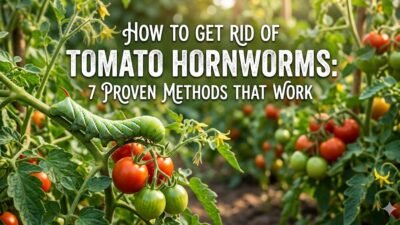
If you grow tomatoes alongside your roses, you may already be fighting a two-front battle. Natural predator strategies work across your whole garden — check out how we tackle How to Get Rid of Tomato Hornworms: 7 Proven Methods That Work using the same principles.
Companion Planting That Genuinely Repels Aphids
Companion planting is one of those strategies that sounds a little too simple to work, but over two seasons of experimenting, I have seen real results from planting the right neighbors near my rose beds.
Marigolds are the most reliable. Plant them around the edges of your rose garden and keep them well watered. Catnip is another strong aphid deterrent — though fair warning, if you have cats, you may be trading one garden visitor problem for another. Garlic and chives planted between rose bushes emit compounds that aphids find deeply unappealing. Lavender and geranium both serve double duty as aphid deterrents while looking beautiful alongside rose plantings.
🌿 Ready to add companion plants around your rose beds? Figuring out spacing for marigolds, garlic, or chives alongside your roses is easier with a little math behind you. Use our free Plant Spacing Calculator to plan exactly how many companion plants fit in your garden bed. 👉 Try the Plant Spacing Calculator free
The Fertilizer Connection Nobody Talks About
One thing that made a significant difference in my garden was switching to slow-release, urea-based nitrogen fertilizers instead of fast-acting liquid feeds. Aphids are heavy nitrogen feeders, and a big surge of nitrogen in the plant after a liquid feeding essentially sends out a dinner invitation to every aphid in the neighborhood. Roses that receive steady, measured nitrogen through slow-release fertilizers maintain healthy growth without the soft, nitrogen-saturated new shoots that aphids find irresistible.
💡 Not sure how much fertilizer your roses actually need? Getting the amount right is half the battle. Too much nitrogen is one of the biggest reasons aphid infestations keep coming back season after season. Use our free Fertilizer Calculator to figure out exactly how much your bed size needs — no guesswork involved. 👉 Try the Fertilizer Calculator free
Fertilizer imbalances do not just invite aphids — they cause a chain of problems across your whole garden. If you grow tomatoes, the same feeding mistakes show up as Blossom End Rot on Tomatoes, and the fix starts in exactly the same place.
When to Use Chemical Options (and Which Ones)
Most of the time, the methods above are enough. But if you are dealing with a truly severe infestation that has not responded to organic methods after two weeks of consistent treatment, targeted chemical options exist.
Spinosad is one of the gentler options, derived from a naturally occurring soil bacteria and less disruptive to beneficial insect populations than broad-spectrum choices. Pyrethrin sprays, made from chrysanthemum flowers, are another step up that remain relatively short-lived in the environment. Pyrethroids are synthetic versions that last longer and pack more punch, but they will also take out beneficial insects in the treated area.
Systemic insecticides should be used with real caution around roses since pollinators visit flowers regularly. If you do use them, apply only during dormancy or well before blooming begins, and never during active flowering.
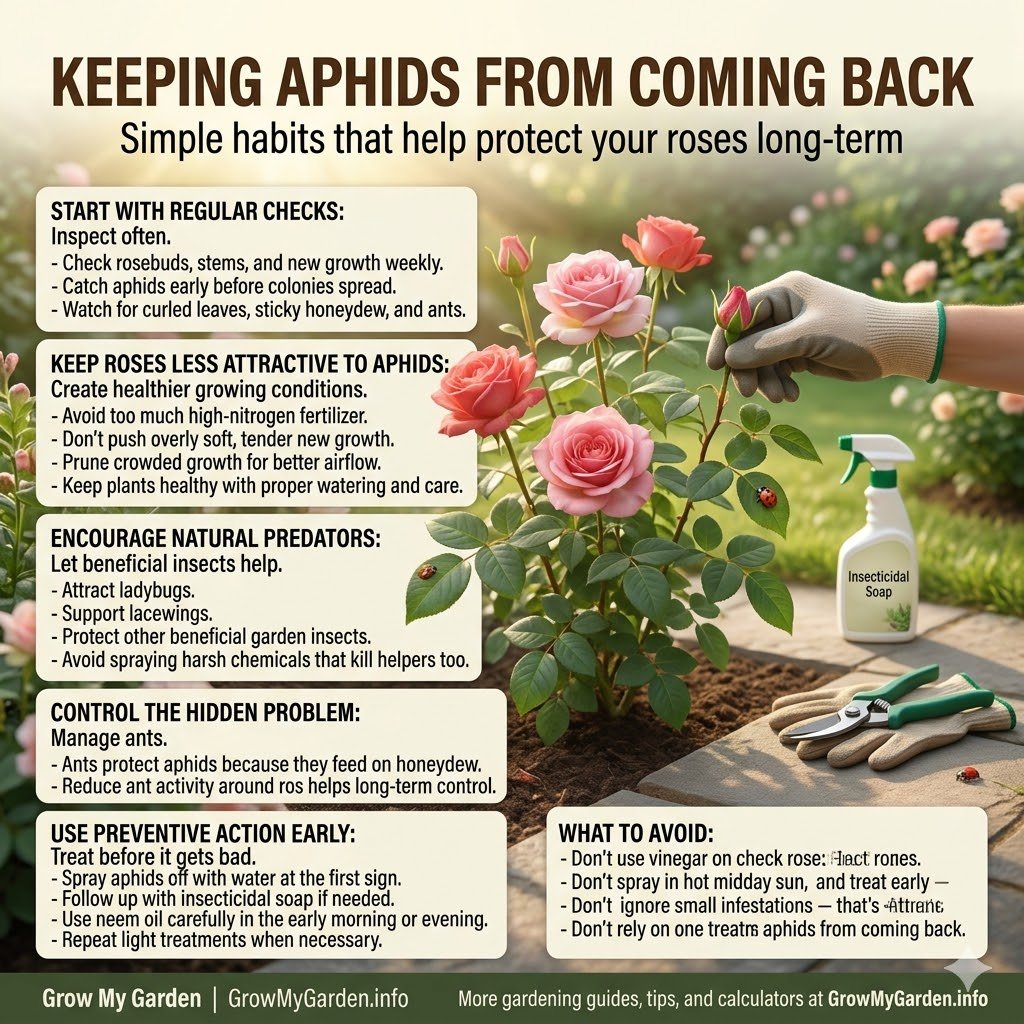
Keeping Aphids From Coming Back
Once you have cleared an infestation, the goal shifts to making your rose garden inhospitable to future aphid colonies. A few habits that have served my garden well:
Walk through your rose beds every week during the growing season. Early detection is genuinely the most powerful tool you have. Catching a cluster of twenty aphids takes thirty seconds to deal with. Catching twenty thousand takes two weeks.
Clean up fallen leaves and debris around the base of rose bushes at the end of the season. Aphids overwinter as eggs tucked into plant matter and mulch, and removing that material disrupts their lifecycle before it starts.
Do not over-fertilize. Use a soil test — the university extension services in most US states offer them affordably — to understand exactly what your roses actually need rather than guessing with heavy nitrogen applications.
Frequently Asked Questions
1. Does soapy water kill aphids on roses?
Yes, mild soapy water can kill aphids by breaking down their outer coating. Use carefully: too much soap can burn rose leaves.
2. Will vinegar kill aphids on roses?
Yes, but don’t use it. Vinegar can damage or burn rose leaves and flowers.
3. What is the fastest way to get rid of aphids?
Spray them off with a strong stream of water, then apply insecticidal soap or neem oil.
4. What is the best rose spray for aphids?
Insecticidal soap is usually the safest and best option for roses. Neem oil also works well.
5. How to get rid of aphids on roses permanently?
You can’t remove them forever, but you can control them by checking roses often, spraying early, removing infested tips, attracting ladybugs, and avoiding too much nitrogen fertilizer.
A Final Thought From the Garden
Aphids are not a sign that you are a bad gardener. They are opportunists. They show up whether you are a master rosarian with thirty years of experience or someone who just planted their first rose bush last spring. The difference between a gardener who loses a season to aphids and one who barely notices them is usually just awareness and a willingness to act early.
Your roses want to thrive. They are remarkably resilient once the pressure of a major aphid infestation is lifted. Get ahead of the problem this spring, build some beneficial insect habitat in your yard, and those blooms you have been working toward will have a real chance to show you what they are capable of.



Leave a Comment