
How to Harvest Cilantro Without Killing the Plant
The first time I harvested cilantro, I yanked out a whole handful and watched the poor plant collapse within a couple of days. After years of growing herbs on my balcony and later in raised beds, I finally cracked the code. The secret is treating cilantro like a cut and come again crop instead of a one time grab.
When you snip only the outer stems and protect the crown at the center, the plant keeps pushing out fresh leaves for weeks. Stick to the one third rule, harvest before bolting sets in, and a single packet of seeds can feed your kitchen for the better part of a season.
After more than a decade of growing herbs, first on a cramped balcony and later in raised beds, I have picked this plant more times than I can count. Somewhere along the way I worked out what I now think of as harvesting cilantro the right way, which really comes down to picking it without killing it and learning how to cut cilantro so it keeps growing. Get the method right and you can cut cilantro so it grows back round after round. Here is everything I wish someone had told me at the start. Read our Herb Gardening guide.
First, know what you are dealing with
Cilantro and coriander are the same plant, Coriandrum sativum, just caught at different stages of life. Some folks call it Chinese parsley, and it sits in the same botanical family as carrots and parsley, the Apiaceae clan. The soft green leaves are what most of us mean by cilantro. The dried seeds that come later are coriander. This matters more than it sounds, because the way the plant grows shapes the way you should pick it.
It is a fast growing, leafy annual herb that adores cool weather, which makes it a classic cool season herb in most gardens. It moves through life in fairly clear stages: it sprouts as a seedling, fills out into bushy vegetative growth, then bolts, flowers, and finally sets seed. It also has a single slender taproot that hates being disturbed, so it is hard to transplant and tends to sulk if you try to move it. On top of that it is sensitive to heat and to the lengthening days of late spring, what gardeners call its photoperiod. The upside is that you almost never need to move it. You just need to harvest it with a bit of sense.
When is cilantro ready to pick?
I wait until the plant stands about six inches tall, with several healthy stems fanning out from the middle. By then it has enough leafy growth to share without missing it. If you start snipping while it is still a tiny seedling, you are basically asking a toddler to run a marathon.
As for how often to harvest cilantro, I take a little every week or so once a plant is established, which keeps fresh leaves coming and the plant tidy. The time of day counts too. I do my picking in the morning, once the dew has dried but before the sun gets bossy. The leaves are crisp and full of water then, so they taste brighter and hold up far longer in the fridge. Harvest at noon, when the plant is wilting in the heat, and you tend to get limp, sad greens that flop the moment they hit the cutting board.
The tools I reach for
You do not need anything fancy for this. For years I just used a clean pair of sharp scissors and they did the job fine. These days I keep a small pair of herb snips by the back door, and for bushier plants I grab my Fiskars pruning shears. The only real rule is that the blades must be sharp and clean.
A clean cut heals fast and keeps disease out. A dull blade crushes the stem instead of slicing it, leaving a bruised, ragged wound that invites rot. If I have been trimming something diseased earlier in the day, I wipe the blades with rubbing alcohol before going anywhere near my cilantro. Think of it the way a careful cook rinses the knife between ingredients.
The one rule that saved my plants: take a third, leave the rest
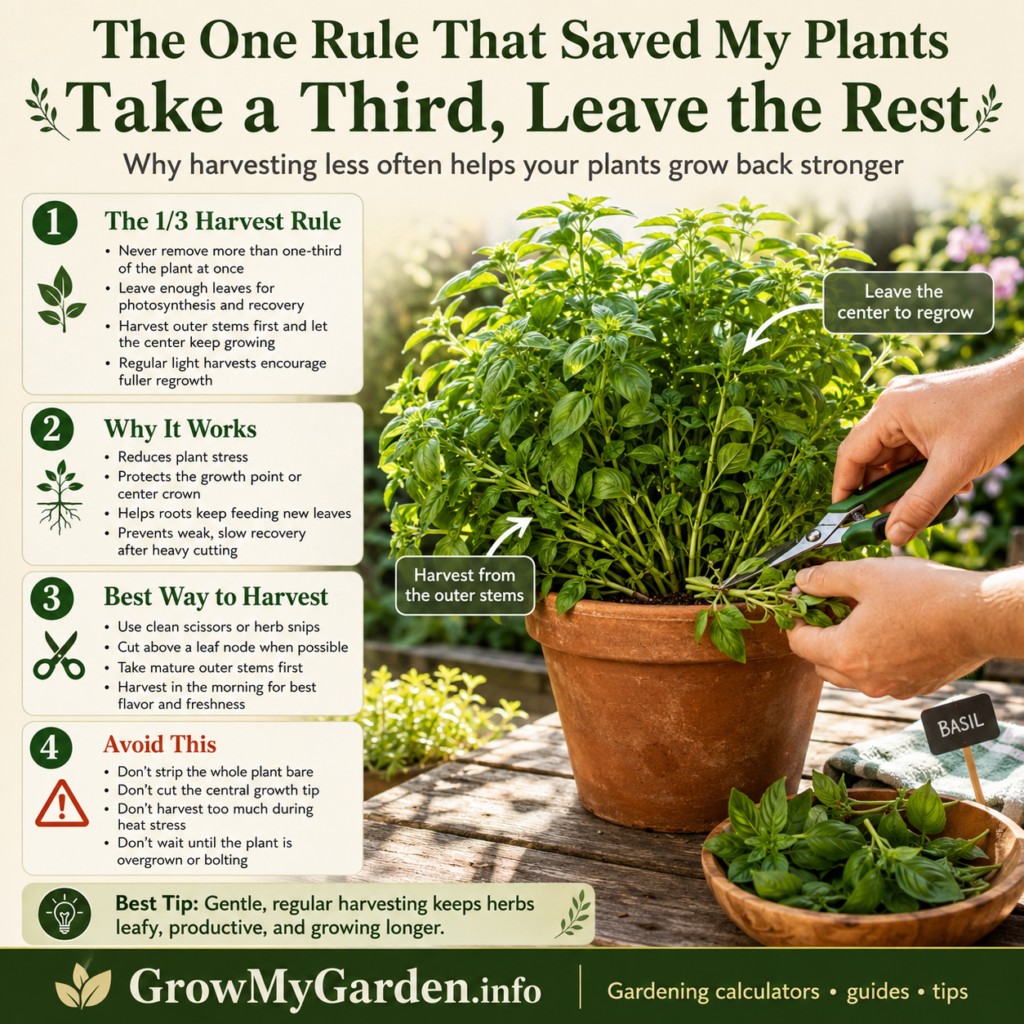
If you forget everything else on this page, hold onto this. Never cut more than about a third of the plant in one sitting. People call it the one third rule, and it is the single habit that keeps a plant alive. This rule holds for most leafy herbs. If you grow basil alongside your cilantro, the same one-third approach applies — here’s how it works for basil.
Cilantro banks its energy in its leaves, so stripping it bare is like draining its savings account. With most of its foliage gone, it has nothing left to fuel new growth, and that is the moment plants quit on you.
Leave at least two thirds standing and the plant bounces back within a week or two. I can eyeball this now, but when I was starting out I literally counted stems. Nine stems on the plant meant I took three. That bit of grade school math kept my cilantro alive through some clumsy early seasons.
Where to cut so it keeps growing
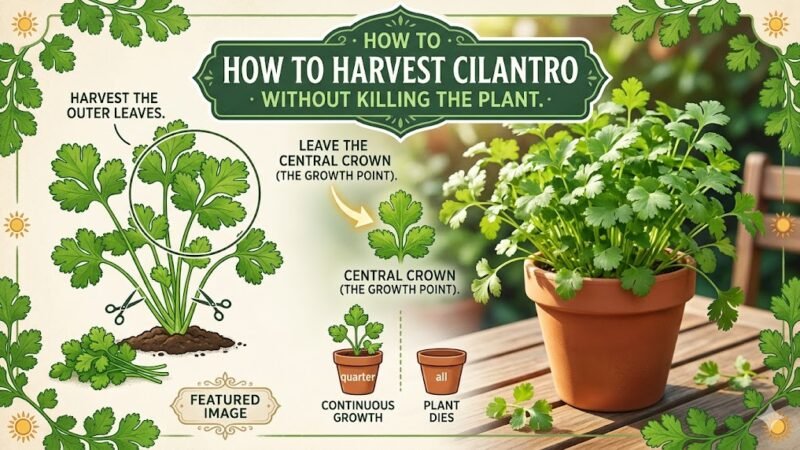
This is the part most beginners get wrong, and I was no exception. The trick is to harvest the outer leaves first and leave the heart of the plant alone.
Cilantro grows from a central point near the soil, often called the crown or the growing point. The newest, tiniest leaves push up from the middle on short inner stems, while the older, larger leaves ride on the outermost stems. When you take those outer stems and protect the inner stems and the central stem at the core, the plant keeps cranking out fresh leaves from the middle. Cut into that center and you have wounded the engine room. So work from the outside in, a little like peeling layers off an onion, only far gentler.
Step by step: how I harvest cilantro
Here is the exact routine I run through every time.
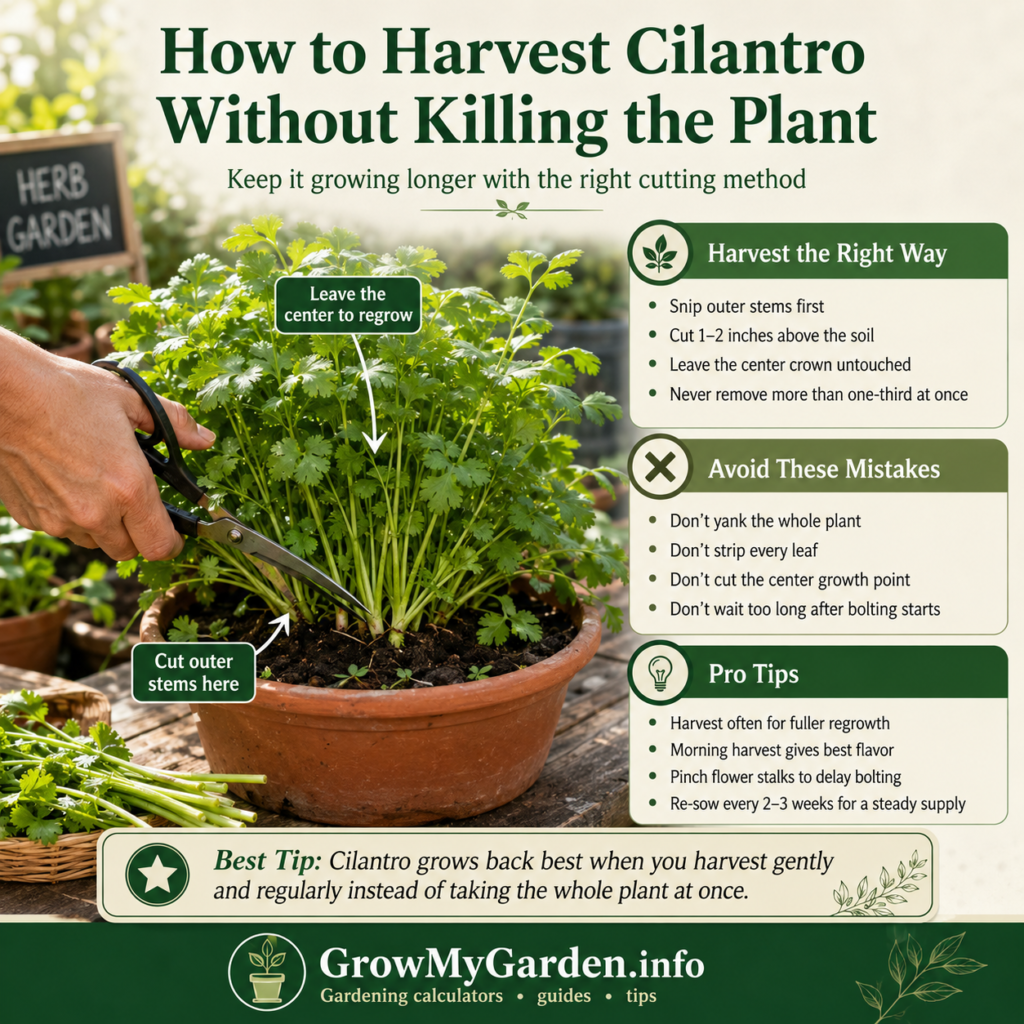
- Look the plant over and pick out the tallest outer stems. These are the oldest and the most ready to go.
- Follow each stem down to about half an inch above the soil, near the stem base. Resist the urge to pinch off only the leafy tips, because the bare stubs you leave behind rarely regrow and just look messy.
- Make one clean snip at the base. Cutting low coaxes a fresh flush of stems instead of weak, leggy growth.
- Move around the plant and repeat, always choosing the outer stems and skipping the small leaves in the center.
- Stop once you have taken roughly a third. Step back, admire your self control, and walk away.
That last step is tougher than it sounds when the plant looks lush and your inner cook wants the whole thing.
Will cilantro grow back after cutting?
It will, and this is where the plant earns its keep. When you cut it properly, low at the base and only a portion at a time, it behaves like a true cut and come again crop. Fresh new growth pushes up from the crown, and within a couple of weeks you have another round ready to pick.
I usually get several harvests of regrowth from a single plant before it decides its run is over. Curious what that actually weighs out to? The Harvest Yield Estimator gives you a rough picture by crop. Regular trimming even nudges it toward bushier growth, since pinching tells the plant to branch out sideways rather than shoot straight up in one leggy stalk. A plant I pinch and pick often looks noticeably fuller than one I leave to its own devices.
The bolting problem nobody warns you about
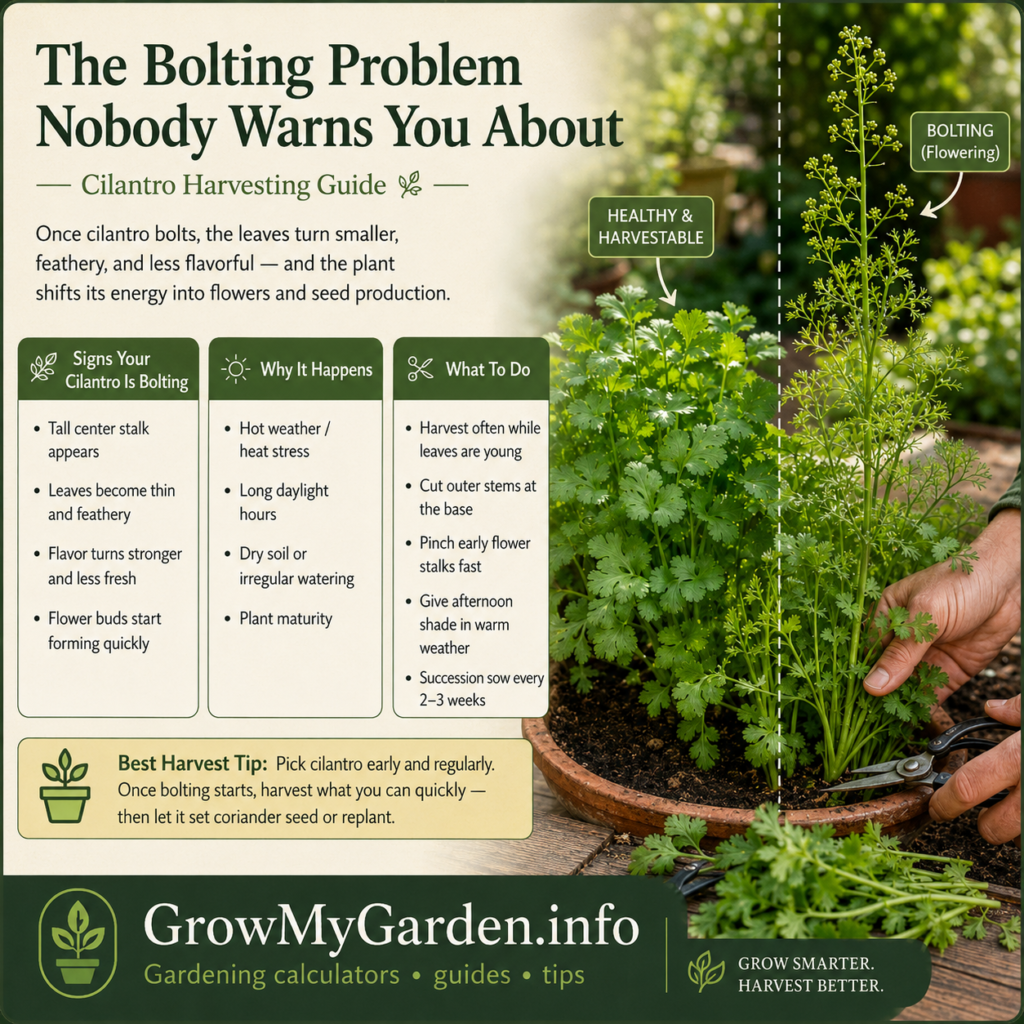
Here is the plot twist with cilantro. It is racing against a clock you cannot see. Once the weather warms or the days stretch longer, the plant flips a switch and sends up a tall flower stalk. This is called bolting, and once it kicks off, the leaf party is more or less over.
A bolting plant stops making those soft, flavorful leaves and pours everything into seeds instead. First you notice small flower buds forming at the tips, then the plant is well and truly going to seed. The leaves that remain turn thin and feathery, almost like dill, and pick up a slightly bitter, soapy edge. You can usually see it coming when the center shoots upward and the new growth gets wispy.
You cannot stop a plant from bolting completely, because it is baked into its nature, but you can slow the clock down:
- Keep the soil evenly moist. Drought stress is one of the fastest ways to trigger bolting. If you’re not sure how much water that actually means week to week, the Watering Schedule Tool works it out for your setup.
- Offer a little afternoon shade once the heat rolls in. I drape a light shade cloth over my bed in late spring.
- Harvest often. Steady cutting keeps the plant in leaf making mode a touch longer.
- Sow in the cool windows. Depending on your USDA hardiness zone, that usually means early spring and again in fall, rather than the dead heat of summer.
Not sure when to sow in your area? Use the Planting Date Calculator to find your exact cool-season window.
If you want extra insurance, plant a variety bred to be bolt resistant. Santo, Calypso, and Leisure are three slow to bolt types I have grown that hold out longer than the generic seed off the rack.
Should you harvest cilantro before or after flowering?
For the best leaves, pick before flowering, while the plant is still in that lush vegetative stage. That is when the flavor is fullest and the texture stays soft. Once it flowers, the leaves thin out and turn sharp, so at that point you are no longer really chasing leaves. You are after what comes next.
Do not rip that bolted plant out just yet, because this is where it hands you a parting gift. Let the flowers open and the bees will throw you a thank you party, since cilantro blooms are a magnet for pollinators in my garden. Once the flowers fade, small green seed pods form, and those pods are coriander.
Leave them on the plant until they turn brown and dry, then snip the seed heads into a paper bag and give it a good shake to free the seeds. Just like that, you have grown your own coriander spice from a plant you thought was finished. I crush mine into curries and the flavor leaves the supermarket jars in the dust. Tuck a few seeds away and you have next season’s crop for free.
Keeping cilantro on your plate all season
Because each plant has a short run before it bolts, a single sowing will not carry you through the year. The fix is succession planting, which is just a tidy name for sow a little, sow often. String enough of those small sowings together and you land something close to a continuous harvest.
I scatter a fresh pinch of seeds every two or three weeks through the cool months. Wondering how many packets that actually adds up to? The Seed Quantity Calculator gives you a precise number based on your bed size. By the time one batch starts to bolt, the next is already coming up behind it, so the kitchen never runs dry.
This successive harvest is how a short lived herb keeps earning its spot in the garden. I set a recurring reminder on my phone so I do not forget, and a plant care app like Planta or even a plain note in your garden journal works just as well for the nudge. It sounds fussy, but the whole thing takes thirty seconds and spares you those bleak stretches with no fresh cilantro in the house.
A quick word on pots versus garden beds
I have grown this herb both ways, and the harvesting rules barely budge. In a pot or container, just make sure it is at least eight inches deep so that taproot has somewhere to stretch. Potted plants dry out faster, so they can bolt sooner if watering slips your mind. In a garden bed the roots have more room and a bit of a buffer against heat, so those plants often last a little longer. Either way, you still take the outer leaves, cut at the base, and leave the center to keep doing its thing.
Planning how many plants to fit in your space? The Plant Spacing Calculator handles that for any bed or container size.
After you pick: storing and preserving fresh cilantro
Freshly cut cilantro wilts in a hurry, so I treat a bunch like a tiny bouquet. I trim the stem ends, stand it in a glass with an inch of water, loosely tent a bag over the top, and slide it into the fridge. It stays perky for a week or more that way. For the long haul, preserving fresh cilantro is easy: chop it, pack it into ice cube trays with a splash of water or olive oil, and freeze it. Those little green cubes drop straight into soups and sauces months down the line.
Cilantro stops being a difficult plant the moment you quit treating it like a one shot salad grab. Pick the outer leaves, cut low, never take more than a third, and always keep a fresh batch coming up behind the last. Do that, and a single packet of seeds can keep your kitchen in fresh leaves and homegrown coriander for the better part of a year. The plant is happy to keep giving. It just wants a gardener with a little patience and a sharp pair of scissors.
Frequently Asked Questions
How do you harvest cilantro so that it keeps growing? Cut the outer stems first and leave the central crown untouched. Snip low, about half an inch above the soil, and never take more than a third of the plant at once. That protected center keeps pushing out fresh leaves.
Will cilantro regrow if you cut it back? Yes. As long as you leave the crown and most of the foliage intact, new growth rises from the center within a week or two. It behaves like a true cut and come again herb.
Does cilantro help with arthritis? Cilantro contains antioxidants and plant compounds that may help calm inflammation, so it fits nicely into a healthy diet. Still, firm evidence that it eases arthritis in people is limited, so think of it as a flavorful addition rather than a treatment. Check with your doctor for any ongoing joint pain.
How to pick cilantro leaves without killing the plant? Take the older outer leaves and leave the small inner ones near the crown. Use sharp scissors for a clean cut, work from the outside in, and stop once you have removed roughly a third. Avoid yanking the whole plant out by the stem.
Can cilantro be harvested multiple times? Yes, several times over. Pick a portion every week or so and the plant keeps regrowing until it bolts. Sowing a fresh batch every couple of weeks, known as succession planting, keeps cilantro on your plate all season.




Leave a Comment