

When to Plant Bulbs in Fall: A Real Gardener’s Guide to Getting the Timing Right
Every fall, thousands of gardeners miss their window — and spend all spring wondering why nothing bloomed. Knowing when to plant bulbs in fall is not guesswork. It comes down to one thing: soil temperature dropping below 60°F. That is when your tulips, daffodils, and hyacinths are ready to go into the ground. Plant them too early and warm soil triggers premature sprouting. Wait too long and the ground freezes before roots can establish. Whether you are in a cold northern zone or a warm southern state, this guide covers the exact fall bulb planting window for your region, so your garden explodes with color come spring blooming season.
I learned this the expensive way. My first fall in a Pennsylvania garden, I dumped forty dollars worth of premium tulip and daffodil bulbs into the ground in late August because I was excited and impatient. By October, green shoots were already poking through the mulch. By January, they were dead. The bulbs had no idea a winter was coming because the soil never told them one was.
That one mistake taught me more about bulb biology than any gardening book ever did. So let me save you that forty dollars and a season of frustration. Read complete Flower Gardening guide.
Why Fall Is the Only Right Time for Spring-Blooming Bulbs
Spring-blooming bulbs — your tulips, daffodils, hyacinths, crocus, alliums, and snowdrops — belong to a fascinating plant group called herbaceous geophytes. These plants evolved over thousands of years to survive harsh winters by retreating underground, storing every bit of energy they need inside a compact bulb. That bulb is essentially a self-contained meal kit, just waiting for the right environmental signal to start cooking.
That signal is cold. Specifically, a sustained period of soil temperatures between 40 and 50 degrees Fahrenheit for anywhere from 8 to 16 weeks, depending on the variety. Horticulturists call this vernalization, though most of us just call it winter. Without it, the flower bud inside the bulb never properly forms. You can have the most perfect planting spot in the world, but if the bulb skips its cold stratification period, it will not bloom. Period.
This is also why fall planting is not just a tradition or a gardening convention. It is the entire biological mechanism that makes spring flowers possible.
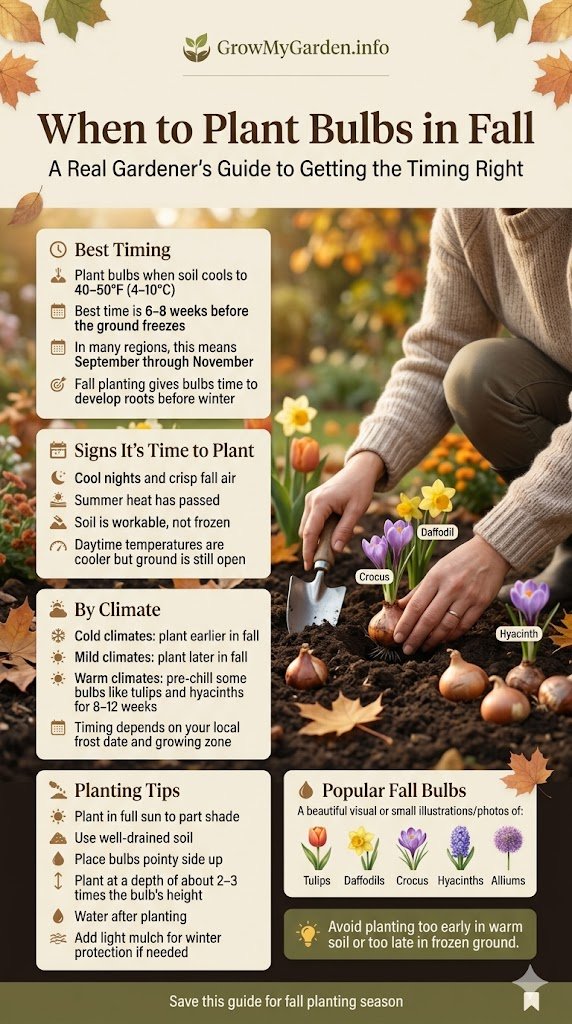
The Golden Rule: Watch Soil Temperature, Not the Calendar
Most gardening articles tell you to plant your bulbs in October, and while that is a reasonable starting point, it is also slightly lazy advice. The real trigger is soil temperature.
You want to get your bulbs in the ground when the soil temperature has dropped consistently below 60 degrees Fahrenheit, measured at a depth of about 6 inches. At that temperature, the bulb can begin growing roots without being tricked into sending up premature shoots. The roots need several weeks to establish before the ground actually freezes solid, because that root system is what feeds the bloom next spring.
A basic soil thermometer, available at any garden center or on Amazon for under fifteen dollars, takes all the guesswork out of this. You can also use the Old Farmer’s Almanac app or Weather Underground, both of which track real-time soil temperatures in your area. Once the reading drops below 60 and stays there, that is your green light.
Not sure about your local frost date? Use our planting date calculator for your climate zone to find your exact fall bulb planting window in under 30 seconds.
As a general rule across the United States, that sweet spot lands somewhere between mid-September and early December, depending on where you live.
Planting Windows by USDA Hardiness Zone
This is where the rubber meets the road, because the fall planting window in Minnesota looks nothing like the one in Georgia.
Zones 3 and 4 (Upper Midwest, Northern New England, Northern Plains)
If you garden in Minneapolis, Fargo, or the Green Mountains of Vermont, your window is short and unforgiving. Aim to get your bulbs in the ground by early to mid-October at the latest. The soil freezes fast here, sometimes by late October, and bulbs need at least two to three weeks of root-growing time before that happens. Daffodils are especially eager in this zone and often start developing roots before you even plant them, so do not wait on those.
Zones 5 and 6 (Mid-Atlantic, Midwest, Pacific Northwest)
This is the sweet spot for bulb growing. Gardeners in Chicago, Philadelphia, Portland, and Columbus have a generous window from mid-October through mid-November. Soil temperatures cooperate, winters are reliably cold, and most bulbs thrive without any extra coaxing. If you are in zone 5 or 6, you can even push tulip planting to Halloween or just after. A late planting actually reduces squirrel pressure, because fewer furry thieves are active once temperatures really drop.
Zones 7 and 8 (Upper South, Pacific Coast)
Places like Nashville, Charlotte, Northern California, and coastal Pacific Northwest present an interesting challenge. Winters are cold enough to satisfy most bulbs without help, but the window shifts later, typically from late October through late November. Soil temperatures do not cooperate until November in many of these areas. Daffodils, alliums, and crocus perform especially well here without any additional preparation.
Zones 9 and 10 (Deep South, Southern California, South Florida)
This is where bulb gardening gets creative. Winters are simply not cold enough for most spring-blooming bulbs to complete their required dormancy period naturally. Tulips, hyacinths, and some crocus varieties need 6 to 10 weeks of artificial pre-chilling in the refrigerator before planting. Gardeners in Houston, Los Angeles, and Miami typically buy bulbs in early fall, chill them in the vegetable drawer of the fridge, and plant in December or even January.
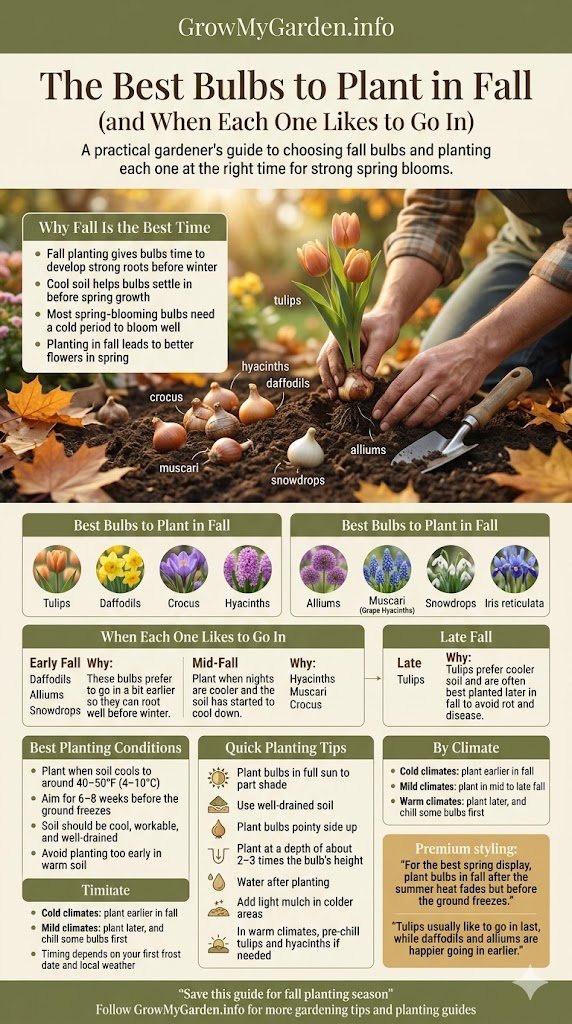
The Best Bulbs to Plant in Fall (and When Each One Likes to Go In)
Not all fall bulbs operate on the same schedule, and knowing the individual preferences of each type can make a real difference in your spring display.
Daffodils (Narcissus)
Plant these first, ahead of everything else. Daffodils are eager bulbs that often start forming roots before they are even in the ground. In zones 5 and above, September planting is not too early. They are also toxic to most wildlife, so squirrels and voles leave them completely alone, which makes them one of the most reliably returning perennials you can grow. A well-established daffodil clump will naturalize and multiply over years without you touching it again.
Tulips (Tulipa)
Tulips are the prima donnas of the bulb world, in the best possible way. They like to go in a little later than daffodils, typically from mid-October through November. In warmer zones, planting later also reduces the chance of fungal disease developing during a warm fall. In zone 7 and warmer, many tulip varieties behave more like annuals and may not reliably perennialize, so be prepared to replant each fall for the best show.
Hyacinths (Hyacinthus)
These fragrant spring favorites are planted at roughly the same time as tulips. They bloom in mid-spring and fill a garden with a perfume that is genuinely intoxicating. Choose large, firm bulbs, as the size of the bulb directly determines the size and density of the flower spike. Plant them 6 inches deep and 6 inches apart. Their intact outer tunics, the papery skin surrounding the bulb, help shield them from pests and disease, so avoid bulbs with damaged or missing skins.
Crocus
Crocus are among the earliest spring bloomers, often poking through snow in late February in colder zones. They are corms rather than true bulbs, and planted in fall at a relatively shallow depth of 3 to 4 inches. Because they are small, they look best in clusters of 10 or more. They are also a wonderful choice for naturalizing in lawns, where they create a carpet-like effect before the grass really wakes up for the season.
Alliums
Ornamental onions are having a major moment in American gardens right now, and for good reason. Their dramatic spherical flower heads in late spring draw pollinators like nothing else and look stunning in cutting gardens. Plant allium bulbs in fall at a depth of about three times their diameter. They prefer loose, slightly sandy soil and full sun. Unlike tulips, most alliums are reliably perennial and come back stronger each year.
Snowdrops (Galanthus)
If you want something blooming in your garden while there is still frost on the ground, snowdrops are your answer. These tiny, elegant white flowers are among the first to emerge in late winter, often in January or February in zones 5 and 6. Plant them in fall at a depth of 3 to 4 inches, ideally in a spot with some afternoon shade. Snowdrops also make wonderful companion plants beneath deciduous trees and shrubs.
If you are already thinking about building out a layered garden bed this fall, pairing snowdrops with nearby rose shrubs creates a stunning late-winter to early-spring sequence. And if you want more roses without spending more money, our step-by-step guide on how to grow roses from cuttings in water is one of the easiest propagation methods you will ever try.
How to Plant Fall Bulbs: Step by Step
Step 1: Pick the Right Spot
All spring-blooming bulbs share one non-negotiable requirement: good drainage. A bulb sitting in waterlogged soil over winter will rot before it ever gets a chance to bloom. If your soil is heavy clay, raise the bed slightly or work in generous amounts of compost and coarse sand before planting.
Most fall bulbs prefer full sun, though planting under deciduous trees is a surprisingly smart strategy. The trees are bare in spring when the bulbs bloom, so the bulbs get full sun exactly when they need it. By the time the tree leafs out, the bulbs have already done their job and are heading back into dormancy.
Once your bulbs fade in late spring, that same sunny bed is the perfect spot to fill with summer color. Check out our guide to the best annuals for full sun to keep your garden going strong from June through frost.
Step 2: Test and Amend Your Soil
Bulbs thrive in a soil pH between 6.0 and 7.0. A simple soil test kit from your local cooperative extension office or a hardware store tells you where you stand. If the soil is too acidic, a light application of garden lime corrects it over the course of a season. Introducing organic matter like compost stimulates root development in heavy clay and improves moisture retention in sandy soils.
Step 3: Prepare the Planting Area
For a new bed, loosen the soil to a depth of at least 12 inches using a spade or garden fork. Work in a couple of inches of compost. If you are planting into an established bed, a narrow bulb auger attachment on a cordless drill is the most time-efficient tool you can own for fall planting. It cores a perfect hole in about 4 seconds and your back will thank you after the first 50 bulbs.
Step 4: Set the Depth and Orientation
The standard rule is to plant a bulb at a depth equal to two to three times its own height. A 2-inch tulip bulb goes in 4 to 6 inches deep. A 1-inch crocus corm goes in about 3 inches deep. Always place the bulb with the pointed end facing up. The growing side faces up and the rooting side faces down. If you truly cannot tell which end is the top, plant it sideways and the bulb will usually find its own way.
For spacing, large bulbs like tulips, hyacinths, daffodils, and alliums should be placed about 6 inches apart. Smaller bulbs like crocus and snowdrops can go as close as 3 to 4 inches apart for a full, lush effect. Planting in groupings of five or more creates far more visual impact than planting bulbs in single rows.
Planting a large bed with mixed varieties? Our plant spacing calculator tells you exactly how many bulbs fit in any bed size — no measuring tape math required.
Step 5: Fertilize and Water In
Work a slow-release, complete fertilizer into the planting hole or broadcast a granular bulb fertilizer over the entire bed. After planting, water the bed thoroughly to settle the soil around the bulbs and kick-start root development. The naturally moist fall soil does most of the watering work from here, since cooler temperatures mean far less evaporation after rain.
Not sure how much water your newly planted bulb bed needs each week? Our watering schedule tool calculates the right amount based on your bed size and local climate.
Step 6: Mulch the Bed
A 2 to 3 inch layer of shredded leaf mulch or wood chips over the planting area helps moderate soil temperature, prevent frost heave during freeze-thaw cycles, and retain moisture through the winter. Do not skip this step in zones 4 and colder. Frost heave, which happens when soil repeatedly freezes and thaws through winter, can literally push bulbs up and out of the ground, exposing them to lethal temperatures.
Pre-Chilling Bulbs for Warm Climates (Zones 8 to 10)
If you garden in the South or Southern California, this section is written specifically for you.
Most tulips, hyacinths, and some crocus varieties require 6 to 10 weeks of temperatures between 40 and 50 degrees Fahrenheit to complete the cold stratification they need to bloom. Since your winters do not provide that naturally, you have to do it artificially.
Purchase your bulbs in September or early October when selection is at its best. Place them in ventilated paper bags or mesh bags, labeled by variety. Put them in the bottom vegetable drawer of your refrigerator.
One critical point: keep bulbs completely away from any fruit, especially apples, pears, and tomatoes. These fruits release ethylene gas as they ripen, and ethylene exposure kills a bulb’s flower bud before you ever get it in the ground. Keep the fruit drawer and the bulb bags in completely separate sections of the refrigerator.
After 8 to 10 weeks of chilling, your bulbs are ready to plant. In most of the Deep South, that means planting from mid-December through January, when outdoor soil temperatures are finally low enough to support the bulbs. Some gardeners in Houston and Atlanta report beautiful results from tulips planted as late as January 15th.
Daffodils are the exception. Low-chilling varieties of Narcissus, paperwhite narcissus, and grape hyacinth thrive in warm climates with very little cold stratification and will perennialize beautifully in zones 8 and 9 without any refrigerator preparation.
A Real-World Case Study Worth Knowing
Longfield Gardens, a well-established Michigan-based bulb supplier that ships to tens of thousands of home gardeners across all 50 states every year, has tracked customer bloom success rates across growing zones for over a decade. Their data consistently shows that gardeners who plant daffodil bulbs in September in zones 5 and 6 see a 30 to 40 percent higher rate of strong first-year bloom compared to gardeners who wait until November. The reason is simple: daffodil roots begin developing within 24 to 48 hours of planting, and an extra 6 weeks of root-building time before the ground freezes produces a noticeably more vigorous plant in spring.
Their data also shows that customers who pre-chill tulips for at least 8 weeks before planting in warm climates see bloom rates approaching those of zone 5 and 6 gardens, even in Houston and Phoenix. Pre-chilling is not a workaround in those climates. It is the whole strategy.
How to Store Bulbs If You Cannot Plant Right Away
Life happens, and sometimes a bag of bulbs gets shoved in a corner and forgotten for a few weeks. Here is what to do.
Store bulbs in a cool, dark, dry location. A paper bag or a ventilated cardboard box works perfectly. Avoid sealed plastic bags, which trap moisture and create the warm, humid environment that mold and fungal growth love. Keep them away from heat sources and out of direct light, which can trigger premature sprouting. And never let your bulbs freeze during storage, since temperatures below 28 degrees will kill them outright.
Most spring-blooming bulbs handle short-term storage of 3 to 6 weeks quite well as long as conditions stay below 65 degrees Fahrenheit. Beyond that window, they start to desiccate and weaken.
If you receive bulbs by mail, inspect them immediately. Each bulb should feel heavy and solid in your hand. A firm, heavy bulb is a healthy bulb. Discard any that feel spongy, show mold, or have soft spots, because one rotting bulb in a planting hole can spread to its neighbors underground.
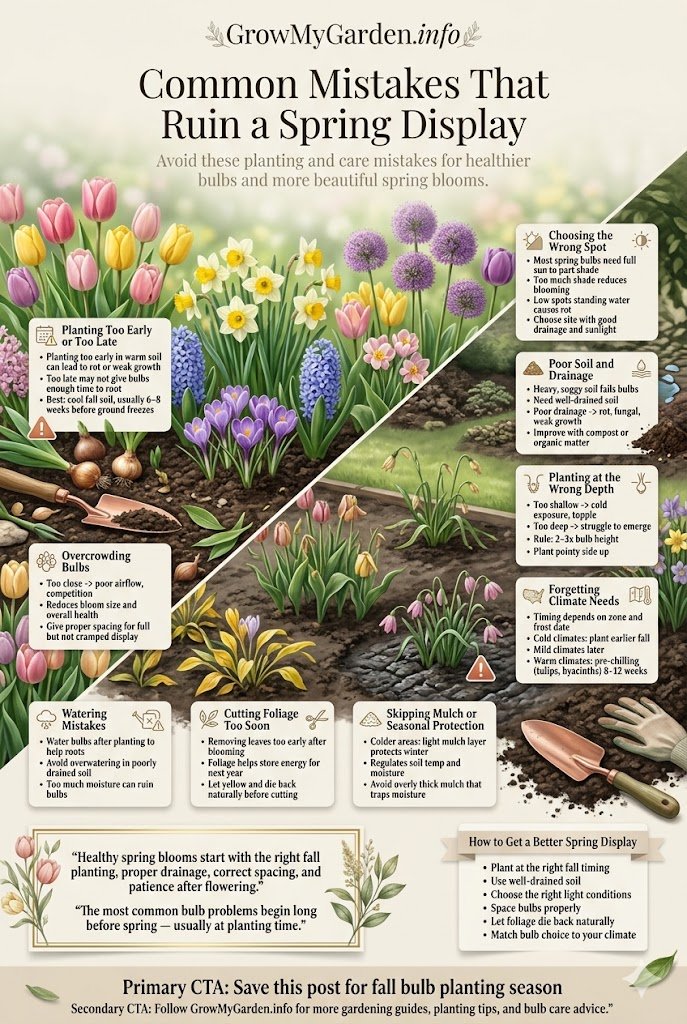
Common Mistakes That Ruin a Spring Display
Planting too shallow. This is the single most frequent reason bulbs fail to bloom. A tulip bulb sitting 2 inches underground has almost no insulation from temperature swings and is an easy target for squirrels and voles. Depth equals protection and stability.
Ignoring drainage. A beautifully prepared bed that sits in a low spot and collects water after rain is a bulb graveyard. Before planting, pour a bucket of water over the area and watch where it goes. If it pools and sits for more than an hour, solve the drainage problem first.
Planting everything at the same bloom time. Mix early bloomers like crocus and snowdrops with mid-spring tulips and late-spring alliums. A thoughtful combination of early, mid, and late-season bloomers keeps your garden in color from February through May without any additional work on your part.
Letting squirrels win. If your neighborhood has an aggressive squirrel population, plant daffodil bulbs around the perimeter of your tulip planting. Squirrels and voles find Narcissus toxic and generally steer clear of areas where it grows. Wire mesh cages buried around especially prized tulip plantings also work extremely well.
Overcrowding established beds. If a bed that used to bloom spectacularly has become sparse over several years, overcrowding is usually the answer. Lift, divide, and replant the clumps in early fall and the blooms will come roaring back.
Frequently Asked Questions
Is November too late to plant bulbs in most of the US?
In zones 5 through 7, November is still a completely viable planting window, especially for tulips. As long as the ground is not frozen solid and is still workable with a shovel, the bulbs can establish enough root mass to produce a bloom in spring. The closer you get to December, the more important it becomes to mulch heavily after planting.
Can you plant bulbs in December?
In zones 6 and 7, yes, if the ground is still soft enough to dig. Tulips are especially forgiving of late planting and sometimes even benefit from it in terms of reduced disease pressure. In zones 4 and 5, December planting is generally too late, as the ground is usually frozen by then.
Why did my bulbs come up but not bloom last spring?
The most common culprits are planting too shallow, too much shade after the foliage emerged, or overcrowded beds where nutrients have been depleted. If you have had bulbs in the ground for several years without dividing them, overcrowding may be quietly reducing bloom production year by year.
Do fall-planted bulbs come back every year?
Daffodils, crocus, alliums, and snowdrops are reliably perennial and will multiply and return each year with minimal care. Tulips are more variable. In zones 5 and 6, Darwin hybrid tulips are among the most reliably perennial varieties available. In warmer zones, most tulips perform best when treated as annuals and replanted each fall for a consistent show.
What is the best fertilizer for fall-planted bulbs?
A granular, slow-release fertilizer applied at planting time, combined with a top-dressing of compost, is the most effective approach. Look for a complete fertilizer with balanced nitrogen, phosphorus, and potassium. Avoid high-nitrogen fertilizers, which push leafy growth at the expense of the flower.
To avoid over or under-applying, use our fertilizer calculator — enter your bed dimensions and it tells you exactly how much product to use.
A Final Thought
Planting bulbs in fall is one of the few acts in gardening that requires genuine faith. You are doing something today for a payoff that will not arrive for five or six months, through the bleakest and coldest stretch of the year. There is something almost stubbornly optimistic about kneeling in October mud and tucking little brown bulbs into the earth while the leaves fall around you.
But that optimism is well earned. When those daffodil spears push through a late-March snow and open into soft yellow cups in the first warm sunlight of spring, every bit of effort from the previous October feels like one of the smartest investments you ever made. Get the timing right, respect the biology, match your bulbs to your zone, and the garden will reward you in ways that never get old.
Now go dig some holes before the frost does it for you.




Leave a Comment