

How to Deadhead Roses Properly (And Why Most Gardeners Get It Wrong)
Deadheading roses is one of the easiest ways to keep your plants looking fresh, healthy, and full of new blooms. When you remove faded flowers at the right time, the rose bush stops wasting energy on old petals and starts focusing on producing more buds.
Whether you grow hybrid teas, floribundas, climbing roses, or shrub roses, learning the proper cutting point makes a big difference. With clean pruners and a few simple steps, you can improve rose blooming, support healthy growth, prevent disease, encourage repeat flowering, and keep your rose garden neat all season. This guide will show you how to deadhead roses properly.
Deadheading. It sounds like something out of a horror movie, but it is one of the simplest, most rewarding habits you can build as a rose gardener. Done right, it keeps your plants pumping out blooms from early summer clear through fall. Done wrong — or skipped entirely — and your roses quietly give up on you. Read our Flower Gardening guide.
This guide is everything I wish someone had told me on day one.
What Deadheading Actually Means
Deadheading is the practice of removing spent blooms from your rose bushes before the plant has a chance to form rose hips and set seed. That last part is the whole point. When a rose flower fades, the plant’s energy shifts toward seed production. It starts developing those little round seed pods at the base of the flower, and in doing so, it signals its reproductive job is done. New bud formation slows down. The blooming cycle stalls.
When you cut faded flowers away at the right spot, you interrupt that process. The plant redirects its resources back into vegetative growth, pushing out new lateral shoots and fresh buds. It is essentially a polite way of telling your rose bush, “We are not done yet.”
Think of it like clipping the end of a candle wick. A little maintenance keeps the whole thing burning longer and brighter.
The Tools You Actually Need
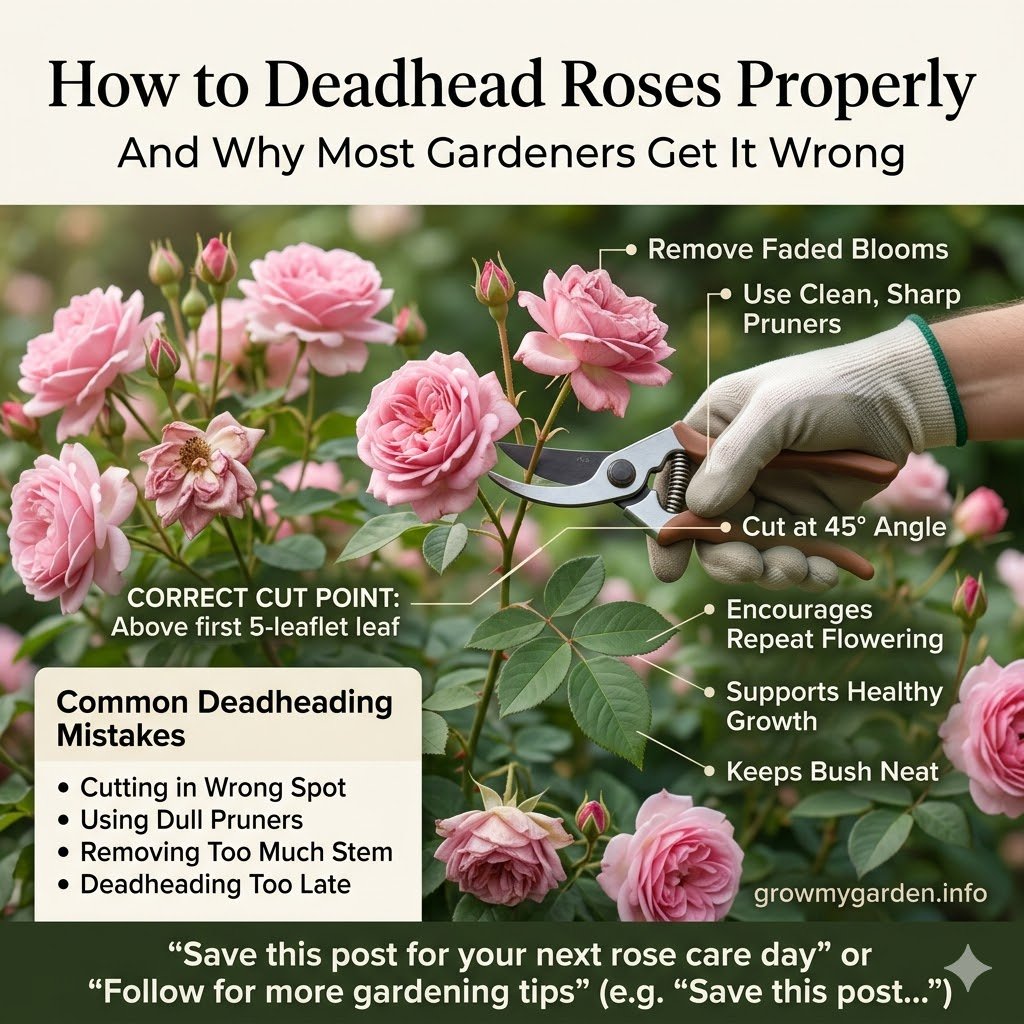
You do not need a cart full of equipment. The single most important item is a sharp pair of pruning shears — specifically bypass pruners rather than anvil-style ones. Bypass pruners work like scissors, making a clean cut without crushing the stem. Crushed stems invite disease, and roses are already prone to enough of that on their own.
I keep a pair of Fiskars bypass pruners clipped to my garden apron. They run about $20 at most hardware stores or on Amazon and last years if you take care of them. For miniature roses or tight spots between climbing rose canes, a pair of small garden scissors does the trick.
Here is one step most gardeners skip entirely: sterilizing your pruning tools between plants. A quick wipe with a cloth dampened with rubbing alcohol takes ten seconds and can stop the spread of black spot and other fungal diseases from one rose bush to the next. If you have ever lost a plant to black spot and could not figure out why it spread so fast, dirty blades are often the culprit.
Step-by-Step: How to Deadhead Roses the Right Way
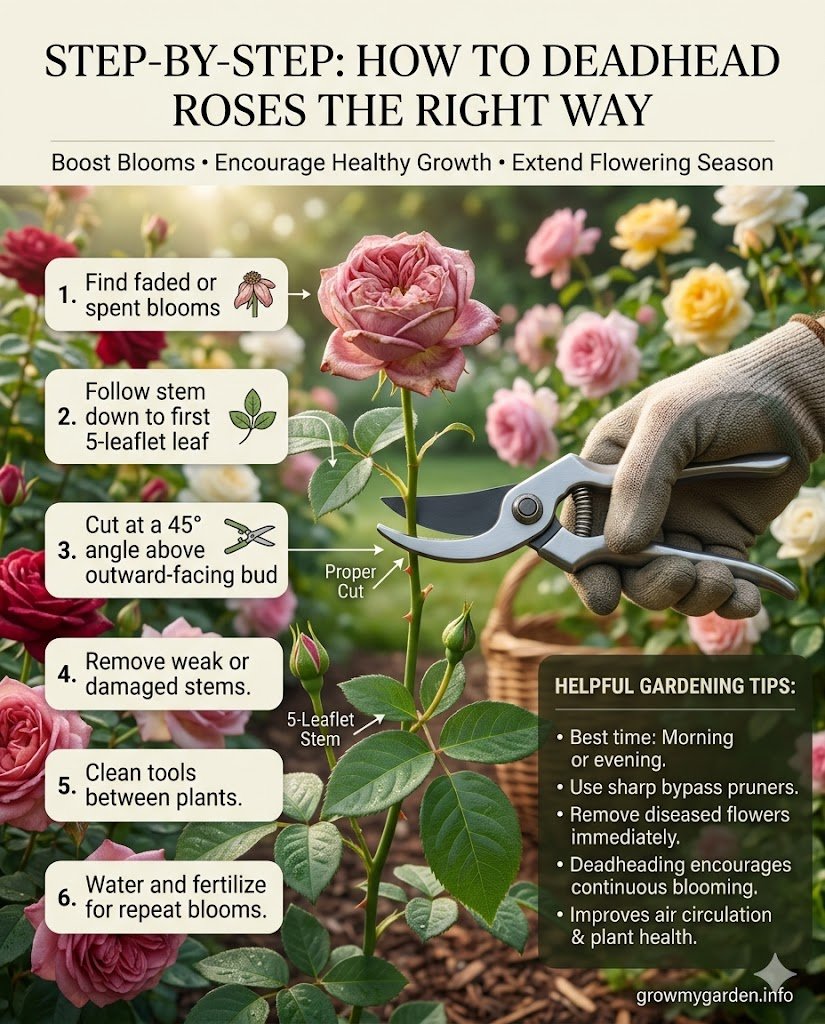
Step 1: Spot the spent bloom
A spent rose is past the point of pretty. The petals are browning, dropping, or shriveling and the center of the flower looks papery. Do not wait until it looks completely dead — the moment it is clearly past its peak, it is time.
Step 2: Find the right leaf node
This is where most people go wrong. Do not just snap the flower off at the neck. Follow the stem down until you find the first set of leaves with five leaflets — what gardeners call the five-leaflet set. Look for one that is pointing outward, away from the center of the bush. That outward-facing bud just below the leaf junction is where your new shoot will grow.
Cutting above an inward-facing bud means the new growth will crowd the center of the plant, reducing airflow and making disease more likely.
Step 3: Make your cut at 45 degrees
Position your sharp secateurs just above that outward-facing bud, angled at roughly 45 degrees, with the low end of the cut facing away from the bud. This angle allows water to run off rather than pool on the cut surface, which reduces the chance of rot. One clean cut — no sawing, no hesitation.
Step 4: Clear away the debris
Drop the spent flower removal trimmings into a bucket or garden bag rather than leaving them on the ground. Rose petals and stem cuttings left in the bed can harbor fungal spores over winter. It takes two extra minutes and makes a real difference in overall rose garden care.
Step 5: Repeat every 7 to 10 days through the blooming season
Deadheading is not a one-and-done task. During the growing season, walk through your rose beds weekly. It becomes almost meditative once you get the rhythm down — you start to notice things about your plants you would miss otherwise, like early signs of aphid activity or a cane that needs support.
Does It Work the Same for Every Rose?
No, and this is an important distinction.
Repeat-blooming varieties — including hybrid tea roses, floribunda roses, grandiflora roses, and most David Austin roses — respond beautifully to regular spent flower removal. These are the plants that will reward you with wave after wave of blooms if you keep up with them through the summer.
Once-blooming varieties, like many rambling roses and some wild roses, only flower on old wood once a year. Deadheading these does tidy them up visually, but it will not produce more flowers until next season. For these plants, it is mostly a cosmetic choice.
Climbing roses are somewhere in between. Many modern climbers are repeat bloomers, but the long arching canes need a lighter touch. Rather than cutting all the way down to the five-leaflet set on every stem, simply removing the spent blooms just below the flower cluster is often enough to encourage reblooming without disrupting the plant’s structure.
Shrub roses, especially self-cleaning varieties like Knock Out roses, are bred to drop their petals on their own and do not require much hands-on deadheading. You can still tidy them occasionally, but skipping it will not set you back the way it would with a hybrid tea.
Read How to Grow Sunflowers from Seeds.
Timing: When to Start, When to Stop
Start deadheading as soon as your roses give you their first flush of flowers — typically late May to early June in most parts of the United States, though this shifts by climate zone. Keep it up steadily through the summer.
The question I get asked the most is: can you deadhead roses in fall? Yes, with one caveat. Stop hard deadheading in late summer, roughly six to eight weeks before your first expected frost. After that point, allowing a few rose hips to develop actually helps signal the plant to slow down, toughen up, and prepare for dormancy. If you keep aggressively cutting in September and October, you can push tender new growth that gets killed by the first frost, weakening the plant heading into winter.
A light cleanup in early fall is fine — trimming back truly ugly faded flowers for appearances — but save the aggressive cutting back for spring pruning season.
What Happens If You Just… Don’t?
Honestly, your roses will not die. But they will dramatically reduce their blooming output. The energy that could go into new bud formation gets poured into seed production instead. By mid-August, a neglected floribunda that could have been showering you with blooms looks tired and sparse. The visual difference between a deadheaded rose bed and a neglected one is startling once you see it side by side.
There is also a secondary benefit people rarely mention: airflow. Dense, old flower heads at the top of stems trap moisture and create little pockets of humidity — perfect conditions for black spot and other fungal problems. Keeping the top growth clean means the plant breathes better.
Common Mistakes Worth Knowing About
Cutting too high. Leaving a long stub above a leaf node creates dead wood that can harbor disease. Always cut close — about a quarter inch above the bud.
Cutting too low. Going too far down the stem removes too much of the plant at once. Unless you are doing a hard renovation prune, stay at the first five-leaflet node.
Using dull tools. A torn, ragged cut from dull garden scissors is worse than a clean cut made at the wrong spot. Sharpen your bypass pruners at the start of every season.
Deadheading in the heat of the day. This is a minor point, but pruning during peak afternoon heat can stress both the gardener and the plant. Early morning, when temperatures are cooler and the plant is well-hydrated, is the better time.
Forgetting to fertilize after a flush. Deadheading alone is not the whole picture. After the first big bloom wave, giving your roses a balanced rose fertilizer helps fuel the next round of flowering. Organic rose care enthusiasts often use alfalfa meal or fish emulsion at this stage — both work well.

A Few Notes on Tools and Resources
If you want to track your garden tasks and bloom cycles, the GrowVeg garden planner app is surprisingly useful for mapping out your rose beds and setting care reminders. The American Rose Society website is a solid reference for variety-specific advice, and For precise frost timing in your area, our Planting Date Calculator gives you your first fall frost date by climate zone — the exact figure you need to count back six to eight weeks and know when to stop hard deadheading.
For those just getting started with rose bush maintenance, the Royal Horticultural Society has free, well-illustrated pruning guides online. These are worth bookmarking even if you are an experienced gardener — there is always something new to pick up.
The Bigger Picture
Deadheading roses is a small act with a surprisingly large payoff. It takes maybe 20 minutes a week for the average home garden. In return, you get a plant that blooms harder, stays healthier, and looks like it belongs on the cover of a gardening magazine rather than a cautionary tale.
What changed everything for me was treating it less like a chore and more like a weekly check-in with my plants. Once you get comfortable with your bypass pruners and know where to make the cut, you start enjoying the process. You notice which canes are the most vigorous. You catch problems early. You start to understand the rhythm of your roses rather than just hoping they perform.
My neighbor was right, as retired schoolteachers often are. The roses were never the problem. I just had not learned to listen to them yet.
FAQ: How to Deadhead Roses Properly
What is the right way to deadhead roses?
The right way to deadhead roses is to remove the faded flower by cutting just above a healthy outward-facing leaf set. Use clean, sharp pruners and make the cut at a slight angle. This helps the rose bush send energy into new growth and fresh blooms.
What month do you deadhead roses?
You usually deadhead roses during the blooming season, from late spring through summer. In many areas, this starts around May or June and continues until early fall. Stop deadheading near the end of the season so the plant can prepare for winter.
Can roses last 2 days without water?
Cut roses may survive 2 days without water, but they will likely wilt and lose freshness quickly. Garden roses growing in the soil can handle short dry periods better, but they still need regular watering, especially in hot weather.
How much should I cut off deadheading roses?
Cut off the spent flower and a short section of stem, usually back to the first healthy 5-leaflet leaf. For weak stems, cut less. For strong stems, you can cut a little lower to encourage better new growth.
What are some common mistakes to avoid when deadheading roses?
Common mistakes include cutting too high above the leaf, using dirty or dull pruners, removing too much healthy growth, deadheading too late in the season, and leaving diseased petals or leaves around the plant. These mistakes can slow blooming and increase plant problems.



Leave a Comment