
Best Annuals for Full Sun: Heat-Tolerant Flowers That Actually Deliver All Summer
Growing flowers in a sun-drenched yard feels rewarding until the wrong plants fry by July. Choosing the best annuals for full sun changes everything. These are plants built for heat, not just tolerant of it. Whether you are filling a border, dressing up containers, or just want colorful annuals that bloom without begging for shade, the right picks make all the difference.
From the fiery blooms of zinnias to the relentless cheerfulness of marigolds, heat-tolerant annuals deliver season-long color with surprisingly little fuss. This guide cuts through the noise and tells you exactly which summer annual flowers thrive when the sun is unforgiving and drought-tolerant annuals are what your garden actually needs. Read our complete Flower Gardening guide.
After years of planting, failing, learning, and finally getting it right, I can tell you that the best annuals for full sun do not just survive the heat. They absolutely revel in it. This is not a recycled listicle with a pretty stock photo bolted on. This is what I actually grow, what I have seen work in real American gardens from coastal Georgia to central Kansas, and what deserves a permanent spot in your sunny flower beds every single growing season.
What “Full Sun” Really Means Before You Plant a Single Thing
Before you grab a flat of colorful annuals for full sun, let us get one thing straight. Full sun means at least 6 or more hours of direct sunlight per day. Most sun-loving annual plants actually want eight to ten hours to perform at their peak. The nuance nobody talks about is the type of sun.
Morning sun is gentler and more forgiving. Afternoon sun, especially in the South and Southwest, is a completely different beast. West-facing and south-facing beds can hit soil surface temperatures well above 100 degrees Fahrenheit in July. Some plants sold as “full sun” on the tag at your local garden center are really built for the milder, less brutal sun you get in the Pacific Northwest or the Upper Midwest.
Understanding sun exposure requirements before you plant is the single most important factor in whether your summer annual flowers thrive or slowly give up on you. So when I talk about summer heat tolerance here, I mean real heat, the sticky, relentless kind that rolls across zones 5 through 10 and turns lesser plants into mulch.
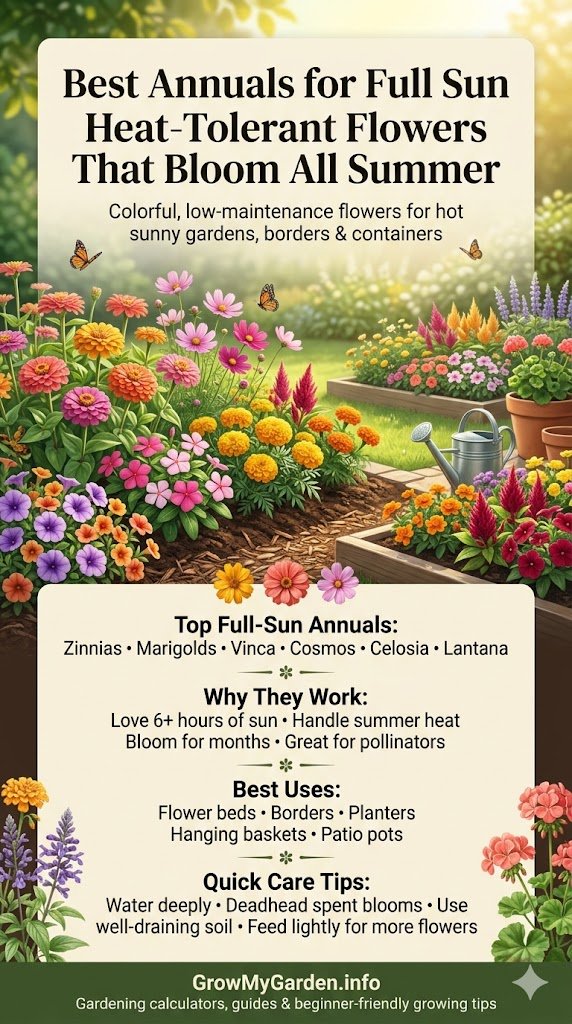
The Best Full Sun Annual Flowers: A Grower’s Honest List
Zinnias: The Crown Jewel of Hot Weather Annuals
If I could only grow one annual flowering plant for a full sun garden, no contest, it would be the zinnia. These are genuinely the hardest-working heat-tolerant annuals available to American home gardeners. They bloom from early summer right up until hard frost, attract monarchs and painted ladies like a magnet, and come in every color from dusty cream to near-black burgundy.
The variety that earns a spot in my garden every year without question is the Benary’s Giant series. Blooms can reach four inches across and they hold up beautifully in a cut flower garden arrangement for well over a week. For mounding, self-branching types that need almost no deadheading, the Profusion series is exceptional. Dwarf forms like Zahara are perfect for patio container plants or edging plants along a border.
How to grow zinnias in full sun, step by step:
- Wait until your last frost date has passed and soil temperatures are at least 60 degrees. In most of the Midwest, that falls between mid and late May.
- Direct sow seeds a quarter inch deep in well-draining soil. Zinnias are completely intolerant of soggy conditions.
- Space seeds six to twelve inches apart based on the variety listed on the seed packet.
- Water gently after sowing and keep soil evenly moist until germination, typically five to seven days.
- Once seedlings reach a few inches tall, thin them to final spacing. Yes, it is painful to pull out little plants. Do it anyway. Crowded zinnias get powdery mildew fast.
- Water at the base rather than overhead and feed every three weeks with a balanced fertilizer.
The mistake I made early on was planting zinnias in dense clay soil without amending it first. They sulked all season and barely bloomed. A generous mix of compost worked into the bed before planting changed everything the following year.
Not sure how many plants fit your bed? Our Plant Spacing Calculator does the math for you in seconds.
Marigolds: Misunderstood, Undervalued, and Completely Essential
Marigolds have a reputation problem. They conjure images of overly regimented municipal plantings, the kind flanking city hall entrances. But look past that association because these colorful annuals are genuine workhorses that every sunny garden should rely on.
African Marigolds, sometimes called American marigolds despite the confusing name, grow two to three feet tall and produce enormous blooms in orange, gold, yellow, and bi-color cream. French Marigolds stay compact at six to twelve inches, making them ideal edging plants and border plants for full sun areas.
Beyond their cheerfulness, marigold roots secrete a compound that repels certain soil nematodes. Their scent discourages aphids, whiteflies, and even deer. Mass planting annuals like marigolds along the perimeter of a vegetable garden creates a living pest deterrent. I have done this for years and it genuinely makes a difference.
They also tolerate surprisingly dry spells once established, which puts them firmly in the drought-tolerant annuals category. Plant after last frost, give them decent well-draining soil, and they will bloom continuously without much fuss. Deadheading flowers encourages even heavier bloom but is not strictly necessary with modern varieties.
Lantana: The Champion of Heat and Humidity Tolerance
If you have a spot that gets relentless afternoon sun and you have essentially given up hope, plant lantana. This plant was practically engineered by nature to laugh at summer heat. I have grown it in black plastic pots on a south-facing concrete patio in Missouri and it just kept going and going through weeks of triple-digit heat indices.
Lantana blooms are small but cluster into flat-topped bundles across an enormous color range: yellow, orange, red, hot pink, lavender, and spectacular multicolored combinations that shift hues as they age. Swallowtail butterflies, bumblebees, and hummingbirds are absolutely drawn to it, making it a cornerstone of any pollinator garden.
It is also a fast grower. A single plant can spread two to four feet across in one season. For hanging basket plants and window box annuals, the Bandana and Luscious series stay more compact and trail beautifully. For in-ground landscaping with annuals at scale, Miss Huff is a large, vigorous cultivar that sometimes overwinters in zone 8 and warmer, behaving almost like a perennial.
One honest caution: lantana berries are toxic, particularly the green unripe ones. Keep it away from areas where children or pets graze unsupervised.
Portulaca (Moss Rose): Ground-Level Color for Bone-Dry Spots
Portulaca, also called moss rose, is the annual that makes gardeners in problem spots quietly exhale with relief. It sprawls along the ground, produces silky rose-like blooms in electric shades of magenta, coral, yellow, and white, and it actively prefers poor, sandy, fast-draining soil. It is the anti-diva of annual plant varieties.
This makes it the answer for rocky slopes, sun-baked strips along sidewalks and driveways, and raised garden beds with soil that dries out between every single rain event. It qualifies comfortably as both a drought-tolerant annual and a true low water annual for full sun conditions.
Portulaca self-seeds generously, so you often get a volunteer crop the following year without replanting. The one quirk is that flowers close at night and on overcast days, so pair it with petunias or verbena for evening color. But as a low maintenance annual for brutal daytime sun with almost no care required, it is nearly unbeatable.
Celosia: The Most Visually Striking Annual You Are Probably Not Growing
Cockscomb, plume celosia, wheat celosia. All forms of Celosia argentea and all of them are among the most interesting-looking annual flowering plants you can put in a summer garden. The crested cockscomb types look like colorful velvet brain coral. The plumed types look like flames frozen in fabric. The wheat types have an elegant, feathery airiness that works beautifully in a cut flower garden.
What makes celosia especially useful is that it gets better as summer intensifies. While many hot weather annuals struggle to look their best in late July and August, celosia doubles down. The saturated colors do not fade in the heat, and they dry perfectly for indoor arrangements, extending their usefulness well past the growing season.
Practical growing tips that actually move the needle:
Plant celosia only in well-draining soil because wet roots lead to crown rot surprisingly fast. Feed with a bloom-boosting fertilizer every three to four weeks. Avoid disturbing the roots when transplanting seedlings since they are sensitive to that. Starting seeds indoors about four to six weeks before your last frost date gives you fuller, earlier-blooming plants, but direct sowing after frost also works well in warmer climates.
Vinca (Catharanthus): The Unsung Hero of Southern American Gardens
Annual vinca, also sold as periwinkle, is something of a quiet champion in the world of summer annual flowers. It does not get the glamor coverage that zinnias and petunias collect, but in the heat and humidity of the American Southeast and Gulf Coast, it is one of the most dependable colorful annuals you will ever grow.
The flowers loosely resemble phlox and arrive in white, pink, red, lavender, and bicolor combinations. The plant stays naturally tidy, rarely needs deadheading, resists most common garden pests, and just keeps blooming through the kind of August heat that sends other plants into early retirement.
The Cora series is especially well regarded for disease resistance and performance in humid, warm climate gardening conditions. The Titan series produces larger blooms with particularly strong heat and humidity tolerance. If you live anywhere from the mid-Atlantic states south through Georgia, Alabama, and across to Texas, annual vinca deserves a starring role in your beds.
Petunias: A Classic That Earns Its Spot Every Year
Yes, petunias are on every list. But there is a real reason for that, and leaving them out would be dishonest. The important distinction is that not all petunias are created equal. Grocery store petunias crammed into hanging baskets tend to need constant deadheading or they turn leggy and stop blooming by July. If you are new to the technique, our guide on how to deadhead roses properly walks through the exact method — the same principles apply across most flowering annuals and give you noticeably better bloom output all season.
The varieties worth investing in for full sun beds and patio container plants are the Supertunia, Superwave, and Wave series. These were specifically bred for heat tolerance, continuous blooming, and dense branching. They spill attractively over container edges and grow thick enough in beds to crowd out some weeds as the season progresses.
Feed petunias every two weeks with a bloom-boosting fertilizer, keep watering frequency consistent, and give them a light trim mid-season if they start getting rangy. They will reward that modest effort with nonstop bright summer colors through the first hard freeze.
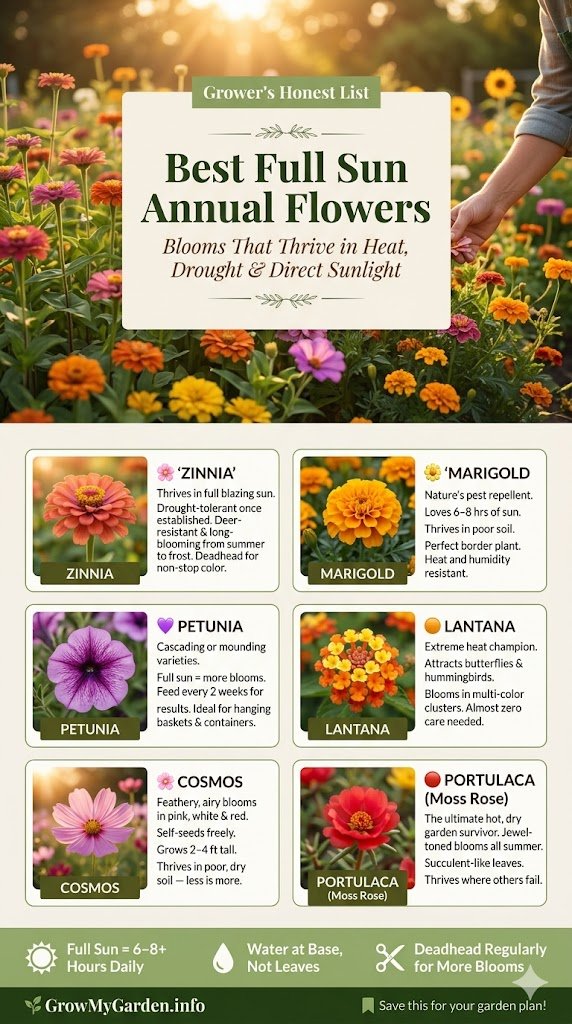
Three More Worth Mentioning (And Growing)
Angelonia, sometimes called summer snapdragon, is an outstanding long-blooming annual for full sun that tolerates heat almost as well as lantana. It has an appealing lavender or pink flower spike and a light fragrance that makes it lovely near patios and walkways.
Gomphrena (globe amaranth) is a compact annual with clover-like blooms in magenta, purple, pink, orange, and white. It is genuinely drought-tolerant, thrives in high-temperature plants conditions, and doubles as a cut flower that dries beautifully. Pair it with celosia for a sensational combination planting.
Verbena bridges the gap between ground cover annuals and upright border plants, comes in dozens of vibrant color combinations, and brings in pollinators reliably. It is especially effective in window box annuals arrangements mixed with trailing calibrachoa for a layered, spilling effect.
Care, Soil, and Watering: What Actually Matters
One of the biggest errors gardeners make with sun-loving annual plants is inconsistent watering. They overwater in spring and then forget about the plants when summer heat hits. The right approach is deep, infrequent watering rather than shallow daily sprinkles. Deep watering pushes roots further into the soil where moisture is more available and stable.
A basic soil moisture meter, widely available at garden centers and on Amazon for under fifteen dollars, removes all the guesswork. Stick it into the root zone and water only when it reads dry. This one habit alone measurably improved the health of my own beds.
Soil preparation for annuals matters more than most gardening content admits. Working in two to three inches of quality compost before planting improves drainage in clay soil, adds water retention in sandy soil, and provides a slow-release nutrient base that reduces how aggressively you need to fertilize. It is the single best investment of your time before a growing season.
If you are building a raised bed for your annuals, our Raised Bed Soil Calculator tells you exactly how many bags of soil and compost to buy.
Mulching flower beds with two to three inches of shredded wood mulch or straw slows evaporation dramatically, keeps soil temperatures from spiking, and creates a much more hospitable root environment during heat waves. In hot climate gardening, mulch is not optional. It is the difference between plants that look good at ten in the morning and plants that look good at four in the afternoon.
Not sure how often to water your full sun annuals? Use our free Watering Schedule Tool to get a weekly watering plan based on your garden size and climate.
For fertilizing annual plants, a balanced granular fertilizer worked into the soil at planting combined with a liquid bloom booster applied every two to three weeks during peak growing season is a combination that consistently outperforms either approach alone.
To avoid over or under-feeding, run your bed size through our Fertilizer Calculator and get exact amounts without guessing.
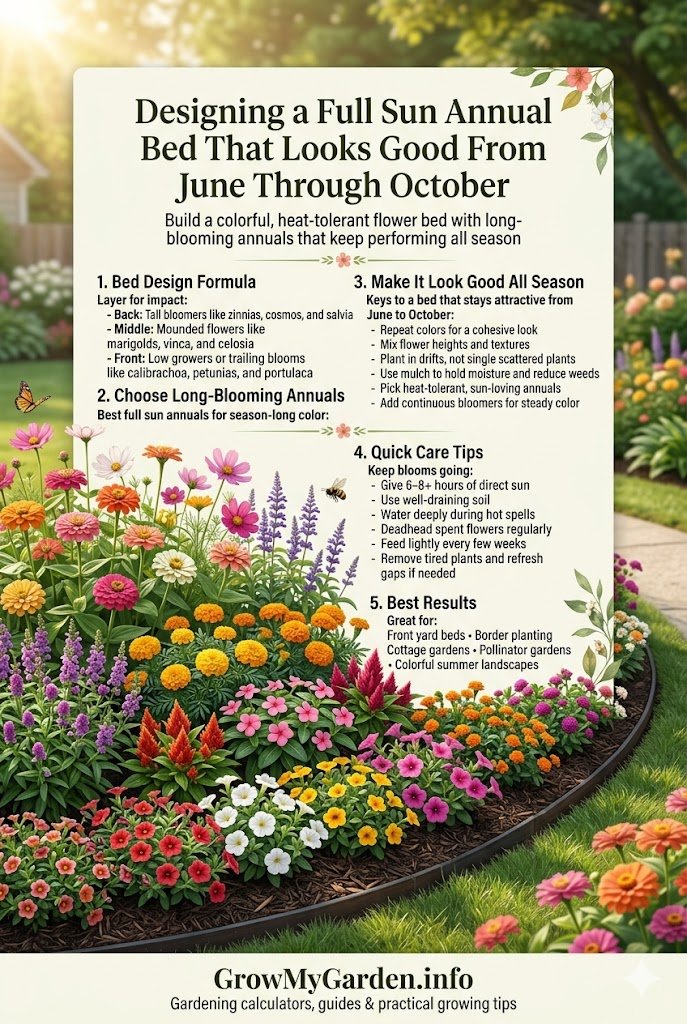
Designing a Full Sun Annual Bed That Looks Good From June Through October
A really satisfying annual border is not a random collection of plants thrown together. It is a little bit of choreography, a layered composition where height, color, and bloom time work together.
Tall background layer (two to three feet): Tall background layer (two to three feet): African marigolds, tall zinnia varieties like Benary’s Giant, plume celosia, or sunflowers for a dramatic back row. If sunflowers are on your list this season, our complete guide to growing sunflowers from seeds covers spacing, depth, and timing so they hit full height right when you need them.
Mid-height middle layer (one to two feet): Compact zinnias, lantana, vinca, or angelonia for the visual heart of the bed.
Front edging layer (six to twelve inches): French marigolds, portulaca, gomphrena, or compact petunias to spill slightly over the edge and tie everything together.
For a cottage garden style, try a warm-toned mixed annual border of orange marigolds, coral zinnias, and red celosia. For something cooler and more refined, lavender angelonia, white vinca, and pink verbena creates an elegant, continuous color garden that reads as intentional without being stiff.
Mixing varieties that attract pollinators, zinnias, lantana, verbena, and gomphrena specifically, transforms a bed into a pollinator garden that is genuinely buzzing with life from morning through afternoon. That kind of biodiversity is its own reward.
FAQ: Best Annuals for Full Sun
What flowers grow best in full hot sun?
Flowers that grow best in full hot sun include zinnias, marigolds, sunflowers, lantana, cosmos, petunias, portulaca, salvia, blanket flower, and coneflowers. These flowers handle strong sunlight well and keep blooming when watered properly.
What are the longest blooming annuals?
Some of the longest blooming annuals are zinnias, petunias, marigolds, geraniums, calibrachoa, impatiens, begonias, and vinca. For full sun areas, zinnias, marigolds, petunias, vinca, and calibrachoa are especially good choices.
What plant says “I love you”?
The most popular flower that says “I love you” is the red rose. Red roses symbolize love, romance, and deep affection. Other love-related flowers include tulips, carnations, peonies, and camellias. If roses are calling your name, learn how to grow roses from cuttings in water — it is one of the most rewarding propagation projects a home gardener can take on.
What flowers grow well in full sun planters?
Flowers that grow well in full sun planters include petunias, geraniums, calibrachoa, lantana, verbena, marigolds, portulaca, zinnias, and vinca. Use well-draining potting mix and water more often because planters dry out quickly in hot sun.
What plants like direct sun all day?
Plants that like direct sun all day include lavender, rosemary, salvia, lantana, coneflowers, black-eyed Susans, yarrow, sedum, marigolds, zinnias, and sunflowers. These plants usually need at least 6–8 hours of direct sunlight daily to grow and bloom well.
A Last Word on Getting Started
There is no perfect first season. Every garden has different soil, different afternoon shade patterns, different microclimates that no article can fully account for. What this guide can do is narrow the odds dramatically in your favor.
Start with two or three of these direct sun garden plants this season. Observe how they respond to your specific conditions. The ones that thrive in your yard are the ones worth building around. That is how experienced gardeners develop their plant lists, not by memorizing what works in general, but by paying attention to what works in particular, in their soil, in their climate, in their corner of the American gardening landscape.
The payoff for that attention is months of vibrant blooms, a yard that earns compliments from neighbors who pass by, and the quietly satisfying knowledge that you gave your summer garden exactly what it needed.

Leave a Comment