

How to Grow Strawberries in Pots (A Real Grower’s Guide That Actually Works)
I killed my first batch of potted strawberries in about three weeks. Overwatered, wrong soil, pot that was barely bigger than a coffee mug. The plants looked sad, turned yellow, and just gave up — and honestly, I couldn’t blame them.
That was years ago. These days, my balcony in late spring looks like something out of a gardening magazine, with fat red strawberries tumbling out of grow bags and hanging baskets. Container gardening strawberries is genuinely one of the most rewarding things you can do with a small outdoor space, and the learning curve is not as steep as I once thought.
This guide covers everything — from picking the right pot to dealing with the sneaky pests that show up right before harvest. Whether you’re working with a tiny apartment balcony or a sun-drenched patio, growing strawberries at home in pots is absolutely doable. Read our Fruit Gardening guide.
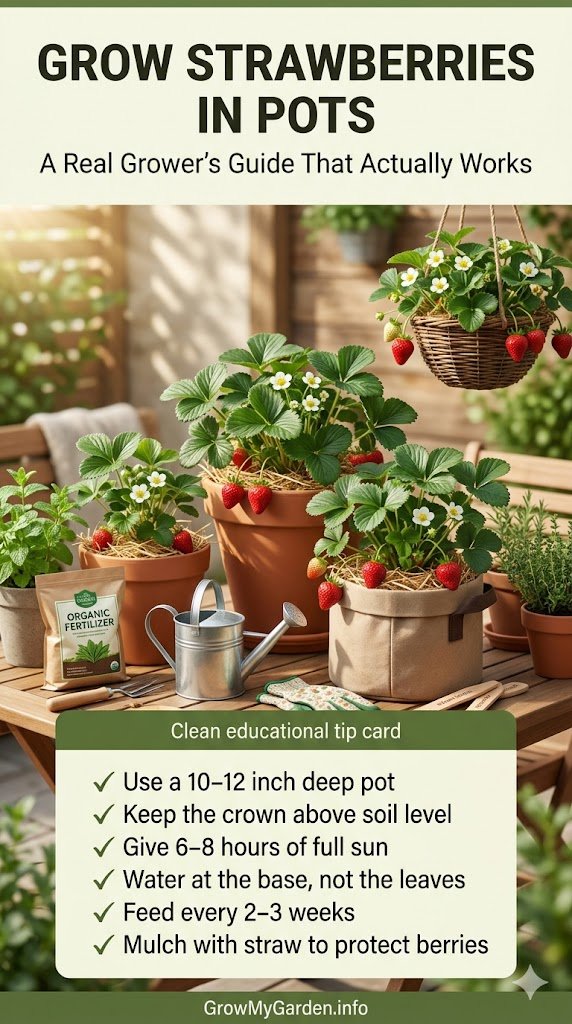
Do Strawberries Grow Well in Containers?
Short answer: yes, remarkably well — sometimes even better than in the ground.
Strawberries have a relatively shallow root system, which makes them well-suited to pot life. In the ground, they compete with weeds and are at the mercy of whatever soil you happen to have. In a container, you control everything: the soil composition, the drainage, the position relative to the sun. That kind of control is actually a gift.
The botanical name for the common garden strawberry is Fragaria × ananassa, and it’s a surprisingly adaptable plant. It tolerates being moved around, which matters a lot if you’re chasing sunlight across a balcony throughout the season. And because containers warm up faster than garden beds in spring, potted strawberry plants often get a head start on the season compared to their in-ground cousins.
The key is giving them what they need from the beginning. Get the pot size, soil, and watering rhythm right, and these plants will reward you generously.
When Is the Best Time to Plant Strawberries in Pots?
Spring planting is the classic answer, and it’s the right one for most people. Aim to get your plants in between early spring and mid-spring, once the risk of hard frost has passed but temperatures haven’t climbed into the scorching range yet.
If you’re buying bare-root plants (which are usually cheaper and often healthier than potted ones from garden centres), early spring is the sweet spot. They establish quickly in cool, moist conditions.
That said, you can also plant in late summer or early autumn — especially if you want your plants to develop strong root systems before next year’s fruiting season. A well-established autumn planting will often outperform a rushed spring one.
A few things to keep in mind with timing:
- Avoid planting during a heatwave. Containers heat up faster than beds, and a newly transplanted strawberry crown does not appreciate being cooked.
- If you’re working with seedlings you started indoors, make sure you harden off seedlings properly before moving them outside permanently. Leave them outdoors for a few hours each day over about a week, gradually increasing their exposure to direct sun and wind.
- Day-neutral strawberries like Albion are a little more forgiving about timing because they fruit based on temperature rather than day length. You can plant these from spring right through early summer.
Timing varies a lot depending on your climate zone and last frost date. The Planting Date Calculator works out your ideal sowing and transplanting dates automatically.
→ Planting Date Calculator
What Size Pot Is Best for Growing Strawberries?
This is where a lot of beginners go wrong — they grab whatever pot is sitting in the shed, and it’s usually too small.
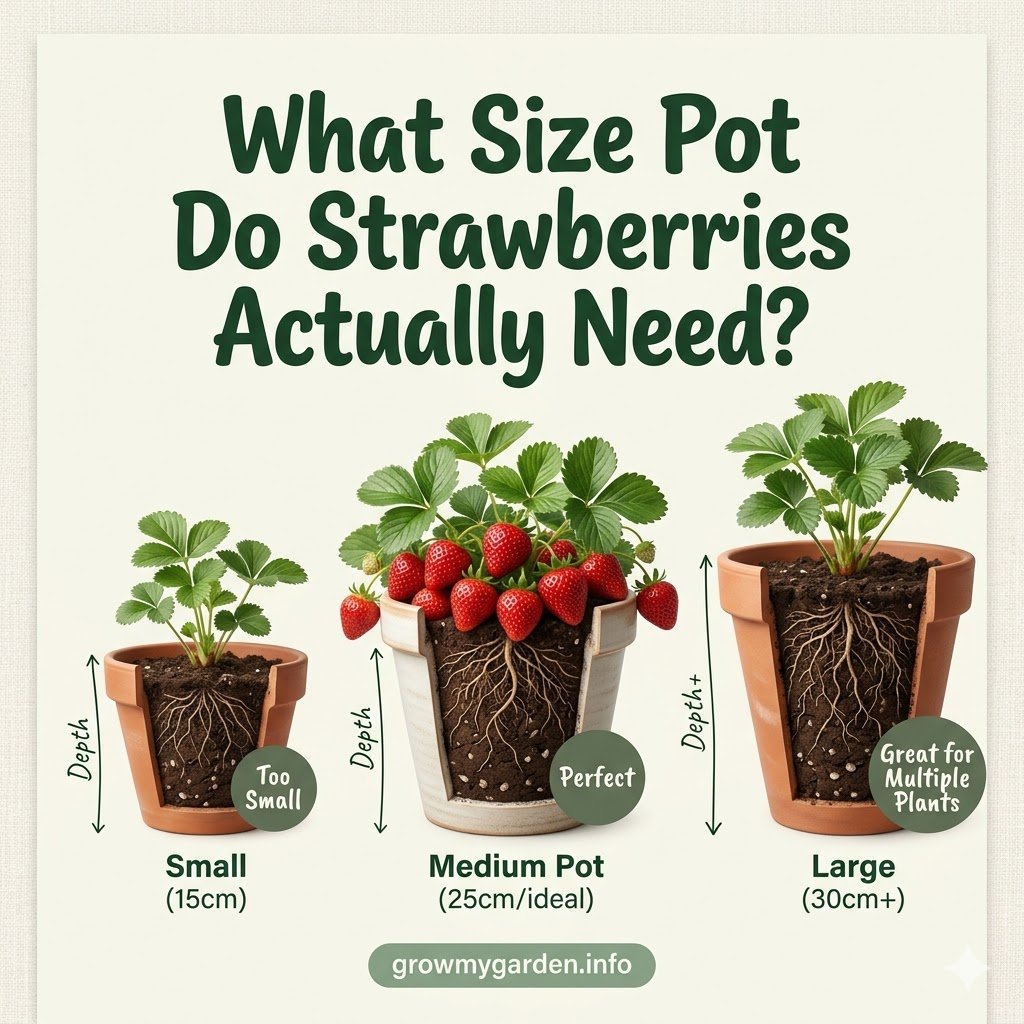
For a single strawberry plant, you want a pot that holds at least 10 to 12 litres. The container needs to be at least 20cm deep, because even though strawberry root depth is modest compared to many vegetables, the roots still need room to spread without hitting a wall.
For growing several plants together, a larger tub, a grow bag, or a strawberry tower planter works brilliantly. A 40-litre grow bag can comfortably hold four to six plants, and I’ve had great results with this setup year after year.
Pot material matters more than most people realise:
- Terracotta pots look beautiful and breathe well, but they dry out fast. In hot weather, you might be watering twice a day, which is exhausting.
- Plastic pots retain moisture longer and are lighter if you need to move things around. They’re not glamorous, but they’re practical.
- Fabric grow bags are genuinely excellent for strawberries. They air-prune the roots, prevent waterlogging naturally, and warm up quickly in spring.
- Hanging baskets work well for trailing varieties — the cascading growth looks spectacular and keeps the fruit off the soil. Just know that they dry out even faster than terracotta, so they need attentive watering.
- Strawberry tower planters are a space-saver’s dream. Stack multiple planting pockets into a vertical column and you can grow a dozen plants in the footprint of a single large pot.
Whatever container you choose, drainage holes are non-negotiable. Without them, you’re looking at root rot inside a week.
How Many Strawberry Plants Can I Put in One Pot?
A good rule of thumb is one plant per 10 to 12 litres of container volume, with each plant getting roughly 20 to 25cm of space from its neighbours.
So in a standard 30-litre pot, three plants is comfortable. In a 40-litre grow bag, four plants is ideal. Go beyond that and you’ll see competition for nutrients, poor airflow between plants (hello, gray mold botrytis), and smaller fruit overall.
Not sure how many plants fit your specific container size?
Use the Plant Spacing Calculator to get an exact number based on your pot dimensions and plant type.
→ Plant Spacing Calculator
For a strawberry hanging basket of the typical 30cm size, two plants is the sweet spot. Three can work if you’re diligent about feeding, but the plants will be crowded.
Tower planters follow their own rules since each pocket is essentially its own small planting space — typically one plant per pocket.
What Is the Best Soil Mix for Potted Strawberries?
Never use straight garden soil in a pot. It compacts, drains poorly, and often introduces disease. Strawberries need something looser and more forgiving.
Here’s the mix I use and trust completely:
- 60% good-quality peat-free compost — look for one designed for fruit and veg
- 20% perlite or vermiculite — this is the secret weapon for drainage and aeration
- 20% loam or a bit of topsoil — adds weight and a mineral base that compost alone lacks
The most important thing to get right is soil pH. Strawberries are particular about acidity — they want a pH between 5.5 and 6.5. Outside that range, they struggle to absorb nutrients even if you’re feeding them regularly. If you’re unsure about your mix, a cheap soil pH meter (Bluelab and Apera both make decent ones) will tell you in seconds. To lower pH, mix in a little sulphur dust. To raise it, garden lime does the job.
Good organic matter in the soil feeds the microbial life that keeps your strawberry potting compost healthy long-term. Worm castings are brilliant for this — a handful mixed in at planting time is like giving the plant a head start.
How Often Should You Water Strawberries in Pots?
More often than you’d think, and less consistently than you might fear.
The honest answer is: it depends on the weather, the pot material, and the size of your plant. But a practical starting point is every one to two days during warm weather, and every three to four days when it’s cool or overcast.
The finger test never fails me. Push your finger about 2cm into the soil — if it feels dry at that depth, water. If it still feels damp, leave it another day. Investing in a soil moisture meter takes the guesswork out entirely; the XLUX T10 is inexpensive and works well.
If you want a more precise weekly watering plan based on your pot size, plant count, and local conditions, the Watering Schedule Tool builds one for you in seconds.
→ Watering Schedule Tool
Two things to avoid above everything else:
- Waterlogging. Sitting in wet soil is a death sentence for strawberry roots. The drainage holes in the pot must be clear. If you’re using saucers, empty them after watering rather than letting the pot sit in standing water.
- Drought stress. Strawberries in containers are completely dependent on you for water. Even a couple of days of drought during fruiting can cause the berries to dry up, crack, or fail to swell properly.
If you go on holiday or tend to forget watering, a self-watering planter with a reservoir base is a genuinely good investment. Drip irrigation on a timer is even better — it’s what I switched to two summers ago and I’d never go back.
Water at the base of the plant rather than over the top. Wet foliage is an open invitation to fungal problems.
What Fertilizer Should I Use for Strawberries in Pots?
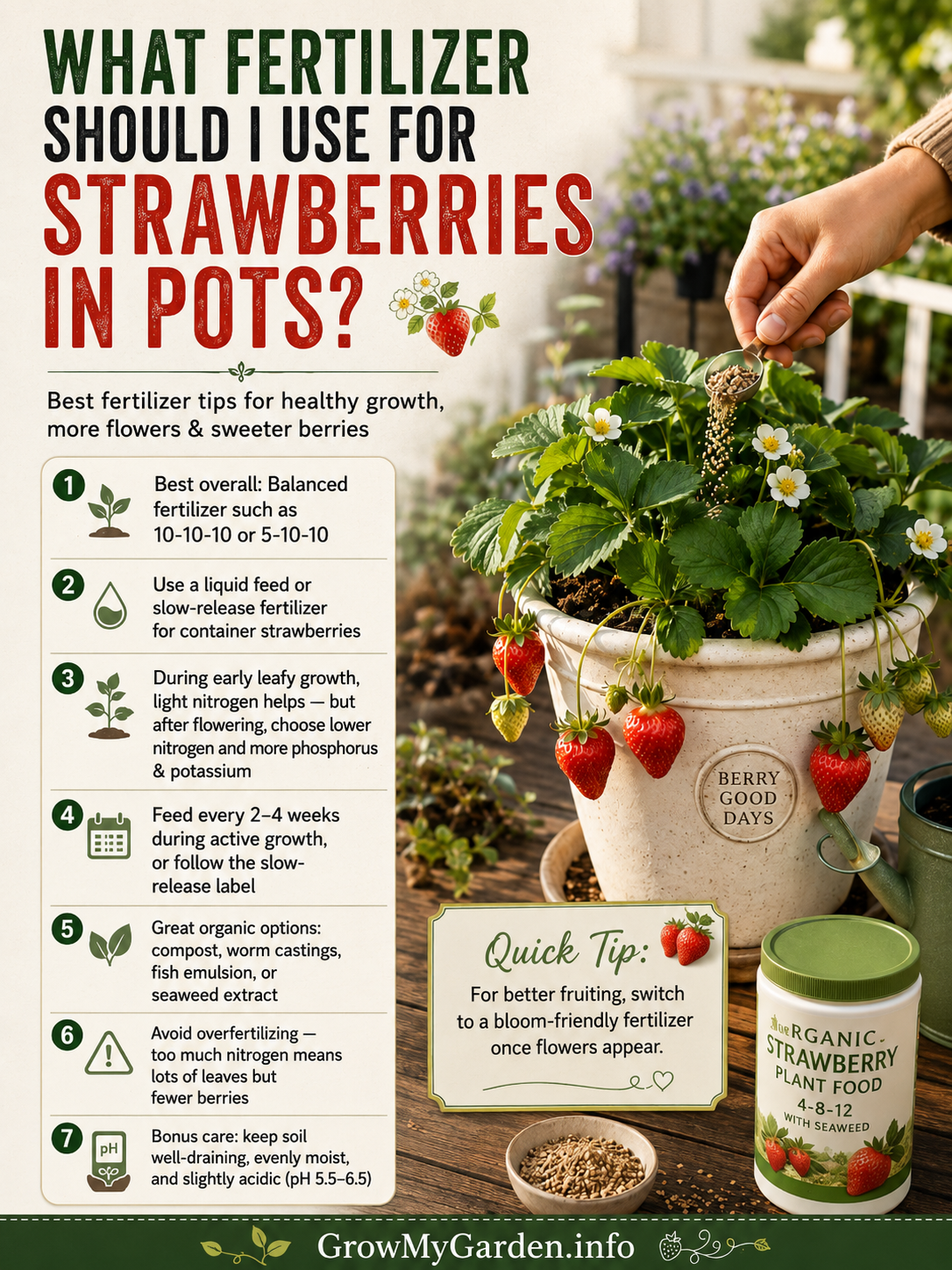
Strawberries in containers exhaust their nutrients relatively quickly, especially during the fruiting season. Regular feeding is not optional — it’s the difference between a handful of disappointing berries and an actual harvest worth getting excited about.
Feed in two phases:
Phase 1 — Early season (spring through to first flowers): Use a balanced NPK fertilizer to encourage strong leafy growth and root development. A liquid seaweed feed is gentle and effective here.
Phase 2 — Flowering and fruiting: Switch to a potassium-rich feed. Tomato fertilizer works brilliantly for this — something like Tomorite or any high-potash liquid feed. The extra potassium encourages flower set and swells the fruit. Feed every seven to ten days during this period.
Feeding amounts depend on your pot size and the product you’re using. The Fertilizer Calculator takes the guesswork out — input your container dimensions and it tells you exactly how much to apply.
→ Fertilizer Calculator
At planting time, mixing a slow-release fertilizer granule into the potting compost gives your plants a steady nutrient base for the first month or two without any effort from you. Osmocote or Miracle-Gro Slow Release are both reliable options.
One thing I learned the hard way: don’t feed when the soil is completely dry. Always water first, then feed. Applying fertilizer to dry roots can burn them.
Which Strawberry Varieties Are Best for Containers?
This matters more than most guides let on. Not every strawberry performs equally well in the confined world of a pot.
Day-neutral and everbearing types are generally the best pick for container gardening. Unlike June-bearing strawberries that dump their entire crop in one glorious but brief window, these types produce fruit steadily from late spring through to autumn. That’s a much better deal for a patio or balcony grower.
A few varieties worth knowing by name:
- Albion — a day-neutral variety with large, firm, sweet fruit. Excellent flavour and produces reliably across a long season. One of my personal favourites.
- Seascape — another day-neutral performer, especially good in warmer climates. Very productive and handles heat reasonably well for a strawberry.
- Mignonette — an alpine strawberry that produces tiny, intensely flavoured berries. Perfect for hanging baskets and smaller containers. No runners to deal with, which makes it low-maintenance.
- Elan and Finesse — everbearing varieties bred specifically with container growing in mind. Worth looking for at specialist nurseries.
Curious how much fruit to realistically expect from your chosen variety and container setup? The Harvest Yield Estimator gives you an estimate along with days to maturity.
→ Harvest Yield Estimator
June-bearing varieties like Elsanta and Honeoye can work in pots, but you’ll get one big harvest and then not much else. For balcony container gardening, that feels like a lot of effort for a short payoff.
How Do You Propagate Strawberry Runners in Containers?
Strawberries send out long, creeping stems called stolons — or runners — that will root themselves into whatever soil they touch. This is how the plant naturally spreads, and it’s also how you get free plants.
Here’s how to propagate runners in containers, step by step:
- Identify a healthy runner. Look for one with a small plantlet at its tip — a cluster of tiny leaves with the beginnings of roots underneath.
- Fill a small pot (about 9cm) with moist potting compost and place it next to the parent plant.
- Pin the plantlet onto the compost surface using a bent piece of wire, a bobby pin, or even a small stone. The roots need contact with the soil.
- Do not cut the runner yet. Leave it attached to the parent plant for four to six weeks while the baby plant establishes its own root system.
- Check for resistance. After a few weeks, give the plantlet a very gentle tug. If it resists, it’s rooted. If it comes straight out of the soil, give it more time.
- Sever the runner once the plant is established, and move the new pot to its permanent spot.
One important note: in the first year, many growers recommend pinching off runners entirely and even deadheading strawberry flowers for the first few months. It feels counterintuitive, but it forces the plant to put energy into root development rather than reproduction. The result the following season is a much more productive plant.
Once you have established second-year plants, let the runners do their thing and thin out stolons that are overcrowding the pot.
Why Is My Potted Strawberry Plant Not Producing Fruit?
Few things are more deflating than a lush, leafy strawberry plant that refuses to produce a single berry. There are usually a handful of culprits:
Not enough sunlight. This is the most common reason. Strawberries need at least 6 to 8 hours of direct sunlight per day. A shaded north-facing balcony will give you beautiful leaves and almost no fruit. Move the pot to a south-facing position if you can. If you genuinely don’t have outdoor sun access, a grow light for strawberries can bridge the gap — look for a full-spectrum LED panel run for 14 to 16 hours per day.
It’s the first year. Many strawberry varieties, especially June-bearing ones, produce little to no fruit in their first season. This is normal. The plant is building energy reserves. First-year fruiting is more common with everbearing and day-neutral types.
Insufficient feeding. A nutrient-depleted plant simply doesn’t have the resources to set fruit. If you haven’t been feeding, start a weekly high-potash regime and give it a few weeks.
The crown is planted too deep. The strawberry crown — that central growing point at the base of the leaves — should sit at soil level. Not above it, not below it. Buried crowns rot. Exposed crowns dry out and die. Get this wrong and the plant will struggle perpetually.
Poor pollination. Strawberries are self-pollinating but they rely on bees, wind, and insects to move pollen around. If you’re growing indoors, you may need to hand-pollinate by running a soft paintbrush gently inside each open flower every couple of days.
Leggy strawberry plant with few flowers. If the plant has grown tall and floppy but isn’t flowering much, it’s likely not getting enough light or has been over-fed with nitrogen, which promotes leafy growth at the expense of fruit.
Dealing with Pests and Diseases
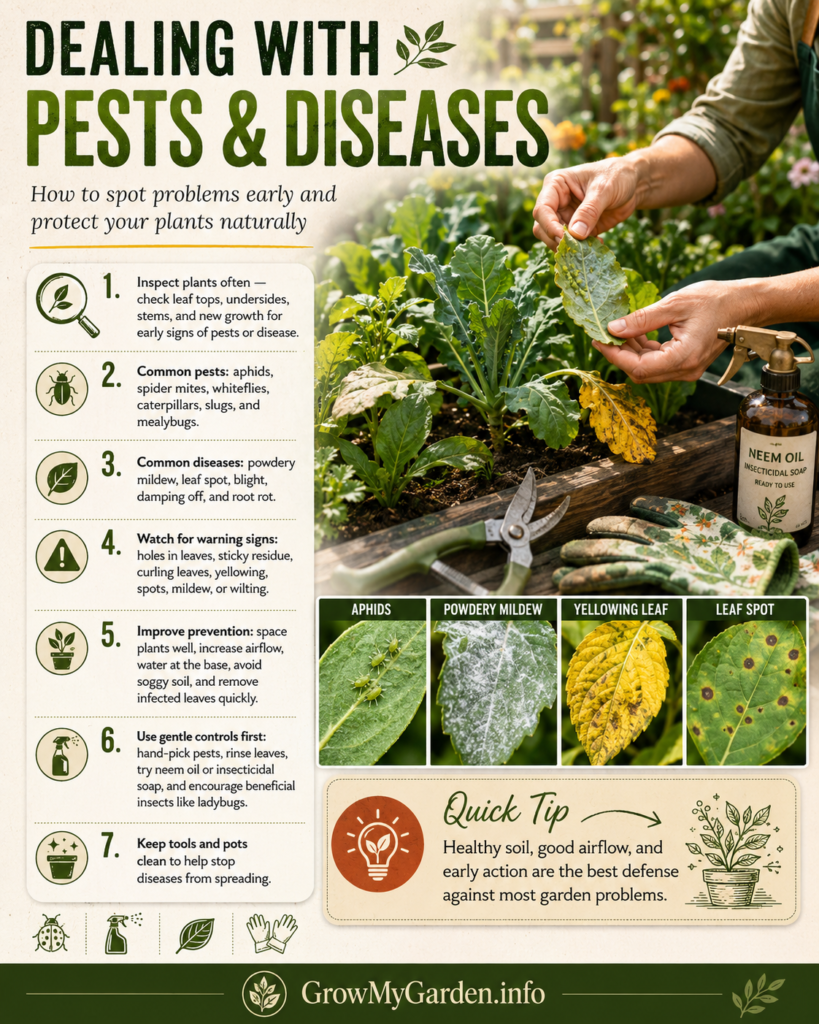
Pots don’t make your strawberries immune — just a bit more manageable when problems do appear. Here are the three most common issues and how to handle them.
Aphids
The small greenish clusters of aphids on strawberries tend to appear in spring, usually on the underside of new leaves and around flower buds. A strong blast of water from a hose knocks most of them off. For a more persistent infestation, neem oil for strawberry plants works well — dilute it as directed and spray in the evening to avoid harming pollinators.
Vine Weevil in Pots
This one is sneaky and genuinely destructive. The adult vine weevil chews scalloped notches into leaf edges, but it’s the larvae — fat, white, C-shaped grubs that live in the soil and eat roots — that do the real damage. By the time the plant collapses, the grubs have already done their worst.
Prevention is far better than cure. Use biological controls like Nemasys Vine Weevil Killer, which is a nematode-based product you water into the soil in late summer. It targets the larvae before they mature. Repotting strawberry plants each spring also gives you a chance to inspect the roots and remove any grubs by hand.
Gray Mold (Botrytis)
Gray mold botrytis is a fungal disease that loves cool, damp conditions and poor airflow — which is exactly what an overcrowded pot of strawberries creates. It shows up as a fuzzy gray coating on ripening fruit and can spread fast.
Prevention: space your plants properly, water at the base rather than overhead, and remove any dead or dying leaves immediately. If it appears, remove affected fruit and foliage, improve air circulation, and consider a copper-based organic fungicide for repeat outbreaks.
For birds (which will absolutely notice your strawberries before you do), bird netting stretched over a simple frame is the most reliable solution. There’s something humbling about racing a blackbird to your harvest every morning, but with netting, you’ll usually win.
Can Strawberries Survive Winter in Pots?
Yes, but they need a little help — more than in-ground plants do.
The issue with overwintering potted strawberries is not usually the cold itself; most strawberry varieties are cold-hardy enough to handle frost. The problem is that containers have no insulating soil mass around them. In a hard freeze, the roots can freeze solid, which kills the plant even if the foliage would have survived the same temperatures in the ground.
Here’s how to protect your plants through the cold months:
- Move pots against a sheltered wall — ideally the side of the house that gets some warmth. A south or west-facing wall makes a real difference.
- Wrap the outside of the pot with bubble wrap, hessian, or horticultural fleece. You’re insulating the root zone, not the plant.
- Mulch around the plants inside the pot with straw or bark to add an extra layer of insulation at the crown level.
- Don’t cover the plants completely for the entire winter. Strawberries need a cold dormancy period to fruit well the following year — completely mollycoddling them can actually reduce next season’s harvest.
- In extreme cold, move pots into an unheated shed, greenhouse, or garage temporarily. You’re not trying to keep them warm, just frost-free.
Come late winter, remove the mulch gradually, check the plants for any dead or damaged foliage, and give them a top dressing of fresh compost to kick off the new season.
FAQ: Growing Strawberries in Pots
What is the trick to growing strawberries?
The main trick to growing strawberries is giving them full sunlight, well-draining soil, consistent watering, and enough space. Strawberries need at least 6–8 hours of direct sunlight daily to produce sweet fruit. Keep the soil moist but not soggy, remove runners if you want bigger berries, and mulch around the plants to keep fruit clean and protect roots.
What is the best fertilizer for strawberries in pots?
The best fertilizer for strawberries in pots is a balanced slow-release fertilizer or a fertilizer slightly higher in potassium, such as 10-10-10 or 5-10-10. Too much nitrogen can grow lots of leaves but fewer berries. Feed potted strawberries every 3–4 weeks during the growing season, or follow the fertilizer label instructions.
How to grow strawberries in pots for beginners?
To grow strawberries in pots, choose a container with drainage holes, fill it with high-quality potting mix, and plant strawberry crowns at soil level. Place the pot in a sunny spot with 6–8 hours of sunlight, water regularly, and fertilize lightly during the growing season. Keep the soil moist, remove dead leaves, and harvest berries when they turn fully red.
How deep do pots need to be to grow strawberries?
Strawberry pots should be at least 8–12 inches deep because strawberry roots are fairly shallow. A wider pot is often better than a very deep one, since strawberries like room to spread. Make sure the container has good drainage holes to prevent root rot.
How long does it take to grow strawberries?
Strawberries usually take about 3–4 months to produce fruit after planting, depending on the variety and growing conditions. June-bearing strawberries often produce one big harvest in late spring or early summer, while everbearing and day-neutral varieties can produce smaller harvests throughout the growing season.
A Few Last Things Worth Knowing
After several seasons of growing strawberries on a balcony, a few things have stuck with me as genuinely useful:
Keep a simple gardening journal — even just a note on your phone. Record when you planted, what variety, when you started seeing fruit, and what problems came up. It sounds fussy but it transforms the following year’s results.
Repot your strawberry plants every two to three years. The soil gets exhausted and compacted over time, and older plants become less productive. Autumn is a good time to divide and repot, or simply start fresh with new plants.
If you’re wondering whether growing your own strawberries actually saves money compared to buying them, the Garden Cost Estimator breaks it down — setup costs, ongoing expenses, and estimated grocery savings side by side.
→ Garden Cost Estimator
If you find yourself with a glut of runners and nowhere to put them, small potted strawberry plants make brilliant gifts. Just saying.
There’s a genuine pleasure in picking a strawberry that went from a seed or a bare-root runner to a ripe, sun-warmed fruit in your own hands. Container gardening strawberries is not just for people with gardens — a south-facing windowsill, a balcony railing, or a set of stacked pots on a doorstep is enough to get started. Once you taste one homegrown strawberry, you’ll understand why people keep doing this.




Leave a Comment