
Best Fruit Trees for Small Gardens (2026 Guide)
I’ll be honest — the first time I tried to grow an apple tree in my 20-foot-wide London garden, I planted the wrong rootstock and ended up with something that wanted to be a forest. It blocked the light, took over the fence, and gave me exactly nine apples. Nine. After that hard lesson, I went deep on dwarf fruit trees, compact varieties, and space-saving techniques. This guide is everything I wish I’d known before.
Having a small garden doesn’t mean settling for a patch of ornamental shrubs and a prayer. With the right tree varieties, a thoughtful approach to rootstocks, and a bit of know-how around pruning and training, even a courtyard garden or a sheltered balcony can produce real, meaningful harvests. Read our Flower Gardening guide.
Let’s get into it.
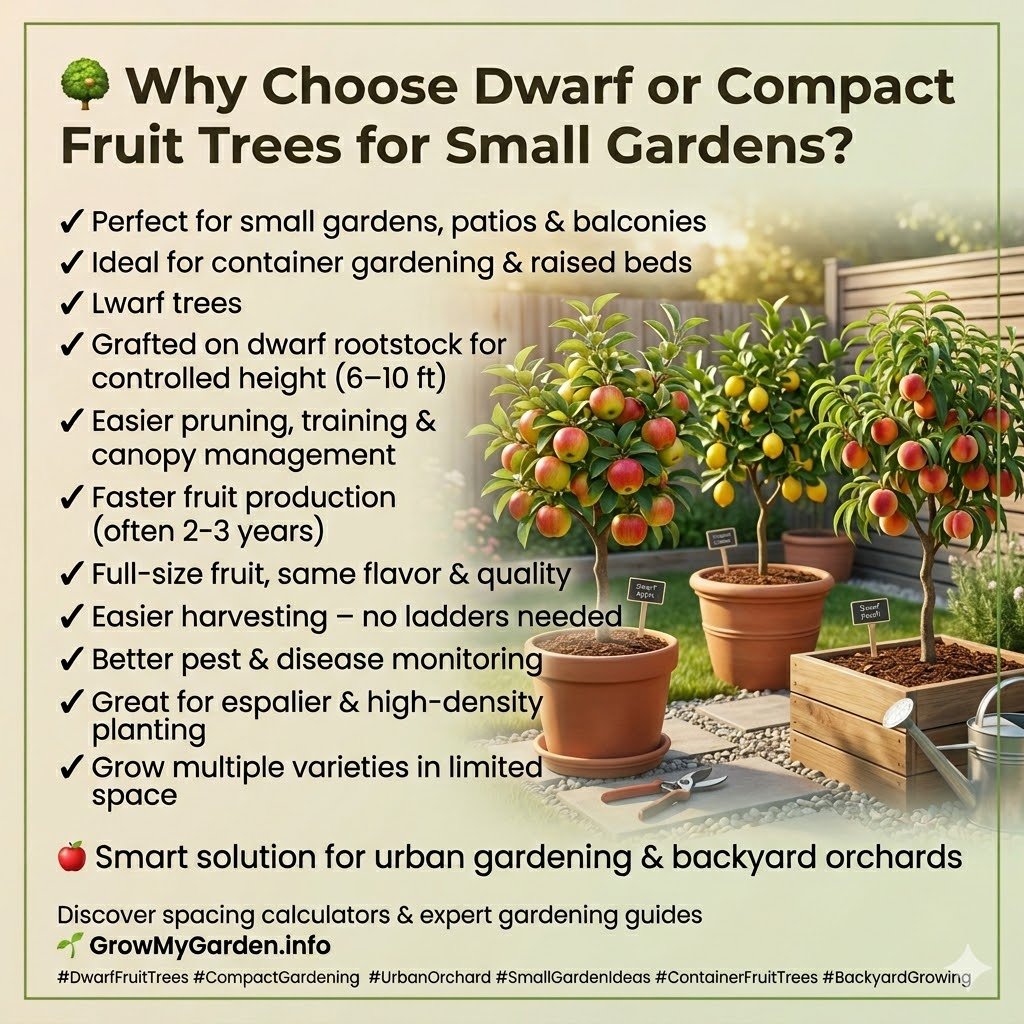
Why Choose Dwarf or Compact Fruit Trees for Small Gardens
The honest answer? Because a standard-size fruit tree in a small garden is like parking a lorry in a Mini’s space. It technically fits, but nothing else does.
Dwarf fruit trees — grafted onto size-controlling rootstocks — are bred to stay manageable. Most top out at 6–10 feet tall with a modest canopy spread of 4–8 feet, which means they behave themselves. You can reach the fruit without a ladder, prune without acrobatics, and actually still have room for a table and chairs.
Beyond size, there are real practical advantages:
Earlier fruiting. Dwarf trees typically produce fruit in 2–3 years versus 5–7 for a full standard tree.
Easier pest control and harvesting. Everything is at eye level — you’ll actually notice aphids on fruit trees before they become a problem.
Flexible placement. Columnar fruit trees, in particular, can slot into a border just 18 inches wide.
Container-friendly. Many semi-dwarf and patio varieties thrive in large pots, which is a genuine game-changer for balcony gardens and terraces.
A quick note on rootstocks: The rootstock controls the tree’s eventual size — not the fruit variety itself. An apple labeled “M9 rootstock” will stay genuinely dwarf (around 6–8 ft). “MM106” gives a semi-dwarf. “M25” gives you a full-size tree that belongs in an orchard. Always check the rootstock when buying, especially online.
There’s also a rewarding lifestyle angle to this. Growing homegrown fruit, even a small yield, reconnects you with where food actually comes from. A productive garden — however compact — quietly attracts pollinators like bees and butterflies, supports garden biodiversity, and gives you something genuinely fresh that no supermarket can replicate.
Even a courtyard garden can produce real, meaningful harvests… 👉 Estimate your harvest yield →
Best Fruit Trees for Small Gardens: Top Picks
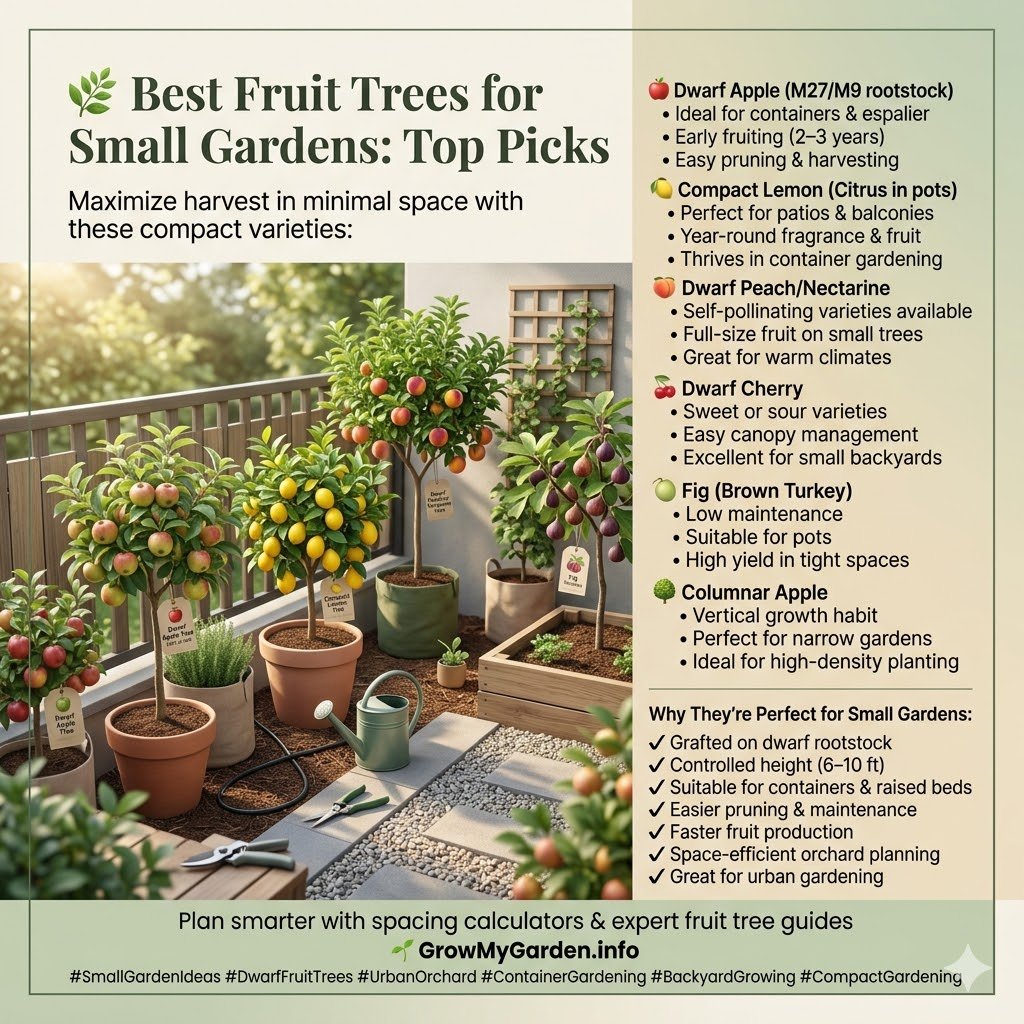
After years of trial, error, and a few genuinely disappointing harvests, these are the varieties I’d plant without hesitation in a small space. I’ve focused on self-fertile fruit trees where possible, because in a small garden you rarely have room for a dedicated pollination partner.
Dwarf Apple Tree
Rootstock: M9 or M26 Mature height: 6–10 ft Self-fertile varieties: ‘James Grieve,’ ‘Greensleeves,’ ‘Braeburn’ Harvest season: August–October depending on variety USDA hardiness zones: 4–8
The classic choice, and for good reason. ‘James Grieve’ is RHS recommended, reliable in UK conditions, and genuinely self-fertile. Columnar apple varieties like ‘Flamenco’ and ‘Bolero’ are worth considering if your border is especially narrow — they grow upright like a green exclamation mark and take almost no lateral space at all.
Dwarf Pear Tree
Rootstock: Quince A or Quince C Mature height: 8–12 ft Self-fertile varieties: ‘Conference,’ ‘Beth’ Harvest season: August–September USDA hardiness zones: 4–9
‘Conference’ is the most forgiving pear you’ll find — partially self-fertile, heavy cropping, and it tolerates a range of soil conditions better than most. Pears also respond beautifully to espalier training against a sunny wall, which stretches their value in tight spaces considerably.
Morello Cherry
Rootstock: Gisela 5 Mature height: 8–10 ft Self-fertile: Yes Harvest season: July–August USDA hardiness zones: 4–8
If your garden is shaded, the Morello is your best friend. It’s one of the rare fruit trees that actually tolerates partial shade, which makes it ideal for north-facing walls. The cherries are tart rather than sweet — brilliant for jams and baking. ‘Stella’ is the go-to sweet cherry variety if you have a sunnier spot to work with.
Fig Tree
Rootstock: Own-rooted Mature height: 6–15 ft (very manageable in a pot) Self-fertile: Yes Harvest season: August–September USDA hardiness zones: 7–11
Figs are actually better in pots because restricting the roots encourages fruiting rather than foliage. ‘Brown Turkey’ is the hardiest variety for UK gardens. In warmer climates, fig trees on a sunny terrace will fruit reliably with minimal fuss — they prefer dry summers and good drainage above all else.
Dwarf Lemon Tree
Rootstock: Trifoliate orange Mature height: 4–8 ft in a container Self-fertile: Yes Harvest season: Year-round (grown indoors or in a conservatory) USDA hardiness zones: 9–11 (or as a container tree brought indoors for winter)
‘Eureka’ and ‘Improved Meyer’ are the dwarf citrus tree workhorses. In the UK, they need to come inside over winter, but they thrive as patio trees in summer. Meyer lemons in particular are sweeter than supermarket varieties and almost addictively productive once they find their rhythm.
‘Eureka’ and ‘Improved Meyer’ are the dwarf citrus tree workhorses… → Interested in growing your own lemon tree? See our guide on How to Grow a Lemon Tree from Seed
Dwarf Peach and Nectarine
Rootstock: St. Julien A Mature height: 8–12 ft Self-fertile: Yes Harvest season: July–August USDA hardiness zones: 5–9
‘Peregrine’ peach and ‘Lord Napier’ nectarine are both self-fertile, disease-resistant varieties that work beautifully fan-trained against a warm south or west-facing wall. Peaches flower early, so frost protection in spring — a simple fleece draped over the blossom on cold nights — makes the difference between a harvest and heartbreak.
Quince Tree
Rootstock: Quince A Mature height: 10–15 ft (very manageable with annual pruning) Self-fertile: Yes Harvest season: October–November USDA hardiness zones: 5–9
The underrated gem of the small garden. Quince trees are ornamental enough to earn their space even without fruit — beautiful blossom in spring, golden fruit in autumn. They’re forgiving of poor soil and partial shade, and a single tree gives a surprising yield of fruit that makes extraordinary membrillo and jelly.
Dwarf Plum Tree
Rootstock: Pixy or St. Julien A Mature height: 8–10 ft on Pixy rootstock Self-fertile varieties: ‘Victoria,’ ‘Opal’ Harvest season: August–September USDA hardiness zones: 4–9
‘Victoria’ plum on a Pixy rootstock is arguably the single most reliable fruit tree for a UK small garden. It’s self-fertile, heavy-cropping, and the plums are genuinely delicious. The Pixy rootstock keeps it compact enough to manage in a border or large pot — one of those plants that earns its place every single year without being asked twice.
Growing Fruit Trees in Containers and Pots
If your garden is essentially a paved courtyard, a balcony, or a terrace with no planting borders, containers aren’t a compromise — they’re a legitimate way to grow fruit trees. In some cases, figs being the clearest example, container growing produces better results than open ground.
The trick is getting the setup right from the start. A fruit tree shoved into a too-small pot with the wrong compost will sulk for years and barely fruit.
Choosing the Right Pot
Start with a pot at least 40–50cm (16–20 inches) in diameter, and go larger whenever possible — 60–75cm is ideal for most patio fruit trees. Heavy-duty plastic or glazed terracotta are both fine; unglazed terracotta dries out far too quickly in summer and isn’t worth the hassle. Make sure there are proper drainage holes — multiple, large ones. Fruit tree roots sitting in waterlogged compost is a fast route to root rot.
The Right Growing Mix
Avoid generic multipurpose compost on its own — it breaks down too quickly, compacts, and holds too much moisture. Mix John Innes No. 3 (a loam-based compost) with about 20% horticultural grit for drainage. This combination stays structured for several years between repottings and gives roots something to grip.
Watering and Feeding Schedule
Container-grown trees are entirely dependent on you for water and nutrition. In summer, that can mean watering every day during a heatwave. A moisture meter — something like the basic XLUX T10 or a similar probe — takes the guesswork out and prevents both over- and under-watering.
Container-grown trees are entirely dependent on you for water… 👉 Calculate your watering schedule →
From early spring through late summer, feed every two weeks with a high-potassium liquid fertilizer. Tomato feed works well and is cheap. Switch to a slow-release organic fertilizer in autumn to help harden new growth before the first frost arrives.
Feed every two weeks with a high-potassium liquid fertiliser from early spring through late summer. 👉 Figure out how much fertilizer you need →
Repotting and Long-Term Care
Every 3–4 years, either repot into a larger container or — if you’ve hit the maximum manageable pot size — do a root prune. Remove the tree, trim the outer 3–4 inches of root ball with clean secateurs, refresh the compost, and replant. It sounds drastic but trees handle it remarkably well and it resets their growth cycle nicely. Tree staking with a short bamboo or metal cane is worth doing in the first couple of years until the root system anchors properly.
→ Growing fruit in containers? Strawberries are another excellent pot crop — here’s how to grow them
Espalier and Wall-Trained Fruit Trees for Tight Spaces
If there’s one technique that genuinely transforms a small garden’s fruit-growing potential, it’s training trees flat against walls or fences. It sounds fussy, but once you understand the logic — it’s really just guided pruning — it becomes one of the more satisfying things you can do in a garden.
Espalier and wall-trained trees have been used in kitchen gardens for centuries, and for good reason. A tree trained flat against a 6-foot wall produces surprisingly good yields while occupying almost zero garden floor space. These trees also benefit from the warmth a wall radiates, which is particularly valuable for peaches, apricots, and figs that need heat to ripen well in cooler climates.
Main Training Methods
Espalier — Horizontal tiers of branches trained outward from a central stem. Best for apples and pears. Needs 8–15 feet of width and 6–8 feet of height.
Fan — Branches radiate outward like a fan from a short trunk. Best for peaches, cherries, apricots, and figs. Needs 10–15 feet of width.
Cordon — A single diagonal stem with short fruiting spurs. Best for apples and pears. Each tree only needs 18–24 inches of space, so you can fit several in a row.
Step-over — A single horizontal tier trained at knee height. Works beautifully as a garden border edge. Best for apples and pears in a kitchen garden setting.
Cordons are genuinely underrated for small spaces. You can fit 4–5 cordon apple trees in the same wall space a single standard tree would occupy, which means you can grow multiple varieties — useful if you need cross-pollination — without sacrificing much room at all.
How to Set Up a Simple Espalier
- Fix horizontal wires to your wall or fence, spaced 18 inches apart, starting at about 18 inches from the ground. Use vine eyes and 14-gauge galvanized wire — it needs to last decades, not seasons.
- Plant your tree (apple or pear on a dwarfing rootstock) in front of the lowest wire, about 6–8 inches from the wall. Water thoroughly and stake loosely.
- In the first year, train two lateral shoots along the bottom wire and allow a central leader to grow vertically toward the next wire. Tie in with soft garden twine — never cable ties or bare wire directly on wood.
- Each subsequent year, train a new pair of laterals to the next wire up. Summer pruning in late July keeps side shoots compact and encourages fruit bud formation. Aim to cut new side growth back to 3 leaves from the base.
- Once the structure is established — usually after 4–5 years — maintenance is mostly light summer pruning and an annual winter prune to keep the shape tidy and air flowing freely through the canopy.
Self-Fertile vs Cross-Pollinating: Which is Right for You?
This is the question that trips up most new fruit growers, and it’s genuinely important to get right before you buy.
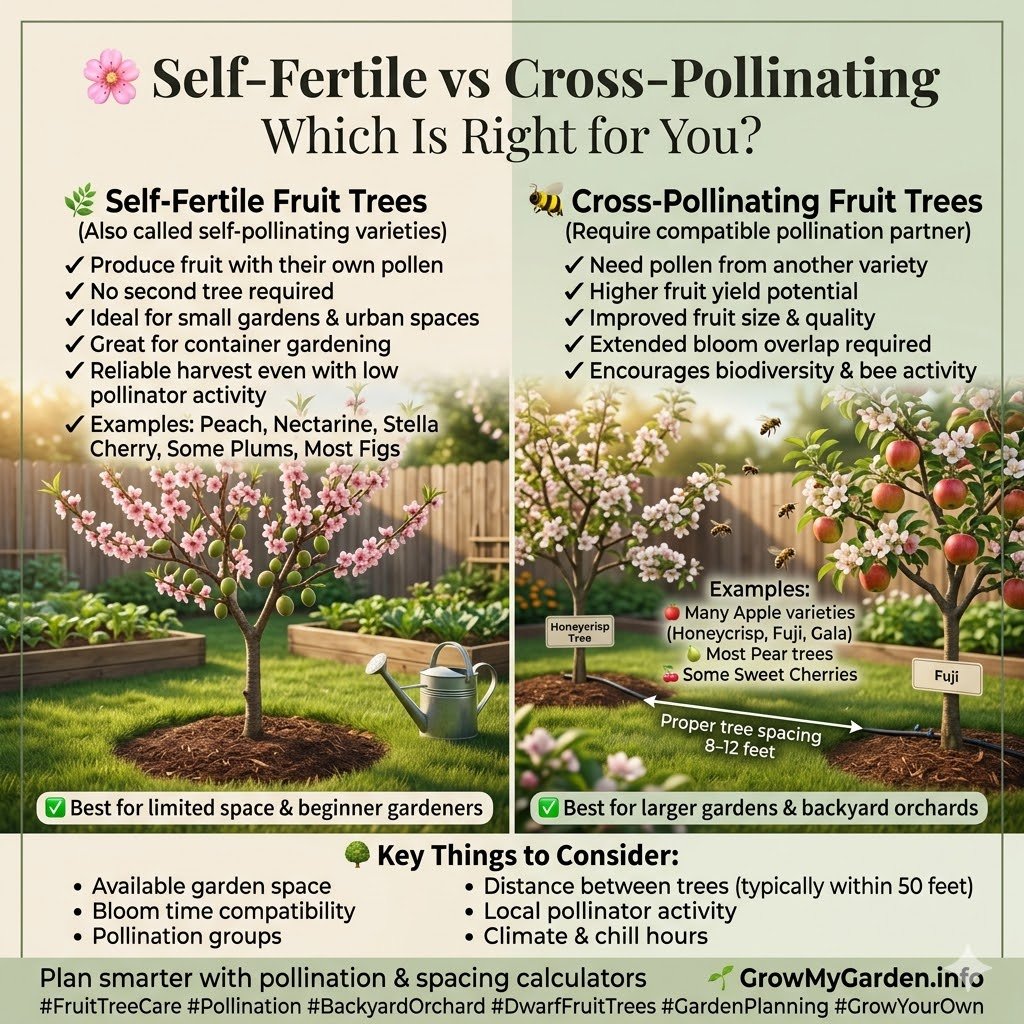
Self-pollinating varieties can fertilise their own flowers — meaning a single tree will produce fruit without needing a partner nearby. Cross-pollinating trees need a compatible variety growing within range (bees typically cover 50–100 feet without much effort) to set a meaningful crop. Plant one cross-pollinating tree alone and you’ll get blossom every spring and an empty fruit bowl every autumn.
Trees That Do Fine on Their Own
The following fruit types reliably produce as a single tree, which makes them ideal for small gardens where there’s no room — or inclination — for a second tree planted purely as a pollen donor:
- Most plum varieties, including ‘Victoria’ and ‘Opal’
- Morello cherry and most sweet cherry varieties
- Fig
- Quince
- Apricot (most varieties)
- Peach and nectarine (most varieties)
- Lemon and kumquat
What About Apples and Pears?
Most apple and pear varieties need a cross-pollinating partner to fruit reliably. A handful — ‘James Grieve’ and ‘Greensleeves’ for apples, ‘Conference’ pear — are partially self-fertile and will give some fruit alone, but consistently better crops with a compatible variety nearby.
If you only have room for one apple but want reliable yields, a family tree is a clever workaround. These are single trees grafted with 2–3 compatible varieties on one rootstock. They’re widely available from specialist nurseries like Keepers Nursery or Orange Pippin Trees in the UK.
One thing worth checking before you assume you need a second tree: your neighbours’ fruit trees count as pollinators. If you’re in an urban or suburban area with other gardens nearby, there’s a good chance compatible trees are already within pollinating range even if you can’t see them over the fence.
Planting, Pruning, and Care Tips for Small Garden Fruit Trees
When and How to Plant
Bare-root trees — sold dormant with no compost around their roots — are the most economical way to buy fruit trees, and they’re available from late autumn through early spring (roughly November to March in the UK). This is also the best time to plant them: the roots establish quietly over winter before the tree puts its energy into spring growth.
Bare-root trees are available from late autumn through early spring… 👉 Find your exact planting dates →
Container-grown trees can technically be planted year-round, but spring or autumn gives the best start. Avoid planting in a summer heatwave or into frozen ground.
Step 1: Dig a planting hole roughly twice the width of the root ball and the same depth. You want the graft union — the knobbly join between rootstock and variety — to sit about 4 inches above soil level. Burying the graft union encourages the tree to send out its own roots and bypass the size-controlling rootstock, which defeats the entire purpose.
Step 2: Improve the soil. Fork the base of the hole to break up any compaction, and mix in a handful of bone meal or a slow-release organic fertiliser. Don’t add large amounts of fresh compost into the hole — it encourages roots to stay in the enriched zone rather than spreading outward.
Step 3: Position and backfill. Place the tree, check the graft union depth, and backfill with the excavated soil, firming gently as you go. Water thoroughly — even in winter — to settle any air pockets around the roots.
Step 4: Stake and mulch. A short stake angled at 45 degrees is more wind-stable than a vertical one for young trees. Lay a 3-inch layer of bark mulch around the base, keeping it clear of the trunk itself. This suppresses weeds and retains soil moisture through summer dry spells.
Pruning Essentials
Pruning intimidates a lot of people, but the core logic is simple. Winter pruning promotes growth — you’re encouraging the tree to push energy into new wood. Summer pruning restricts growth and encourages fruit bud formation. For small gardens, summer pruning is often the more valuable of the two.
For freestanding dwarf trees, the main winter pruning tasks are removing dead, damaged, or crossing branches; thinning the canopy to let light and air in; and shortening any excessively vigorous shoots by about a third. Do this between November and February while the tree is fully dormant.
Avoid winter pruning stone fruits — cherries, plums, peaches, and apricots — due to the risk of silver leaf disease entering through open wounds in cold, wet conditions. Prune those in summer instead, between May and August, when the sap is flowing and cuts heal cleanly.
Thinning Fruit
This is the task most beginners skip and then regret. When trees set more fruit than they can carry to full size — which young trees often do — the result is dozens of small, flavourless fruits and, worse, branches that snap under the weight.
In June or July, during the natural “June drop” period when trees shed excess fruit themselves, go through the remaining clusters and thin to one fruit per cluster, spaced about 4–6 inches apart. It’s painful to remove fruit you’ve been waiting months for, but the fruits that remain will be dramatically larger and better flavoured. Think of it as editing — fewer, better.
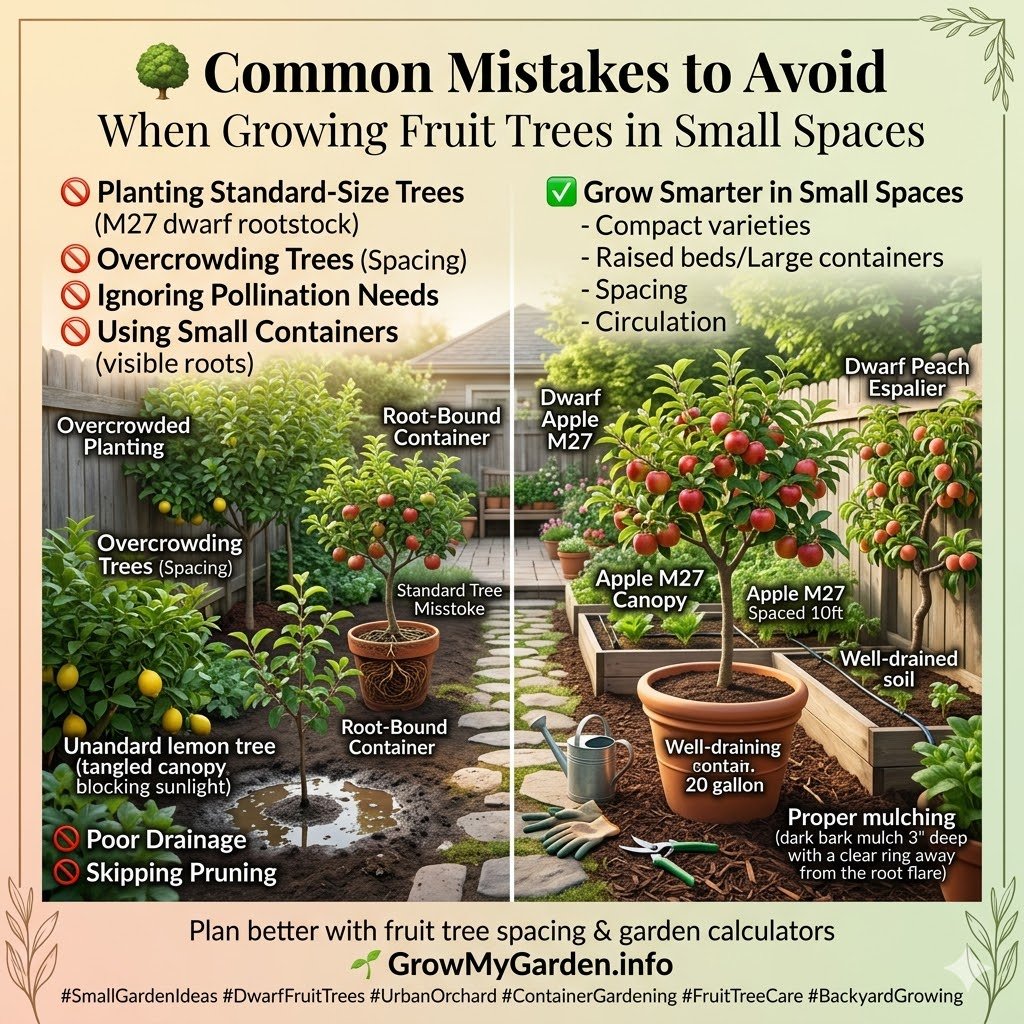
Common Mistakes to Avoid When Growing Fruit Trees in Small Spaces
Most fruit tree failures aren’t down to bad luck. They come down to a handful of repeatable mistakes that are entirely avoidable once you know what to watch for.
Buying the wrong rootstock. A mislabeled or unknown rootstock is the fastest way to end up with a full-size tree where you wanted a compact one. Always buy from reputable specialist nurseries — not garden centre impulse buys — where the rootstock is clearly stated. If you’re in the UK, the RHS Plant Finder is a useful reference for tracking down verified suppliers.
Planting too close to walls or fences. The temptation to push trees right against a boundary is understandable, but roots need room. Even a dwarf tree should be planted at least 18–24 inches away from a solid wall. The soil immediately against a wall is also often very dry due to the rain shadow effect — rain simply never reaches it.
Ignoring pollination requirements. One self-fertile tree will fruit reliably. One cross-pollinating tree planted alone will give you blossom and nothing else for the rest of its life. Check this before you buy — it’s written on the label or clearly listed on the nursery’s website.
Overwatering (or forgetting to water) container trees. Waterlogged roots rot; parched roots drop fruit early. Container trees can’t regulate their own water supply the way ground-planted trees can. A simple moisture meter takes ten seconds to use and removes all the uncertainty.
Pruning stone fruits in winter. Plums, cherries, peaches, and apricots are all susceptible to silver leaf and other fungal diseases when pruned in cold, wet winter conditions. The rule is easy to remember: if it has a stone in the middle, prune it in summer. May through August is the safe window.
Choosing the wrong variety for your climate. Frost hardiness matters — especially around blossom time. A late spring frost can destroy an entire year’s crop even on a fully cold-hardy tree if the blossom is already open. If you’re in a frost-pocket garden or a cold northern area (USDA zone 5 or lower), look specifically for late-flowering varieties rather than just cold-hardy ones.
Not netting against birds. You’ll put months of care into a tree and a flock of starlings will clear every last fruit in an afternoon the moment it starts to colour up. Fleece netting over smaller trees is cheap and effective. For wall-trained trees, a permanent framework with clip-on netting is worth the investment if birds are persistent visitors in your area.
Quick Answers to Common Questions
How much space does a fruit tree need in a small garden? A dwarf fruit tree on an M9 or M27 rootstock needs as little as 4–6 feet of space in all directions. Columnar varieties can fit into as little as 18 inches of border width. For container growing, a 50–75cm pot handles most compact varieties comfortably. The key variable — always — is the rootstock.
A dwarf fruit tree on an M9 or M27 rootstock needs as little as 4–6 feet of space… 👉 Use the Plant Spacing Calculator →
Can you grow fruit trees in pots? Yes, and some trees perform better in pots than in open ground. Figs are the most obvious example — container growing restricts the roots and pushes the tree toward fruit production rather than leaf production. Dwarf lemons, kumquats, patio peaches, and plums on Pixy rootstock all do well in containers with the right potting mix and regular feeding.
What is the easiest fruit tree to grow? ‘Victoria’ plum on a Pixy rootstock is hard to beat for ease. Self-fertile, relatively disease-resistant, forgiving of imperfect pruning, and reliably productive. Fig trees in containers are also a strong beginner choice — they need minimal pruning, handle occasional neglect, and are genuinely interesting to grow.
How tall do dwarf fruit trees grow? True dwarf trees on M9, M27, or Pixy rootstocks typically reach 6–10 feet at maturity. Semi-dwarf trees reach 10–15 feet. Annual pruning can keep any tree somewhat smaller than its natural ceiling, within reason — though you can’t prune your way to a 5-foot tree if the rootstock wants to reach 15.
Which fruit trees grow in partial shade? Morello cherry is the standout choice for shaded positions and will perform reliably on a north-facing wall. Quince trees also tolerate partial shade better than most fruit trees. That said, most fruit trees want full sun — at least 6 hours of direct sunlight daily — for reliable cropping. Shade reduces yields even on tolerant varieties, so manage expectations accordingly.
Small gardens reward intentional choices far more than large ones. Every tree earns its place twice — once in blossom and once in fruit. Start with one or two self-fertile trees in the right spot, get the rootstock right, and resist the temptation to cram in more than your space allows. A single well-chosen ‘Victoria’ plum or fan-trained peach, harvested at its peak on a warm August afternoon, is worth considerably more than a dozen stressed trees fighting over the same patch of ground.




Leave a Comment