

How to Grow a Lemon Tree from Seed (The Complete, No-Fluff Guide)
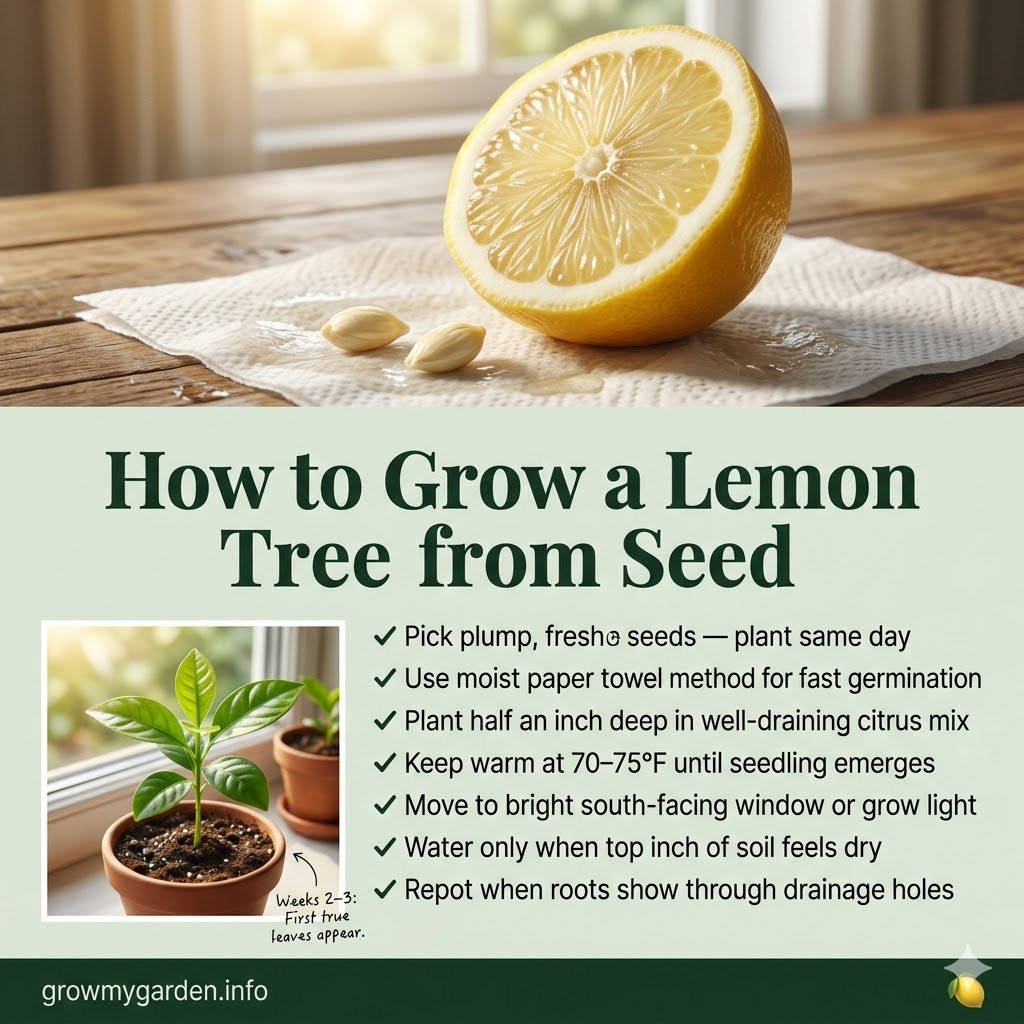
The day I pulled a seed from a grocery store lemon and actually grew it into a thriving tree, I realized most gardening guides were skipping the most important parts. Learning how to grow a lemon tree from seed is not complicated, but it does demand the right start. Everything begins with fresh lemon seeds — plump, moist, and planted before they dry out.
Understanding seed viability early saves you weeks of waiting on duds. Most beginners overlook lemon seed germination conditions like warmth and humidity, which are honestly the whole game. Nail those basics, and citrus seed sprouting happens faster than you’d expect. This guide covers every stage, no fluff included.
If you want to know how to grow a lemon tree from seed — not just the textbook version, but what actually happens at each stage — this guide covers everything. The good, the slow, and the occasional dead seedling you had to say goodbye to. Read our complete Fruit Gardening guide.
Why Bother Growing from Seed at All?
Fair question. A grafted lemon tree from a nursery will fruit faster, sometimes within two or three years. A seed-grown tree takes longer — often five to fifteen years before you see actual lemons. So why do so many gardeners still choose seeds?
Because the process itself is the point.
A seed-grown tree is something you watched come to life from scratch. The lemon seed germination phase, the first tiny sprout, the moment you realize the seedling needs a bigger pot — every stage builds a kind of investment you just do not get when you buy a three-gallon tree off a shelf.
There is also the matter of fresh lemon seeds being essentially free. You eat the lemon, you plant the seeds. If a few do not make it, you are not out anything. Read How to Grow Avocado From Seed Indoors.
Seed Selection and Prep: Start Here or Struggle Later
This stage gets skipped over in most gardening guides. Do not skip it.
Which Lemon Variety Should You Grow?
Three varieties dominate home growing in the US:
Eureka lemon — The standard grocery store lemon you probably already have in your refrigerator. Reliable, true-to-type, and widely grown in California and Arizona.
Lisbon lemon — Very similar to Eureka, slightly more cold-hardy, and common across the Southwest. Great for zones on the cooler edge.
Meyer lemon — Technically a cross between Citrus limon and a mandarin orange, but commonly grouped with lemons. Meyer lemons are more cold-tolerant, produce sweeter fruit, and are excellent for growing in pots indoors. If you live in a state north of USDA hardiness zone 9, Meyer is often the smarter starting choice.
Timing your planting correctly makes a real difference, especially if you plan to move your tree outdoors for summer. Use the Planting Date Calculator to find the ideal sowing and transplanting window for your specific climate zone.
For most beginners in the US, start with whatever lemon you have in the kitchen. Eureka seeds are widely available and perform well.
Seed Viability: Pick the Right Seeds
Slice open a ripe lemon and look carefully. Seed viability matters enormously here. You want seeds that are plump, firm, and creamy-white in color. Avoid anything thin, wrinkled, or see-through — those are typically hollow or underdeveloped and will not germinate.
Here is something most articles do not mention: lemons are often polyembryonic, meaning a single seed can contain multiple embryos. When a polyembryonic seed sprouts, it may send up two or even three shoots. This is actually useful because one of those shoots will usually be genetically identical to the parent tree, giving you a more predictable result than a regular seed-grown plant.
Rinse your seeds under cool water to remove all pulp. Do not let them dry out completely. Lemon seeds lose viability fast once they desiccate, so plant them the same day you remove them, or wrap them in a damp paper towel and refrigerate for no longer than two to three days.
Removing the Seed Coat
This is optional but genuinely worth doing. The outer papery layer around the seed (the seed coat) can slow germination by several days. Using a pair of tweezers, gently peel it back to expose the green or cream-colored embryo inside. Work slowly — nick the embryo and the seed is done.
This single step has consistently improved my germination rate citrus-wide by one to two weeks.
Step-by-Step: How to Germinate Lemon Seeds
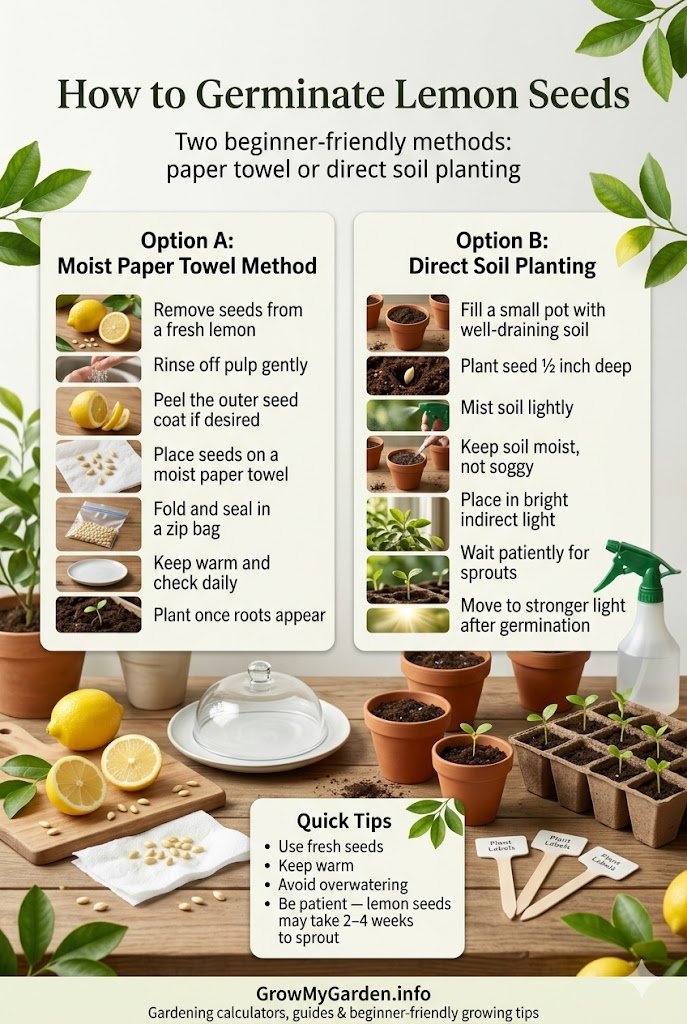
Option A: The Moist Paper Towel Method
This is my preferred starting method because you can visually monitor progress without disturbing the seeds.
- Dampen a paper towel until it is moist but not dripping.
- Lay your prepared seeds on one half of the towel and fold the other half over them.
- Slide the towel into a Ziploc bag and seal it, leaving a small gap for airflow.
- Place the bag somewhere warm — 70 to 75 degrees Fahrenheit is ideal. The top of a refrigerator, near a heat vent, or on a seedling heat mat all work.
- Check every two days. You are looking for a small white root emerging from the seed.
- Once the root is about a quarter inch long, transfer the seed to soil immediately.
Most seeds using this method show citrus seed sprouting within seven to fourteen days. Some take up to three weeks, especially if your space runs cooler.
Option B: Direct Soil Planting
If you prefer planting straight into pots:
- Fill a small 3-inch pot with a well-draining soil mix — I use 70 percent potting soil with 30 percent perlite. Sandy loam works well too. Avoid anything labeled “moisture control” as those formulas retain too much water for citrus.
- Push each seed half an inch deep, pointed end down.
- Water gently and cover the pot with a clear plastic bag or humidity dome.
- Set in a warm location and maintain consistent moisture by misting daily.
With this method, seedling emergence typically happens within two to three weeks.
Planning to start a batch of seeds across multiple pots for better odds? The Seed Quantity Calculator helps you figure out exactly how many seeds to gather before you start — useful if you are saving seeds from several lemons at once.
The Seedling Stage: What to Do When Green Appears
The moment a sprout breaks soil is exciting. What happens next is critical.
First True Leaves
Your seedling will first produce two rounded, smooth leaves called cotyledons. These are not true leaves — they are the seed’s stored energy reserves doing their job. Wait for the first true leaves, which are pointed, slightly glossy, and shaped like actual lemon leaves. Those typically appear within two to four weeks of germination.
Once the first true leaves are fully open, remove the plastic covering and move the plant into bright light.
Light Requirements
Lemon trees are sun-hungry. They want a minimum of six to eight hours of full sun per day. A south-facing window is your best friend indoors. If your home does not have strong natural light — mine definitely does not during Pacific Northwest winters — a grow light is not optional, it is necessary.
I use an LED grow light on a timer set to run fourteen hours daily. The Govee smart plug app handles scheduling automatically. This setup has worked consistently for three consecutive seedlings.
Thinning Seedlings
If you planted multiple seeds in one pot and several germinated, you will need to thin seedlings down to one per pot. Choose the strongest, tallest shoot and remove the others by snipping at soil level. Do not pull — that disturbs the roots of your keeper.
If a polyembryonic seed produced multiple shoots, keep the most vigorous one unless the shoots are clearly growing as separate plants, in which case you can carefully separate and pot them individually.
Soil, Potting, and Repotting
Best Soil for Lemon Trees
Lemon trees want a slightly acidic soil pH, somewhere between 5.5 and 6.5. Most quality citrus potting mixes hit this range. Brands like Miracle-Gro citrus soil and Fox Farm Ocean Forest are popular among US home growers and widely available at Home Depot and Lowes.
Moving your lemon tree into a larger container or planning an outdoor raised bed? Instead of guessing how many bags of citrus mix to buy, use the Raised Bed Soil Calculator to get an exact estimate based on your container dimensions.
If you mix your own, combine potting soil with perlite and peat moss. Perlite improves drainage; peat moss lowers pH slightly and adds lightness. Add a bit of organic matter, like worm castings, for slow nutrient release.
Container Size for Lemon Trees
Start small. A 3-inch or 4-inch pot is plenty for a seedling. Oversized pots hold excess moisture that roots cannot absorb, which leads to root rot faster than almost anything else.
Progress through containers as the tree grows:
- Seedling stage: 3 to 4-inch pot
- 6 months to 1 year: 1-gallon pot
- Year 1 to 2: 3-gallon pot
- Year 2 onward: 5 to 15-gallon pot depending on how large you want to go
Terracotta pots are excellent for citrus because they breathe and allow excess moisture to escape through the walls. Always choose containers with drainage holes — no exceptions.
Repotting lemon trees should happen when roots begin circling the bottom or emerging from drainage holes. Root-bound symptoms include stunted growth, leaves yellowing despite adequate watering, and soil drying out unusually fast.
Watering, Fertilizing, and Light: The Ongoing Care
Watering Frequency
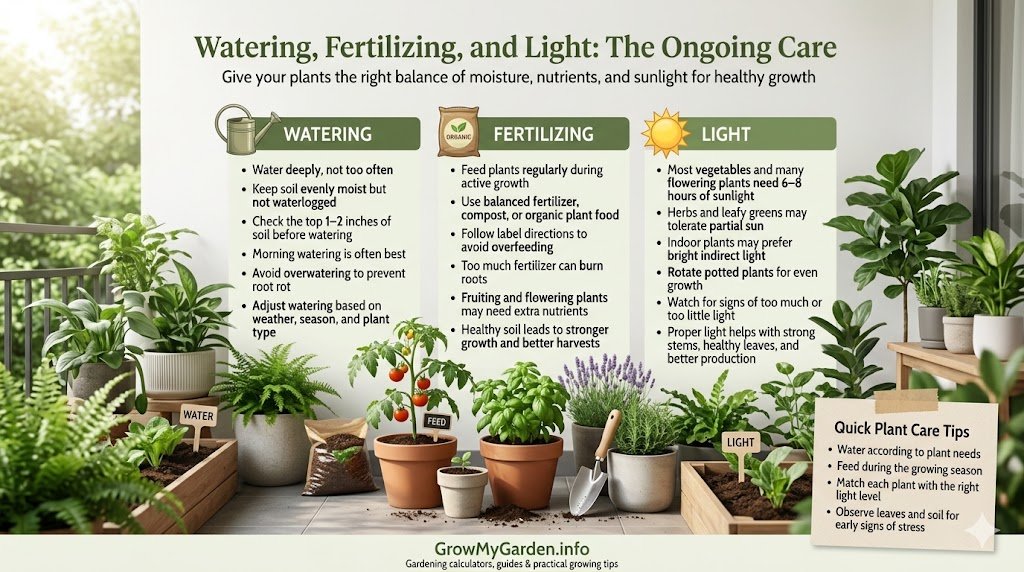
Not sure how much water your potted lemon tree actually needs each week? It depends on your climate zone, pot size, and season. Use the Watering Schedule Tool at GrowMyGarden to get a personalized weekly watering estimate — no guesswork involved.
Water when the top inch of soil feels dry. Stick your finger in — if it comes out with damp soil clinging to it, wait another day. Overwatering symptoms include yellowing leaves lemon tree owners see most often, mushy stems near the soil line, and a sour smell from the pot.
During active growing season (spring through early fall), water more frequently. In winter, back off significantly.
Fertilizing
Lemon trees are heavy feeders and need a nitrogen-rich fertilizer to stay green and healthy. Look for a citrus fertilizer NPK ratio with a higher first number — something like 6-3-3 or 8-4-4.
Knowing the right NPK ratio is one thing — knowing exactly how much fertilizer to apply to your specific pot size is another. Skip the measuring guesswork with the Fertilizer Calculator at GrowMyGarden. Enter your container size and it does the math for you.
During the growing season, feed every two to three weeks with a liquid citrus fertilizer. A slow-release fertilizer like Osmocote for citrus worked into the top layer of soil also does well for a set-it-and-forget-it approach. Stop feeding from November through February when the tree slows its growth.
Humidity
Citrus trees prefer humidity levels around 50 percent. In dry climates or during heated winters, the air inside most US homes drops well below that. A small humidifier nearby works well. Alternatively, place the pot on a tray of pebbles filled with water — evaporation from the tray adds moisture to the surrounding air without wetting the roots.
Pest and Disease Management
Indoor lemon trees are not immune to problems. Here are the ones you are most likely to encounter.
Scale insects are small, brown, waxy bumps that cling to stems and leaf undersides, sucking sap from the plant. Wipe them off manually with a cotton swab dipped in rubbing alcohol, or spray with diluted neem oil.
Citrus leafminer is a tiny moth larva that tunnels through young leaves, leaving a squiggly silvery trail. Damage looks alarming but rarely kills a healthy tree. Remove badly affected leaves and apply spinosad-based spray if the infestation is heavy.
Fungal disease prevention comes down to airflow and avoiding wet foliage. Do not splash water on the leaves when watering, keep the tree in a space with some air circulation, and avoid letting fallen leaves sit in the pot.
If you grow your tree outdoors in the Southeast, be aware of citrus greening disease (also called HLB), a bacterial disease spread by the Asian citrus psyllid. There is no cure, so prevention through pest control and buying certified disease-free nursery stock is important.
Grafting vs. Seed Grown: An Honest Comparison
If fruiting quickly is your primary goal, a grafted tree is the better choice. Grafting bypasses the juvenile phase citrus trees go through when grown from seed — that long period where the tree simply grows but does not flower or fruit.
Seed-grown trees can take anywhere from five to fifteen years to fruit. Lemon tree growth rate from seed is also slower overall in the early years compared to grafted trees, which have a mature root system from the start.
That said, a seed-grown tree often grows into a more robust, long-lived plant. And if indoor beauty, the extraordinary fragrance of lemon tree flowering season, and the personal satisfaction of growing from scratch matter to you — seed growing is absolutely worth it.
Pollination Indoors: Does It Happen Automatically?
Yes, but sometimes it needs help. Lemon trees are self-fertile, meaning they do not need a second tree to produce fruit. However, indoors there are no bees or wind to move pollen around.
When your tree flowers, gently use a small paintbrush or a cotton swab to transfer pollen from one flower to another. Brush the center of each open flower, moving from bloom to bloom. Do this every day while the flowers are open. This simple step of pollination lemon tree indoors can make the difference between a tree that drops all its flowers and one that sets actual fruit.
FAQ: Real Questions, Straight Answers
Can you grow a lemon tree from a seed? Yes, absolutely. Lemon seeds from a grocery store lemon germinate reliably when kept warm and moist. Most seeds sprout within one to three weeks under proper conditions.
How long does it take to grow a lemon tree from seed? Germination happens in one to three weeks. Growing to a mature, fruit-producing tree takes five to fifteen years from seed, though some growers see flowers as early as year four under ideal conditions.
Do lemon trees grown from seed produce fruit? Yes, though it takes much longer than grafted trees. Seed-grown trees eventually reach maturity and can fruit just as prolifically as their grafted counterparts. The wait is the trade-off.
How to germinate lemon seeds fast? Remove the seed coat (the papery outer layer), use the moist paper towel method, and keep temperatures at 70 to 75 degrees Fahrenheit with a seedling heat mat. This combination typically produces sprouting within seven to ten days.
Should I dry lemon seeds before planting? No. This is one of the most common mistakes. Drying lemon seeds kills or severely reduces seed viability. Plant fresh lemon seeds immediately after removing them from the fruit, or store them wrapped in a damp paper towel for no more than two to three days.
What is the best soil for lemon seeds? A light, well-draining mix with a slightly acidic soil pH between 5.5 and 6.5. A blend of quality potting soil and perlite works well. Avoid heavy, moisture-retaining mixes.
How deep should I plant a lemon seed? About half an inch deep, pointed end facing down. Do not plant deeper — lemon seedlings are small and need to push through as little soil as possible.
When should I transplant lemon seedlings? Once the seedling has developed its first true leaves and outgrown its starter pot. Look for roots emerging from drainage holes as a clear signal it is time to move up one container size.
Why is my lemon seedling dying? The most common causes are overwatering, insufficient light, or temperatures that are too cold. Check that your soil drains properly, your light source is strong enough (at least six hours daily), and your space stays above 60 degrees Fahrenheit at night.
Can lemon trees grow in cold climates? Not outdoors year-round. In USDA hardiness zones below 9, lemon trees need to spend winters indoors. Grown in containers, they can thrive anywhere in the US as long as they are brought inside before nighttime temperatures drop below 50 degrees Fahrenheit.
Growing a lemon tree from seed is not a weekend project. It is a years-long relationship with a plant that will test your patience, occasionally confuse you, and reward you with one of the most satisfying experiences in home gardening. The tree on my windowsill started as a seed pulled from a lemon I used to make tea. It is taller than me now.
Whatever stage you are at — holding seeds over your kitchen sink or nursing a leggy seedling back to health — you are part of a process that is genuinely worth seeing through.




Leave a Comment