
How Much Soil Do You Need for a 4×8 Raised Bed? (The Real Answer, Not the Guesswork)
I remember standing at Home Depot with a cart full of random soil bags, absolutely convinced I had enough. Spoiler alert: I did not. I came home, started filling my brand-new 4×8 raised bed, and ran out of mix halfway through. Two more trips to the store later, I finally had a full bed — but I also had a very annoyed spouse and a dent in my weekend budget.
That experience taught me something that no gardening YouTube video had bothered to explain clearly: the math behind filling a raised bed is not complicated, but it is easy to ignore. And when you ignore it, you waste money, waste time, and sometimes end up with a bed that never performs the way it should.
So let me walk you through exactly how much soil a 4×8 raised bed needs, what kind of growing medium actually works, how to calculate bags versus bulk delivery, and what mistakes to sidestep. If you have never done raised bed gardening before, treat this like the guide you wish you had found first.
For more read our complete Vegetable Gardening guide.
The Math First: Volume is Everything
A 4×8 raised bed is named for its footprint — four feet wide, eight feet long. But the number that actually drives how much soil you need is the third dimension: depth. And here is where a lot of beginners trip up.
The formula is simple:
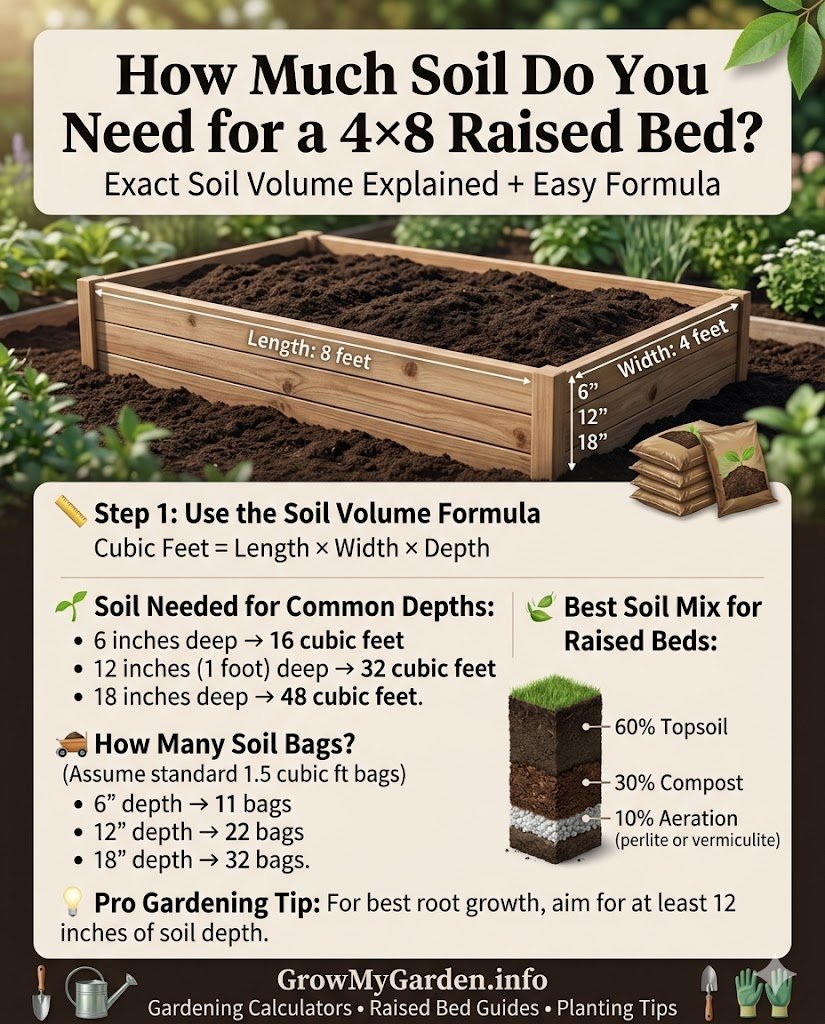
Length × Width × Height = Volume in cubic feet
For a standard 4×8 bed that is 12 inches (1 foot) deep:
4 × 8 × 1 = 32 cubic feet
If your bed is only 6 inches deep (common with shallow frame kits):
4 × 8 × 0.5 = 16 cubic feet
That is a massive difference — literally double the soil — depending on whether you build six inches high or twelve. This is why bed depth is arguably more important than bed width when budgeting for your garden.
Most experienced gardeners recommend at least 10 to 12 inches of depth for a proper vegetable garden bed. Root vegetables like carrots and beets need every bit of that depth. Even leafy greens benefit from loose, deep growing medium that allows for strong root health and good drainage.
The 27 Rule You Will Use Forever
Here is something worth saving to your notes app right now.
1 cubic yard = 27 cubic feet
This is sometimes called the “27 Rule,” and it becomes your best friend the moment you start pricing bulk soil delivery. When you call a local landscape supplier and they quote you a price per cubic yard, you can instantly do the conversion in your head.
For a 4×8 bed that is 12 inches deep, you need 32 cubic feet of soil. That is roughly 1.19 cubic yards. Most bulk deliveries have a one-yard minimum, so you are looking at a single yard of mix with a little left over for topping off after the soil settles — which it absolutely will.
For a 6-inch deep bed needing 16 cubic feet, that rounds out to just under 0.6 cubic yards. At that volume, buying bags may actually make more sense.
How Many Bags Do You Actually Need?
Walk into any garden center and you will mostly find soil sold in 1.5 cubic foot bags. Some brands sell 2 cubic foot bags. Premium mixes sometimes come in smaller 1 cubic foot quantities.
Using standard 1.5 cubic foot bags as your benchmark:
- 12-inch deep 4×8 bed (32 cubic feet): You need roughly 21 to 22 bags
- 6-inch deep 4×8 bed (16 cubic feet): You need roughly 10 to 11 bags
Always round up, not down. Soil settles after watering, sometimes quite dramatically in the first few weeks. I have seen freshly filled beds drop by two to three inches after the first good rain. Factor that into your planning.
Here is a quick buying reference:
| Bed Depth | Cubic Feet Needed | 1.5 cu ft Bags | 2 cu ft Bags |
|---|---|---|---|
| 6 inches | 16 cu ft | 11 bags | 8 bags |
| 10 inches | 26.7 cu ft | 18 bags | 14 bags |
| 12 inches | 32 cu ft | 22 bags | 16 bags |
Want to skip the math entirely? Our Raised Bed Soil Calculator handles every dimension — just enter your bed size and depth and it tells you exactly how many bags to buy. See the process practically.
Bags vs. Bulk Delivery: Which Makes More Sense for You?
This comes down to three things: volume, vehicle, and budget.
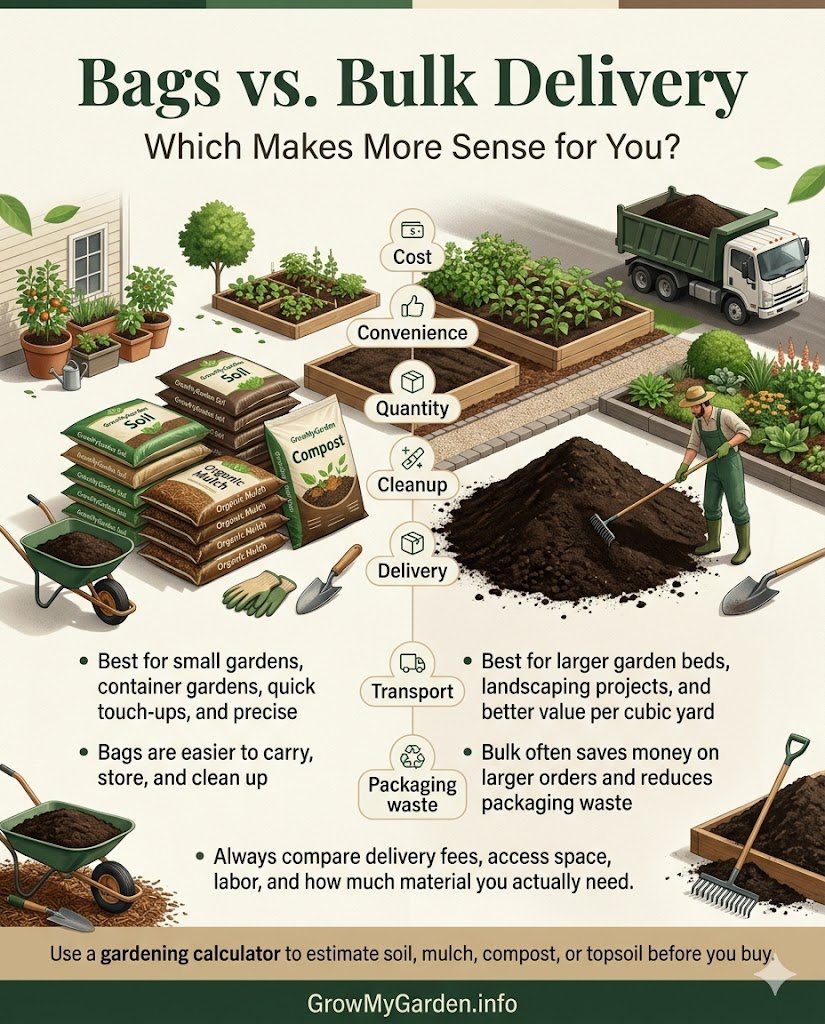
Buy bags if:
- You need fewer than 20 cubic feet
- You have a car, not a truck
- You want flexibility in mixing different soil products
- You are doing a raised bed gardening project for the first time and want control over every ingredient
Order bulk delivery if:
- You have multiple beds or a large project
- You want to save on cost per cubic foot (bulk is almost always cheaper at scale)
- You have somewhere to dump and store a cubic yard or two
- You are doing a landscaping-scale vegetable garden bed setup
Bulk soil delivery averages around $30 to $60 per cubic yard depending on your region and mix quality. A premium bagged mix can run $8 to $12 per 1.5-cubic-foot bag, putting your cost for a 12-inch deep 4×8 bed between $175 and $260 just in bagged product. That same volume of bulk compost-blend soil might cost $40 to $80 delivered in many parts of the country.
If you want to see the full picture — soil costs weighed against what you will actually grow — the Garden Cost Estimator compares your setup investment against estimated grocery savings over a season.
The math is hard to argue with when you are filling more than one bed.
What Kind of Soil Actually Goes In There?
This is where most first-timers make their biggest mistake. They assume “garden soil” from a big box store will do the job. It might work, but a purpose-built raised bed mix will dramatically outperform plain topsoil for one key reason: structure.
Native soil compacts. In a raised bed container, compacted growing medium chokes roots, kills drainage, and turns your beautiful garden into a sad, waterlogged mess by midsummer.
The gold standard for raised bed gardening is a blend that balances moisture retention, aeration, and organic matter. There are a few popular approaches:
The Classic 60/30/10 Mix
This is the most widely used blend for backyard vegetable beds:
- 60% topsoil — provides the bulk and mineral nutrients
- 30% compost — feeds microbial activity, adds organic matter, improves water retention
- 10% aeration material (perlite, pumice, or coarse sand) — keeps the mix from compacting and supports drainage
This blend performs well for most crops. It is forgiving, relatively affordable to build, and holds up over multiple growing seasons with annual top-dressing of fresh compost.
Mel’s Mix (The Square Foot Gardening Method)
If you have come across square foot gardening, you have probably heard of Mel Bartholomew’s iconic recipe:
- One third compost (ideally from multiple sources)
- One third peat moss or coco coir as a substitute
- One third vermiculite
Mel’s Mix is genuinely excellent for dense planting and high-yield vegetable gardens. Vermiculite is lighter than sand and holds moisture well without compacting. Coco coir is increasingly preferred over peat moss because it is a renewable byproduct rather than a harvested resource — and honestly, it performs comparably.
The downside? It is expensive upfront. Vermiculite and quality compost are not cheap. For a 12-inch deep 4×8 bed, building Mel’s Mix from scratch can cost $150 or more. But the soil structure it creates is genuinely impressive — loose, rich, and perfectly draining.
The Budget Fill Method
If cost is a real concern, gardeners have been improvising for centuries. One approach inspired by the Hügelkultur tradition involves layering organic material at the bottom of a deep bed — logs, straw, cardboard — and then topping with a thinner layer of quality soil mix. The organic material breaks down slowly, feeding the soil from below while reducing how much purchased mix you need to fill the bed.
This works best with beds that are 12 inches or deeper. A 4×8 bed filled with eight inches of organic base material might only need four to six inches of purchased soil blend on top, cutting your cost nearly in half.
Soil Amendments Worth Adding From Day One
Even a good commercial blend benefits from a few targeted amendments before your first planting. Not sure how much granular fertilizer to work in for a bed this size? The Fertilizer Calculator figures out the right amount by bed dimensions and fertilizer type
Compost is the most important of all. If you are building a 60/30/10 mix, your compost layer already handles this. If you bought a pre-bagged topsoil blend, mix in one to two inches of compost on top. It improves soil biology, moisture retention, and provides a slow, steady release of nutrients that keeps plants happy without burning.
Perlite or pumice added at roughly 10 to 15 percent by volume improves aeration dramatically, especially in clay-heavy native soil mixes. Think of perlite as little air pockets baked into your soil — roots love the breathing room.
A balanced organic fertilizer like a 10-10-10 granular blend worked into the top few inches gives your first round of plants a solid nutritional foundation. Raised beds drain more freely than in-ground beds, which means nutrients move through the soil faster. Feeding early and consistently matters.
Soil Settlement: Plan for It
Nobody warns you about this enough. Fill your bed, water it thoroughly, and watch it drop. Once your bed is filled and you are into your first growing week, the Watering Schedule Tool tells you exactly how much water your bed needs each week based on what you are growing. Sometimes two inches, sometimes three. Factors like how airy your mix is, how much perlite you used, and how deeply you water all influence the rate of settlement.
The solution is simple: slightly overfill on day one, or keep extra mix on hand to top off after the first week. I personally leave my beds about an inch above the frame edge, knowing they will settle flush or just below after the first few waterings. Explore Grow Tomatoes in Pots.
A Step-by-Step Walkthrough for First Timers
Here is how to approach filling a 4×8 raised bed from scratch, assuming a 12-inch frame depth:
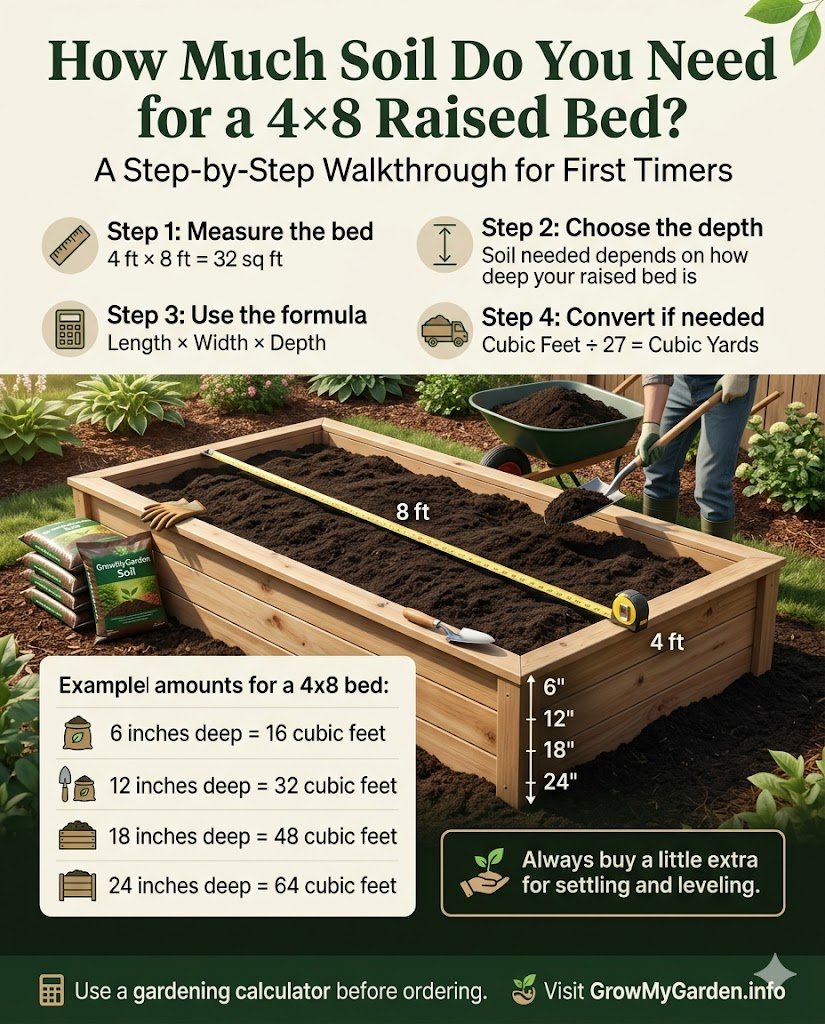
Step 1 — Calculate your volume. 4 × 8 × 1 = 32 cubic feet. Add ten percent for settlement: about 35 cubic feet target.
Step 2 — Choose your blend. For most home gardeners, a quality pre-bagged raised bed mix combined with added compost is the easiest starting point. Look for bags specifically labeled “raised bed mix” rather than “garden soil” — the texture is meaningfully different.
Step 3 — Buy your materials. Using 1.5 cubic foot bags, grab 23 to 24 bags. Mix in two or three bags of quality compost and one bag of perlite for drainage.
Step 4 — Layer strategically. If using cardboard or straw for a Hügelkultur-style base, lay it down first and wet it. Then add your soil blend in layers, lightly mixing as you go.
Step 5 — Water thoroughly before planting. This settles the mix and reveals any low spots that need topping off. Give it a day before planting.
Once your bed is filled and settled, the next question is how many plants actually fit in a 4×8 footprint. The Plant Spacing Calculator maps out exactly how many vegetables, herbs, or fruits you can plant based on each crop’s spacing requirements.
Step 6 — Top dress every season. Each spring, add one to two inches of fresh compost. Your soil biology will thank you, and your plants will produce visibly better.
One Last Thing Before You Dig In
The biggest thing I would tell my past self — standing in that Home Depot parking lot with a cart full of not-enough bags — is this: raised bed soil is not a one-time purchase. It is an investment that grows in value every season when you tend it properly.
Get the math right, pick a blend that suits your budget and your crops, and do not underestimate how much those first few waterings will compact things down. A well-built growing medium in a 4×8 raised bed will honestly reward you for years. The tomatoes you pull from it will make the whole calculation feel like the easiest decision you ever made.
Frequently Asked Questions
How much soil is needed to fill a 4×8 raised bed?
It depends on the bed depth. A 4×8 bed with 12 inches of soil needs 32 cubic feet of soil.
How much soil should a raised bed have?
Most raised beds should have at least 12 inches of soil for good root growth.
How do you calculate soil for a raised bed?
Multiply length × width × depth in feet = cubic feet of soil.
Then divide by 27 to get cubic yards.
What is the cheapest way to fill a raised bed?
Use a layered method with bottom fill like logs, branches, leaves, cardboard, and then top it with quality soil.
What not to fill a raised garden bed with?
Don’t fill it with construction debris, treated wood, trash, rocks only, or contaminated soil.



Leave a Comment