
The Only Companion Planting Chart for Vegetables You’ll Ever Need (Tested, Real, and Printable)
A Companion Planting Chart For Vegetables makes it easier to plan a healthier, more productive garden without guessing which plants belong together. By matching the right vegetable companion planting pairs, you can support better growth, improve flavor, attract beneficial insects, and reduce common garden problems naturally. Some plants help repel pests, while others improve soil, provide shade, or make better use of limited garden space. Whether you grow tomatoes, carrots, peppers, cucumbers, beans, or leafy greens, a clear chart helps you avoid bad combinations and choose smart plant pairings. This guide will help you use companion planting for stronger plants, fewer pests, and a balanced vegetable garden.
The missing piece was not fertilizer. It was not even watering. It was what vegetables grow well together — and just as importantly, what vegetables should never share a raised bed. Read our Vegetable Gardening guide.
This companion planting guide for vegetables is the thing I wish I had found in year one. It covers the complete companion planting chart by vegetable, the science behind why compatible plants help each other thrive, and a step-by-step companion planting layout for vegetables that works whether you are managing a small kitchen garden in a suburb or a half-acre backyard in rural Georgia. Beginners and experienced growers both get something useful here.
Let us dig in.
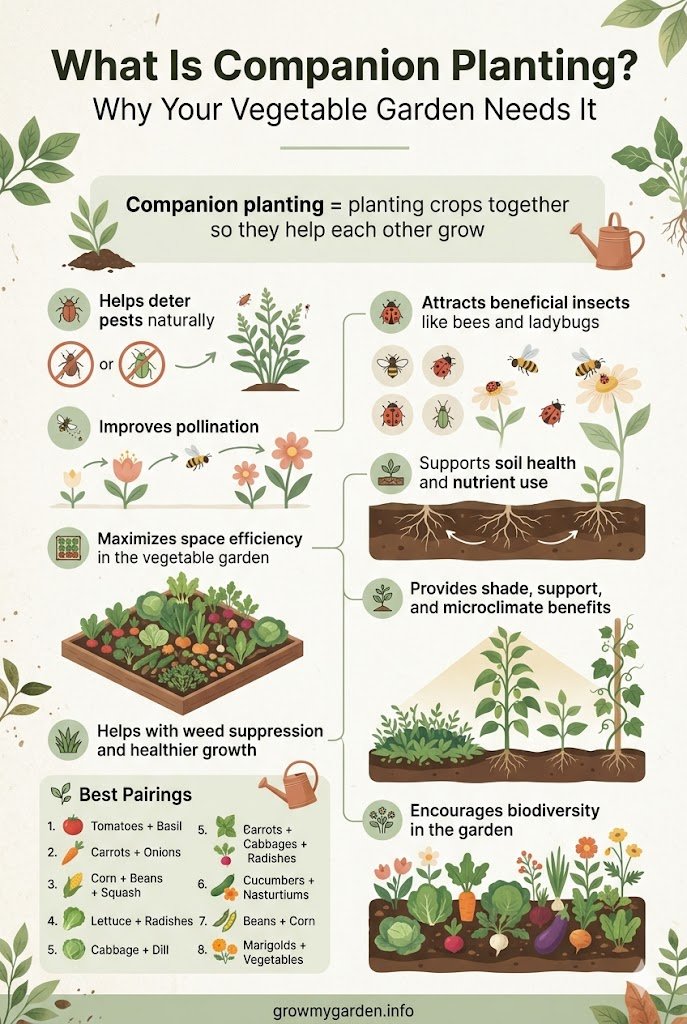
What Is Companion Planting and Why Does Your Vegetable Garden Need It
Companion planting is the practice of growing specific plants near each other because they provide measurable benefits to one another. It sits at the heart of organic gardening and polyculture farming — the idea that a diverse, mixed planting system is healthier, more resilient, and more productive than a monoculture of any single crop.
The concept has been practiced for thousands of years. Indigenous American farmers used the famous Three Sisters combination — corn, beans, and squash grown together — as a cornerstone of their agricultural system. The corn provided a natural trellis for climbing beans. The beans fixed atmospheric nitrogen, enriching the soil. The squash sprawled across the ground, suppressing weeds and holding moisture beneath its giant leaves. This was not mysticism. It was sophisticated, empirically refined polyculture that fed entire civilizations without a bag of synthetic fertilizer in sight.
Modern organic gardening borrowed heavily from these traditions and expanded them into what we now call companion planting — a complete vegetable companion planting guide built on decades of field observation and increasingly, peer-reviewed research.
The benefits break down into four categories: natural pest control, soil health improvement, pollinator attraction, and space-saving garden design. When you plan your garden companion planting chart correctly, all four work simultaneously, without you having to manage them beyond the initial planting decision.
The Science Isn’t Soft — Here’s What Actually Happens Between Compatible Plants
Before I hand you the companion planting chart for your vegetable garden, I want to explain the mechanics. Understanding why these plant pairings work will make you a smarter, more adaptable gardener — not just someone checking boxes on a list.
Nitrogen Fixation: The Underground Economy
Legumes — beans and peas in particular — form a symbiotic relationship with soil bacteria called Rhizobium. These bacteria colonize the plant’s roots and convert atmospheric nitrogen into ammonium that plants can actually absorb. This process, called biological nitrogen fixation, is genuinely remarkable: your bean plant is manufacturing its own fertilizer from thin air and depositing it in the soil around its roots.
Plant beans near heavy feeders like corn, squash, or brassicas (broccoli, cabbage, kale, cauliflower) and those neighboring plants get a slow, steady supply of available nitrogen throughout the season. This is one of the most well-documented and reliable companion planting combinations in agricultural science, not just gardening folklore.
Aromatic Masking: Confusing the Enemy
Many garden pests locate host plants primarily through scent. When you interplant strongly aromatic herbs — rosemary, sage, basil, thyme — among your vegetables, you create what researchers describe as olfactory confusion. The pest’s chemical detection system gets overwhelmed. It simply cannot isolate the scent of your carrots when rosemary is screaming next to them.
A 2010 study in the Annals of Applied Biology by Finch and Collier confirmed that intercropping brassica crops with non-host plants reduced pest colonization by cabbage root flies significantly. The mechanism was exactly this aromatic masking effect. This research is regularly cited in organic pest management literature and aligns with what experienced gardeners have observed for generations.
Trap Cropping: Setting a Decoy
This is one of the most underappreciated tools in the companion planting layout for vegetables. Certain plants are irresistible to the insects you most want to keep away from your food crops. You plant those sacrificial companions nearby — intentionally — and let the pests swarm them instead of your tomatoes and squash.
Nasturtiums are the gold standard trap crop. Aphids love them with a devotion that borders on irrational. Plant nasturtiums at the edges of your beds, near cucumbers, squash, or peppers, and aphid populations will cluster there rather than dispersing across your whole garden. You can then remove the infested plants, spray them with water, or simply wait — ladybugs and parasitic wasps will find the buffet on their own.
Blue Hubbard squash planted at garden perimeters acts as a trap crop for squash vine borers and cucumber beetles, drawing them away from more tender zucchini and summer squash plants inside the bed.
Weed Suppression and Moisture Retention Through Ground Cover
Low-growing companions function as living mulch. Sweet alyssum, clover, and nasturtiums spread horizontally across the soil surface, keeping it cool, slowing evaporation, and — critically — blocking the light that weed seeds need to germinate. In a hot American summer, weed suppression through companion ground cover plants can meaningfully reduce your maintenance burden and improve soil health at the same time.
Companion Planting Chart for Vegetables — Complete Reference Guide
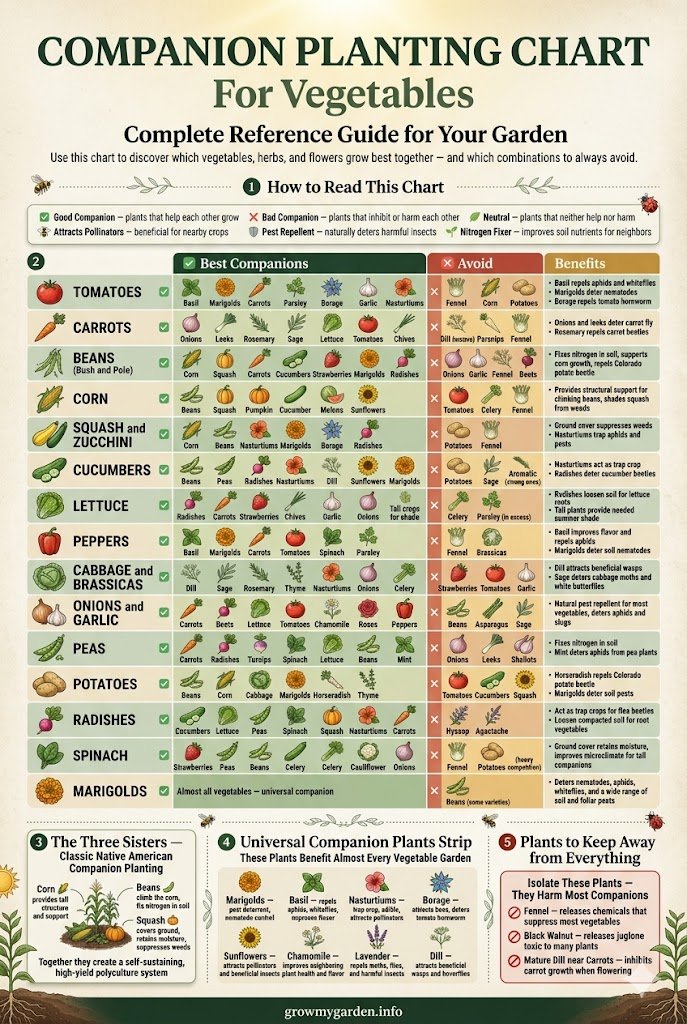
This is the most comprehensive companion planting chart by vegetable I have been able to compile through personal testing, extension research, and peer-reviewed sources. Use it as a quick reference guide for garden planning each season. A printable companion planting chart version follows in a clean layout below. Read Starting a vegetable garden from scratch.
Tomatoes
Best companion plants: Basil, French marigolds, carrots, borage, garlic, parsley, asparagus, celery
Incompatible plants: Fennel, brassicas (broccoli, cabbage, cauliflower, kale), potatoes, corn
Companion notes: Basil is the most famous tomato companion and for good reason — it repels thrips, aphids, and whiteflies while being easy to tuck between plants. Borage deters tomato hornworms and attracts pollinators. French marigolds release alpha-terthienyl from their roots, which is toxic to the root-knot nematodes that devastate tomato plants in southern gardens. Keep tomatoes away from potatoes — they belong to the same family and share the late blight pathogen (Phytophthora infestans). Never plant them in the same bed. Read Growing tomatoes in pots.
Peppers
Best companion plants: Basil, tomatoes, carrots, marjoram, spinach, oregano, geraniums
Incompatible plants: Fennel, apricot, brassicas
Companion notes: Peppers and tomatoes are compatible plants that share similar growing needs and pest pressures. Basil planted between them creates an aromatic barrier that flying insects find genuinely disorienting. Spinach planted beneath pepper plants acts as living mulch, keeping root zones cool during the high heat that summer brings to most American growing zones. Avoid planting peppers near fennel, which releases allelopathic compounds that inhibit the growth of most vegetable crops.
Cucumbers
Best companion plants: Beans, dill, radishes, sunflowers, peas, nasturtiums, corn, beets
Incompatible plants: Potatoes, aromatic sage, strong herbs in large quantities
Companion notes: Radishes are the hero companion for cucumbers — they deter cucumber beetles more reliably than almost anything else I have tried. Sunflowers serve double duty as a natural trellis for climbing cucumber vines while also attracting beneficial insects to the garden. Beans planted nearby fix nitrogen for the heavy-feeding cucumber crop. Nasturtiums at the perimeter draw aphids away from cucumber foliage.
Corn
Best companion plants: Beans, squash, pumpkin, cucumbers, melons, sunflowers
Incompatible plants: Tomatoes, celery
Companion notes: Corn demands nitrogen and space. Plant it in blocks of at least three rows (single rows do not self-pollinate effectively) and surround the hills with pole beans and squash. This is the Three Sisters combination refined over centuries by Indigenous American farmers and still one of the best companion planting combinations available to modern vegetable growers. The squash’s large leaves cover the ground completely, suppressing weeds and retaining moisture in the soil. Beans climb the corn stalks naturally.
Squash and Zucchini
Best companion plants: Corn, beans, nasturtiums, borage, radishes, French marigolds, catnip
Incompatible plants: Potatoes
Companion notes: Borage may be the single most valuable companion for squash — it attracts bumblebees and other native pollinators that squash flowers absolutely require for fruit set, and it is said to deter the tomato hornworm as a bonus. Nasturtiums at the edges of the squash bed act as trap crops for aphids and squash bugs. Squash vine borers, a nightmare for gardeners across the Midwest and South, can be partially deterred by surrounding plantings of radishes and catnip.
Beans (Bush and Pole)
Best companion plants: Carrots, cucumbers, squash, radishes, corn, potatoes, strawberries
Incompatible plants: Onions, garlic, beets, fennel, leeks
Companion notes: Beans are nitrogen-fixing plants that improve soil health for whatever grows near them. They are broadly compatible with most vegetable crops and serve as a backbone of any polyculture garden layout. The one category to avoid entirely: the allium family. Onions, garlic, and leeks release root compounds that directly suppress the rhizobium bacteria responsible for bean nitrogen fixation. Planting beans next to onions essentially cripples both crops. I learned this the expensive way in 2021 — do not repeat my mistake.
Peas
Best companion plants: Carrots, radishes, turnips, mint, beans, lettuce, spinach, cucumbers
Incompatible plants: Onions, garlic, leeks, shallots
Companion notes: Peas, like beans, are nitrogen-fixing plants that improve surrounding soil for neighboring vegetables. They are cool-season crops that pair naturally with lettuce and spinach, which share similar timing. Mint planted nearby deters aphids and other soft-bodied pests that target pea foliage. Avoid planting peas anywhere near the allium family for the same reasons that affect beans.
Carrots
Best companion plants: Tomatoes, lettuce, rosemary, sage, onions, leeks, chives, radishes
Incompatible plants: Dill, parsnips, celery, anise
Companion notes: Carrots and onions are one of the most reliable companion planting combinations in the vegetable garden. Onions confuse the carrot fly (Psila rosae), a common pest that detects its host plant through scent cues. Rosemary and sage planted nearby provide similar olfactory masking. Here is the trap many gardeners fall into: dill seems like it should be a compatible plant for carrots because both belong to the Apiaceae family. It is actually the opposite — dill and carrots are incompatible vegetables that compete intensely and cross-pollinate in ways that affect seed quality.
Onions and Garlic
Best companion plants: Carrots, beets, tomatoes, chamomile, summer savory, lettuce, strawberries
Incompatible plants: Beans, peas, asparagus, sage
Companion notes: Alliums are powerful natural pest control agents in the vegetable garden. Their strong, volatile sulfur compounds confuse a wide range of flying pest insects that would otherwise target neighboring crops. Chamomile planted with onions is said to improve their flavor — and while I cannot cite a clinical trial for that claim, experienced kitchen gardeners have observed this pairing for centuries. Chamomile also attracts hoverflies, whose larvae are voracious aphid predators.
Potatoes
Best companion plants: Horseradish, beans, cabbage, French marigolds, basil, thyme
Incompatible plants: Tomatoes, cucumbers, squash, sunflowers, raspberries
Companion notes: Horseradish is the definitive companion plant for potatoes — it deters Colorado potato beetles, one of the most damaging insect pests in American vegetable gardens, particularly in the Midwest and Mid-Atlantic states. Tuck a horseradish plant at the corners of the potato bed. French marigolds planted in rows between potato hills suppress nematodes in the soil. Keep potatoes far from tomatoes — they share the same devastating blight pathogen and will pass it between each other rapidly.
Beets
Best companion plants: Cabbage family, lettuce, onions, catnip, kohlrabi, garlic
Incompatible plants: Pole beans, mustard
Companion notes: Beets are agreeable neighbors to most vegetables and particularly benefit from proximity to the cabbage family. Onions and garlic deter the leaf miners that sometimes target beet foliage. Pole beans are the one significant incompatible vegetable — they produce root secretions that stunt beet development. Bush beans are generally fine, but keep pole varieties away.
Lettuce
Best companion plants: Carrots, radishes, strawberries, chives, tall crops (corn, sunflowers), dill
Incompatible plants: Celery, parsley, fennel
Companion notes: Lettuce is one of the most rewarding crops to interplant because it grows fast, fills gaps between slower plants, and genuinely benefits from the dappled shade that taller crops provide. In summer heat, lettuce bolts quickly when fully exposed. Growing it under the partial shade of corn or pole beans extends the harvest window considerably. Chives planted at the lettuce bed edge deter the aphids that congregate on soft lettuce leaves. Strawberries and lettuce make natural companions in a kitchen garden — they share similar moisture needs and neither crowds the other.
Broccoli, Cabbage, Cauliflower, and Kale
Best companion plants: Dill, nasturtiums, sage, chamomile, beets, celery, onions, thyme
Incompatible plants: Strawberries, tomatoes, pole beans, rue
Companion notes: The brassica family — broccoli, cabbage, cauliflower, kale — is among the most pest-targeted in the American vegetable garden. Cabbage loopers, imported cabbageworms, and cabbage aphids are relentless. Dill planted among brassicas attracts parasitic wasps (Cotesia glomerata) that lay their eggs in cabbageworm larvae, effectively eliminating them without any spray. Sage and thyme both repel the cabbage white butterfly, preventing egg-laying in the first place. Nasturtiums act as trap crops at the perimeter, pulling aphids away from the brassica leaves.
Spinach and Swiss Chard
Best companion plants: Strawberries, peas, beans, celery, radishes, brassicas, corn
Incompatible plants: None well-documented
Companion notes: Spinach and Swiss chard are some of the most easygoing companion plants in the garden. They grow quickly, stay low, and act as excellent ground cover beneath taller crops. Plant spinach between corn rows before the corn gets tall — the spinach will have finished its cool-season harvest by the time corn needs the space and light. Strawberries and spinach pair beautifully in a raised bed, sharing moisture requirements and complementing each other’s root depths.
Radishes
Best companion plants: Carrots, peas, lettuce, cucumbers, spinach, nasturtiums, beets
Incompatible plants: Hyssop
Companion notes: Radishes mature in 25 to 30 days, which makes them the perfect space-saving garden crop to tuck between slower-growing vegetables. They function as natural trap crops for flea beetles, drawing those chewing pests away from eggplant, spinach, and brassicas. Interplanting radishes with carrots also loosens the soil as radish roots develop, creating channels that help carrot roots penetrate more easily.
Eggplant
Best companion plants: Marigolds, basil, spinach, beans, peppers, tarragon
Incompatible plants: Fennel, corn (competes for similar pest pressure)
Companion notes: Eggplant is a heavy feeder from the nightshade family that attracts flea beetles with enthusiasm. French marigolds planted around the base reduce this pressure. Basil and tarragon are both said to improve eggplant flavor and vigor — basil in particular appears to reduce aphid populations on neighboring eggplant foliage.
Asparagus
Best companion plants: Tomatoes, basil, parsley, marigolds, dill, nasturtiums
Incompatible plants: Onions, garlic, potatoes
Companion notes: Asparagus and tomatoes share a remarkable mutual benefit: tomatoes repel the asparagus beetle while asparagus releases a root secretion that repels certain nematodes targeting tomato roots. This is one of the most scientifically interesting companion planting combinations in the vegetable companion guide and worth building into any permanent garden bed design.
Celery
Best companion plants: Tomatoes, beans, brassicas, leeks, cosmos, daisies
Incompatible plants: Corn, carrots (in large quantities), parsnips
Companion notes: Celery is a modest but reliable companion for heavy feeders like tomatoes and brassicas. Its strong scent deters the white cabbage butterfly when planted among brassica crops. Cosmos and daisies planted near celery attract beneficial insects that help with pollination across the whole kitchen garden.
Melons and Pumpkins
Best companion plants: Corn, beans, radishes, marigolds, nasturtiums, borage, catnip
Incompatible plants: Potatoes
Companion notes: Melons and pumpkins follow the same companion planting logic as squash. They are heavy nitrogen users, benefit from bean companions, need active pollinator support (borage and marigolds are essential), and use nasturtiums as perimeter trap crops for aphids and squash bugs. Radishes interplanted at the edge of the melon patch deter cucumber beetles, which affect melons as aggressively as they target cucumbers.
Strawberries
Best companion plants: Spinach, lettuce, beans, thyme, borage, sage
Incompatible plants: Brassicas (large quantities), fennel
Companion notes: Borage is the legendary strawberry companion — gardeners have observed for centuries that borage planted near strawberries seems to improve both yield and flavor, though the scientific mechanism is not fully understood. Thyme planted among strawberry plants deters the worm pests that burrow into the fruit. Spinach and lettuce fill in ground cover gaps in the strawberry bed beautifully, completing the mixed planting ecosystem.
Universal Companions: Plant These Everywhere
Some plants are not just good for one or two crops — they are broadly beneficial across the entire vegetable garden companion planting layout. These are worth growing in quantity regardless of what else you have planned.
French Marigolds belong at the edges and throughout beds. They suppress nematodes in soil, deter aphids above ground, and attract predatory wasps that parasitize caterpillar larvae. They are as close to a universal companion as the garden offers.
Nasturtiums are trap crops, pollinator magnets, and edible garden plants all in one. The flowers and leaves are completely edible with a pleasant peppery flavor — a useful bonus. Plant them anywhere aphids have been a problem in past seasons.
Borage self-seeds prolifically once established, which means you plant it once and it volunteers in your garden every year afterward. Its star-shaped blue flowers attract native bumblebees and honeybees with unusual effectiveness. Plant it near squash, melons, strawberries, and tomatoes.
Sweet Alyssum is a ground-cover companion that attracts hoverflies — whose larvae eat aphids — and creates a dense living mulch that suppresses weed germination. Its honey-like scent also confuses many flying pest insects.
Dill attracts parasitic wasps, ladybugs, and lacewings. Allowed to flower, it becomes a hub of beneficial insect activity. Keep it away from carrots and fennel, but plant it freely near brassicas, cucumbers, and lettuce.
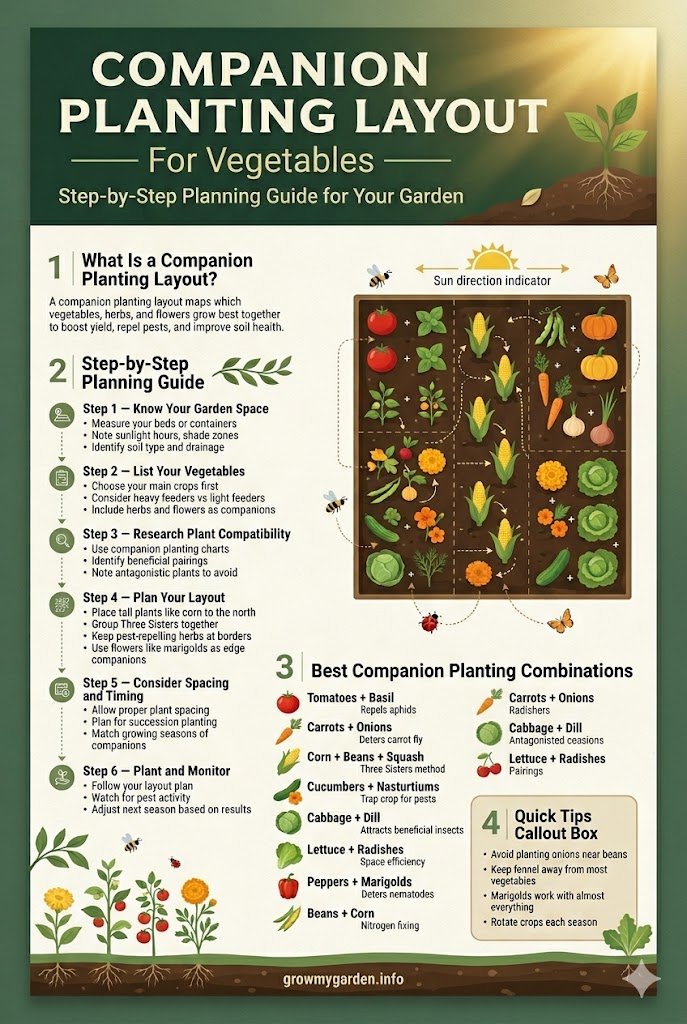
Companion Planting Layout for Vegetables — Step-by-Step Planning Guide
Good intentions without a plan produce a chaotic garden. Here is how to actually translate this companion planting chart into a functional garden layout. Read smart vegetable garden layout.
Step 1 — Sketch Your Space Before You Touch a Seed
Pull out graph paper or open the Planter app (available on iOS and Android) before buying anything. Map every bed or growing space with accurate dimensions. Planter has a built-in compatibility alert system that flags bad plant pairings in real time as you arrange crops in your digital layout — worth the subscription cost just for that feature alone.
Mark which areas get full sun, which get afternoon shade, and which tend to hold moisture longer. This information shapes your companion planting layout more than anything else.
Step 2 — Place Your Heavy Feeders First
Tomatoes, corn, peppers, squash, eggplant, and melons are your anchor crops. They demand the most space, sunlight, and nutrition. Position these before anything else.
Step 3 — Assign Nitrogen Fixers to Every Heavy-Feeder Section
For every nitrogen-hungry crop, plan a legume companion nearby. Corn gets beans. Squash gets beans. Brassica beds get peas along the edge. This is the foundation of organic gardening soil health — letting plants do the fertilizing work.
Even with legume companions doing the work, heavy feeders often benefit from a supplemental boost mid-season. The Fertilizer Calculator figures out the right amount by bed size so you are not guessing when and how much to apply.
Step 4 — Build Aromatic Perimeters
Once your heavy feeders and legume companions are positioned, ring the beds with strongly aromatic herbs and flowers. Rosemary, sage, thyme, and lavender along the outermost edges create a scent barrier that flying pest insects find unappealing. French marigolds anchor every corner.
Step 5 — Deploy Trap Crops at Entry Points
Think about where pests typically enter your garden. For most gardeners, it is from the edges and the directions that get the most wind. Nasturtiums at windward corners and perimeters draw aphids in before they reach the interior crops.
Step 6 — Fill Gaps with Ground Cover Companions
Every square inch of bare soil is an invitation for weeds and moisture loss. Sweet alyssum, low-growing clover, spinach, and lettuce fill gaps between main crops, acting as living mulch and keeping the whole bed biologically active.
Step 7 — Combine with Crop Rotation the Following Season
Companion planting and crop rotation work together, not as alternatives. Move your plant families to different beds each season. Where the nitrogen-fixing beans grew this year, plant heavy feeders next year to take advantage of the enriched soil. Your planting journal — Gardenize is the best app I have found for this — should track companion pairings and locations so you can rotate intelligently.
Companion Planting Chart for Beginners — The Shortlist
If this whole guide feels overwhelming, start here. These are the five most reliable, well-documented, beginner-friendly companion planting combinations that will give you the most noticeable improvement in your first season.
Tomatoes + Basil + French Marigolds — Plant basil between tomato stems within 12 inches. Ring the bed with marigolds. Aphid and whitefly pressure drops noticeably.
Beans + Corn + Squash (Three Sisters) — Plant in a block of at least 3 rows. Follow the timing sequence: corn first, beans when corn is 6 inches, squash a week later. Remarkable productivity from a small space.
Carrots + Onions — Alternate rows of carrots and onions. Both deter each other’s primary pests. Simple, effective interplanting that requires no changes to your watering or fertilizing routine.
Brassicas + Dill — Plant dill liberally in and around your broccoli, cabbage, cauliflower, and kale beds. Allow it to flower. Parasitic wasps will show up and handle the cabbageworms.
Cucumbers + Radishes — Tuck radishes around cucumber transplants. Cucumber beetle pressure reduces meaningfully. Radishes finish in 30 days and can be succession-planted continuously throughout the season.
Common Mistakes That Undermine Your Companion Planting Combinations
Planting companions too far apart. Most companion planting benefits — aromatic masking, root interactions, beneficial insect attraction — require plants to be within 12 to 18 inches of each other. A basil plant at the far end of the garden is not protecting your tomatoes. Physical proximity is the mechanism.
Before you plant, use the Plant Spacing Calculator to map how many companion pairs actually fit within that 12 to 18-inch window in your specific bed size — so proximity works in your favor from day one.
Ignoring the incompatible plants list. Gardeners research what grows well together and then skip the enemies list entirely. Fennel is the most dangerous offender. It is allelopathic — it releases growth-inhibiting chemicals from its roots that affect most vegetables in the bed around it. Grow fennel in an isolated container, separated from your vegetable garden entirely.
Treating companion planting as a standalone pest control strategy. Companion planting reduces pest pressure. It does not create a pest-free environment. You still need to scout your plants weekly, check the undersides of leaves for eggs and colonies, and have a response plan — insecticidal soap, hand removal, or targeted organic sprays — for genuine infestations.
Forgetting succession planting. Many companion plant relationships are most effective when the companions are present throughout the whole season. Radishes pulled after 30 days leave a gap in cucumber beetle deterrence. Succession-plant them every three weeks so the protection is continuous.
Skipping soil testing. Companion planting works significantly better when soil pH and nutrient levels are in a reasonable range. A soil that is severely pH-imbalanced or badly depleted will struggle regardless of how thoughtfully you have arranged your plant companions. Use the MySoil app paired with a basic soil test kit to check your baseline each spring.
Good companion planting only works if your soil health baseline is solid. If you are filling a new bed this season, the Raised Bed Soil Calculator tells you exactly how many bags of soil to buy before you start arranging your companions.
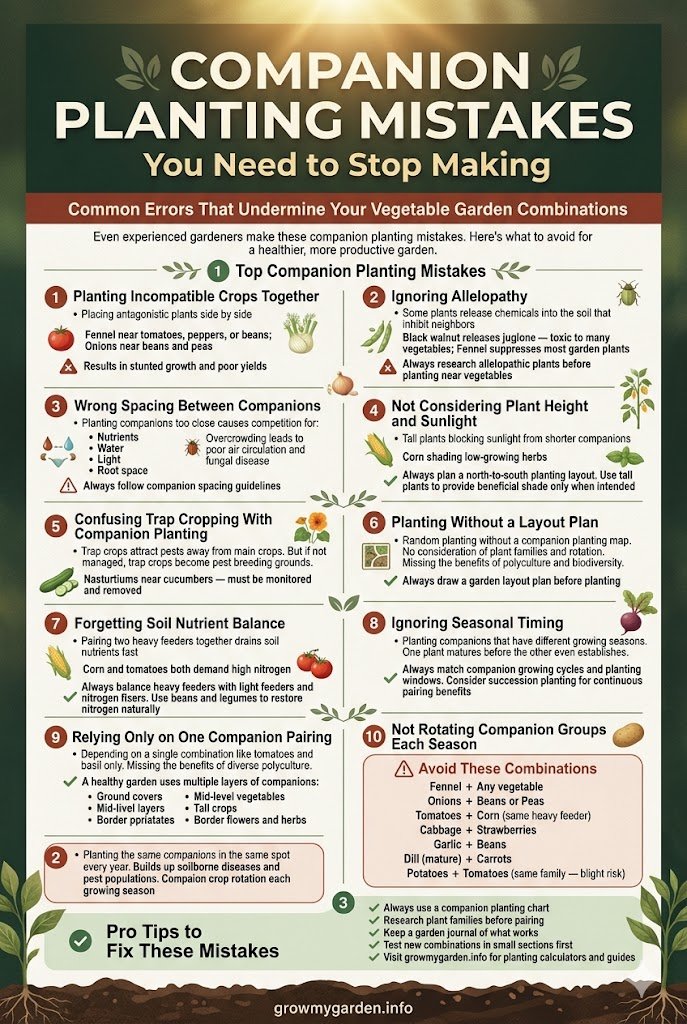
Printable Companion Planting Chart — Format for Your Garden Shed
The quick reference companion planting table below is formatted to print cleanly on a single US letter page. Pin it to your garden shed door, tape it inside your seed storage bin, or fold it into your garden journal.
| Vegetable | Plant With | Avoid | Key Benefit |
|---|---|---|---|
| Tomatoes | Basil, Marigolds, Borage, Garlic | Fennel, Potatoes, Brassicas | Pest deterrence, nematode suppression |
| Peppers | Basil, Spinach, Carrots, Marjoram | Fennel, Apricot | Ground cover, aromatic masking |
| Cucumbers | Beans, Radishes, Dill, Sunflowers | Potatoes, Strong sage | Beetle deterrence, nitrogen |
| Corn | Beans, Squash, Pumpkin, Melons | Tomatoes, Celery | Three Sisters polyculture |
| Squash and Zucchini | Nasturtiums, Borage, Beans, Corn | Potatoes | Trap crops, pollinator attraction |
| Beans | Carrots, Corn, Cucumbers, Squash | Onions, Garlic, Fennel | Nitrogen fixation |
| Peas | Carrots, Lettuce, Mint, Radishes | Onions, Garlic, Leeks | Nitrogen fixation, pest deterrence |
| Carrots | Onions, Tomatoes, Rosemary, Sage | Dill, Celery, Parsnips | Pest fly confusion |
| Onions and Garlic | Carrots, Beets, Chamomile | Beans, Peas, Asparagus | Aromatic pest masking |
| Potatoes | Horseradish, Beans, Marigolds | Tomatoes, Cucumbers | Beetle deterrence |
| Beets | Cabbage family, Onions, Lettuce | Pole Beans, Mustard | Compatible root depth |
| Lettuce | Carrots, Chives, Radishes, Tall crops | Celery, Fennel | Shade, aphid deterrence |
| Broccoli and Cabbage | Dill, Nasturtiums, Sage, Chamomile | Strawberries, Tomatoes | Caterpillar and aphid control |
| Spinach and Swiss Chard | Peas, Beans, Strawberries, Corn | None documented | Ground cover, nitrogen use |
| Radishes | Cucumbers, Carrots, Peas | Hyssop | Trap crop, soil loosening |
| Eggplant | Marigolds, Basil, Beans | Fennel | Flea beetle deterrence |
| Asparagus | Tomatoes, Basil, Parsley | Onions, Garlic | Mutual nematode protection |
| Celery | Tomatoes, Brassicas, Beans | Corn, Parsnips | Pest butterfly deterrence |
| Melons and Pumpkins | Corn, Beans, Borage, Nasturtiums | Potatoes | Pollinator attraction, trap crops |
| Strawberries | Borage, Spinach, Thyme, Lettuce | Fennel, Heavy brassicas | Flavor and yield improvement |
| Marigolds (French) | Every vegetable | None | Nematode suppression, aphid control |
| Nasturtiums | Squash, Cucumbers, Tomatoes | None | Trap crop, edible, pollinators |
| Basil | Tomatoes, Peppers, Asparagus | Sage, Common Rue | Whitefly and aphid repellent |
| Dill | Brassicas, Cucumbers, Lettuce | Carrots, Fennel | Beneficial wasp attraction |
| Borage | Tomatoes, Squash, Strawberries | None | Pollinator magnet, hornworm deterrent |
Tools I Use to Plan and Track Companion Planting
Planter App (iOS and Android) — My primary garden planning tool. The companion planting alert feature alone justifies the subscription. It flags incompatible vegetable pairings in real time and has a solid seed database for most American vegetable varieties.
Gardenize — Better as a garden journal than a planner. I use it to log what grew where, record performance notes, and plan crop rotation from season to season. The photo logging feature is genuinely useful for tracking pest damage patterns.
iNaturalist — For pest identification. Photograph the insect, get a species-level identification, and immediately know whether it is a beneficial insect or a pest that needs addressing. Far more reliable than searching Google Images.
MySoil App — Paired with a physical soil test kit from your local cooperative extension office. Soil health is the foundation that companion planting improves upon — if your starting point is badly imbalanced, no amount of smart plant placement will fully compensate.
University Cooperative Extension Websites — Particularly UC Davis, University of Kentucky, and the Penn State Extension. These publish companion planting guides based on regional research rather than garden mythology. Worth bookmarking for your specific growing zone.
The Bigger Picture: Biodiversity Is the Strategy
Everything in this companion planting guide for vegetables points toward one underlying principle: biodiversity in your garden layout is your best defense against pests, disease, and soil depletion.
A monoculture — rows upon rows of the same crop — is essentially an all-you-can-eat sign for every pest that targets that plant. A mixed planting system, even an imperfect one, disrupts that dynamic at every level. It confuses insects. It enriches the soil through nitrogen fixation and varied root depth interactions. It creates habitat for beneficial insects that do pest control work on your behalf. It reduces the spread of plant-specific pathogens because infected plants are surrounded by non-hosts rather than identical neighbors.
This is what polyculture farming has known for thousands of years and what modern organic gardening research is increasingly confirming through field trials. The vegetable companion planting chart in this guide is not a magic formula. It is a framework for building a garden that functions more like an ecosystem — resilient, self-regulating, and genuinely productive with less intervention from you.
Start with one or two of the beginner companion planting combinations listed above. Add a few more each season. Keep a journal. Pay attention to what your garden is telling you through the health of your plants and the behavior of the insects living in it.
Within three seasons, the difference is not subtle. Your garden will look different, feel different, and produce differently — and you will understand exactly why. If you want to track whether that investment in companion flowers, herbs, and soil amendments is paying off in food value, the Garden Cost Estimator compares your seasonal costs against estimated grocery savings.
Frequently Asked Questions
What are the best all-around companion plants?
Some of the best all-around companion plants are marigolds, basil, nasturtiums, dill, chives, calendula, and borage. These plants can help attract pollinators, bring in beneficial insects, repel certain pests, and support a healthier vegetable garden naturally.
What is the “Three Sisters” method?
The Three Sisters method is a traditional planting technique where corn, beans, and squash are grown together. Corn gives beans a natural pole to climb, beans help add nitrogen to the soil, and squash spreads along the ground to shade the soil, reduce weeds, and hold moisture.
Why are some plants “bad” companions?
Some plants are considered bad companions because they may compete for the same nutrients, attract the same pests, spread diseases, block sunlight, or slow each other’s growth. For example, planting crops with similar pest problems too close together can make garden issues worse.
How do I apply this to my garden?
Start by choosing your main vegetables, then use a companion planting chart to see which plants grow well nearby and which ones to avoid. Place helpful herbs and flowers around your beds, keep enough spacing between crops, and rotate plant families each season for healthier soil and fewer pest problems.


Leave a Comment